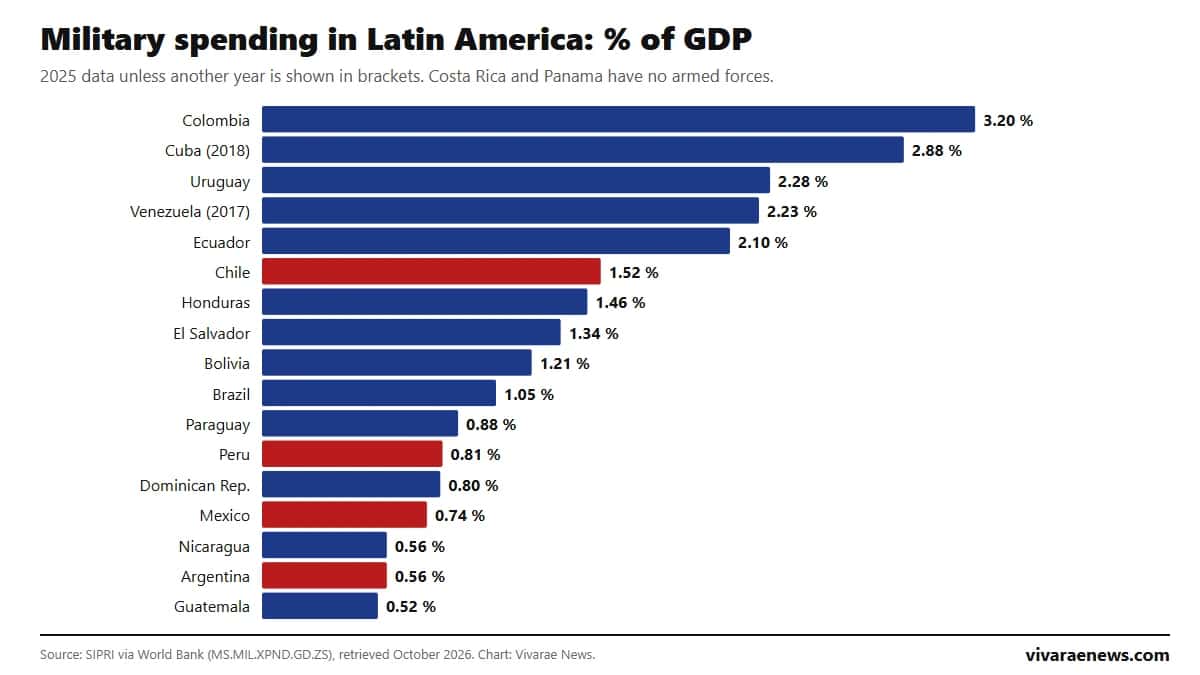
Colombia is the Latin American country that spends the most on defense relative to the size of its economy: 3.20% of GDP in 2025, according to Stockholm International Peace Research Institute (SIPRI) data published by the World Bank. It is followed by Uruguay (2.28%) and Ecuador (2.10%), not counting Cuba and Venezuela, whose latest data are from 2018 and 2017. In dollars, Brazil spends the most: US$23.95 billion in 2025.
The average for Latin America and the Caribbean is 1.07% of GDP, less than half the global average (2.48%). Costa Rica and Panama have no armed forces and record no military spending. This ranking will be updated on this same page whenever SIPRI publishes new data, which happens once a year.
Ranking of military spending in Latin America as a % of GDP
| Rank | Country | Military spending (% of GDP) | Year | In 2010 |
|---|---|---|---|---|
| 1 | Colombia | 3.20% | 2025 | 3.64% |
| 2 | Cuba | 2.88% | 2018 | 3.33% |
| 3 | Uruguay | 2.28% | 2025 | 1.88% |
| 4 | Venezuela | 2.23% | 2017 | 1.01% |
| 5 | Ecuador | 2.10% | 2025 | 3.07% |
| 6 | Chile | 1.52% | 2025 | 2.25% |
| 7 | Honduras | 1.46% | 2025 | 1.07% |
| 8 | El Salvador | 1.34% | 2025 | 1.09% |
| 9 | Bolivia | 1.21% | 2025 | 2.79% |
| 10 | Brazil | 1.05% | 2025 | 1.54% |
| 11 | Paraguay | 0.88% | 2025 | 0.75% |
| 12 | Peru | 0.81% | 2025 | 1.48% |
| 13 | Dominican Republic | 0.80% | 2025 | 0.67% |
| 14 | Mexico | 0.74% | 2025 | 0.43% |
| 15 | Nicaragua | 0.56% | 2025 | 0.51% |
| 16 | Argentina | 0.56% | 2025 | 0.81% |
| 17 | Guatemala | 0.52% | 2025 | 0.44% |
| — | Costa Rica and Panama | No armed forces | — | — |
Source: SIPRI via the World Bank, indicator MS.MIL.XPND.GD.ZS, latest year available per country. Nicaragua and Argentina are tied after rounding. SIPRI's military spending includes armed forces, defense ministries, paramilitary forces trained for military operations and military pensions, so it may differ from each country's official budgets.
Which Latin American country spends the most on defense in dollars
| Rank | Country | Military spending 2025 (US$ millions) |
|---|---|---|
| 1 | Brazil | 23,950 |
| 2 | Colombia | 14,503 |
| 3 | Mexico | 13,648 |
| 4 | Chile | 5,328 |
| 5 | Argentina | 3,876 |
| 6 | Ecuador | 2,736 |
| 7 | Peru | 2,596 |
| 8 | Uruguay | 1,954 |
| 9 | Dominican Republic | 1,037 |
| 10 | Bolivia | 688 |
Source: World Bank, indicator MS.MIL.XPND.CD, SIPRI data in current dollars. Brazil, Colombia and Mexico account for most of the region's military spending. Venezuela, which spent about US$3.991 billion in 2010, has had no data since 2017.
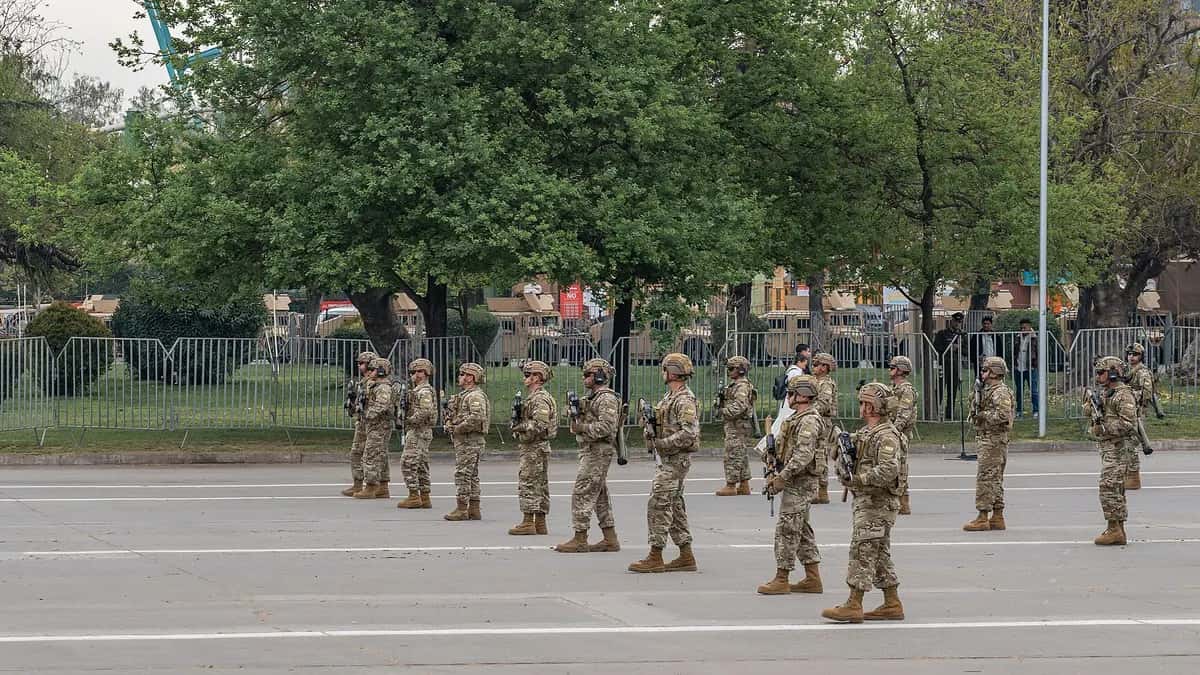
Military spending in Chile, Mexico, Argentina and Peru
- Chile (1.52%): down from 2.69% in 2000 and 2.25% in 2010. In dollars it has been stable at around US$5.3 billion. Part of its funding came from the Copper Reserved Law, replaced in 2019.
- Mexico (0.74%): the large country that spends least relative to GDP after Argentina, although its spending in dollars almost tripled since 2010. The series shows a jump to 1.13% in 2024 and a fall in 2025.
- Argentina (0.56%): the lowest spending among the large economies, compared with 1.15% in 2000.
- Peru (0.81%): down from 1.48% in 2010 and 1.24% in 2023.
| Country or region | 2000 | 2010 | 2020 | 2025 |
|---|---|---|---|---|
| Colombia | 3.03% | 3.64% | 3.53% | 3.20% |
| Chile | 2.69% | 2.25% | 2.07% | 1.52% |
| Brazil | 1.73% | 1.54% | 1.33% | 1.05% |
| Mexico | 0.41% | 0.43% | 0.72% | 0.74% |
| Latin America and the Caribbean | n/a | n/a | n/a | 1.07% |
| World | n/a | n/a | n/a | 2.48% |
Source: World Bank (SIPRI). Mexico's change between 2024 and 2025 is the sharpest in the series and should be read with caution until SIPRI publishes its next revision. What soldiers earn in each country is explained in how much a soldier earns in Chile and how much a soldier earns in Mexico.
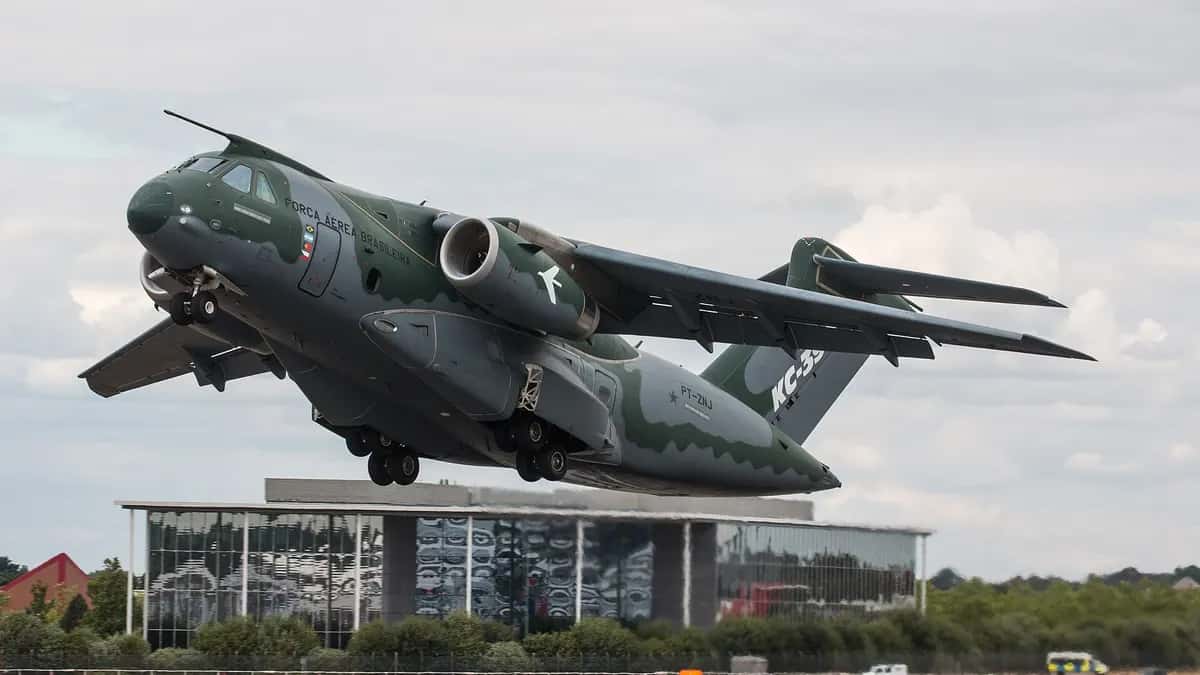
How military spending in Latin America has changed since 2010
| Country | 2010 (US$ millions) | 2025 (US$ millions) | Change |
|---|---|---|---|
| Brazil | 34,003 | 23,950 | −30% |
| Colombia | 10,422 | 14,503 | +39% |
| Mexico | 4,789 | 13,648 | +185% |
| Chile | 4,894 | 5,328 | +9% |
| Argentina | 3,475 | 3,876 | +12% |
| Peru | 2,179 | 2,596 | +19% |
| Ecuador | 2,094 | 2,736 | +31% |
Source: World Bank (SIPRI), current dollars; change is our own calculation. Brazil's drop in dollars is largely explained by the real's depreciation: measured in its own currency, the budget did not fall by that much. Mexico is the opposite case: its military spending in dollars almost tripled in fifteen years, alongside the armed forces' greater role in public security.
How to read the military spending ranking
- The share of GDP shows each country's relative effort; spending in dollars shows its absolute size.
- SIPRI uses a common definition for all countries, which includes military pensions and some paramilitary forces.
- A fall in the percentage does not always mean less spending: it may be because the economy grew faster than the defense budget.
- Cuba and Venezuela have no recent data, so their position may have changed.
Other regional rankings with official data: fertility rate, public debt, homicide rate and GDP per capita.
How to cite this data
Vivarae News (2026). "Military spending in Latin America 2026: ranking by country according to SIPRI and the World Bank". Updated October 29, 2026. Available at https://vivaraenews.com/en/military-spending-in-latin-america-ranking-by-country-2026/. The data may be reproduced by citing Vivarae News and linking to this page; each country's figures belong to SIPRI and the World Bank.
Frequently asked questions
Which Latin American country spends the most on defense?
Relative to its economy, Colombia (3.20% of GDP in 2025). In dollars, Brazil, with US$23.95 billion.
How much does Chile spend on defense?
1.52% of GDP in 2025, about US$5.328 billion, according to SIPRI and the World Bank.
Which Latin American countries have no army?
Costa Rica and Panama, which have public security forces but no armed forces.
How much does Mexico spend on defense?
0.74% of GDP in 2025, about US$13.648 billion.
What is the average military spending in Latin America?
1.07% of GDP in 2025, compared with 2.48% globally.