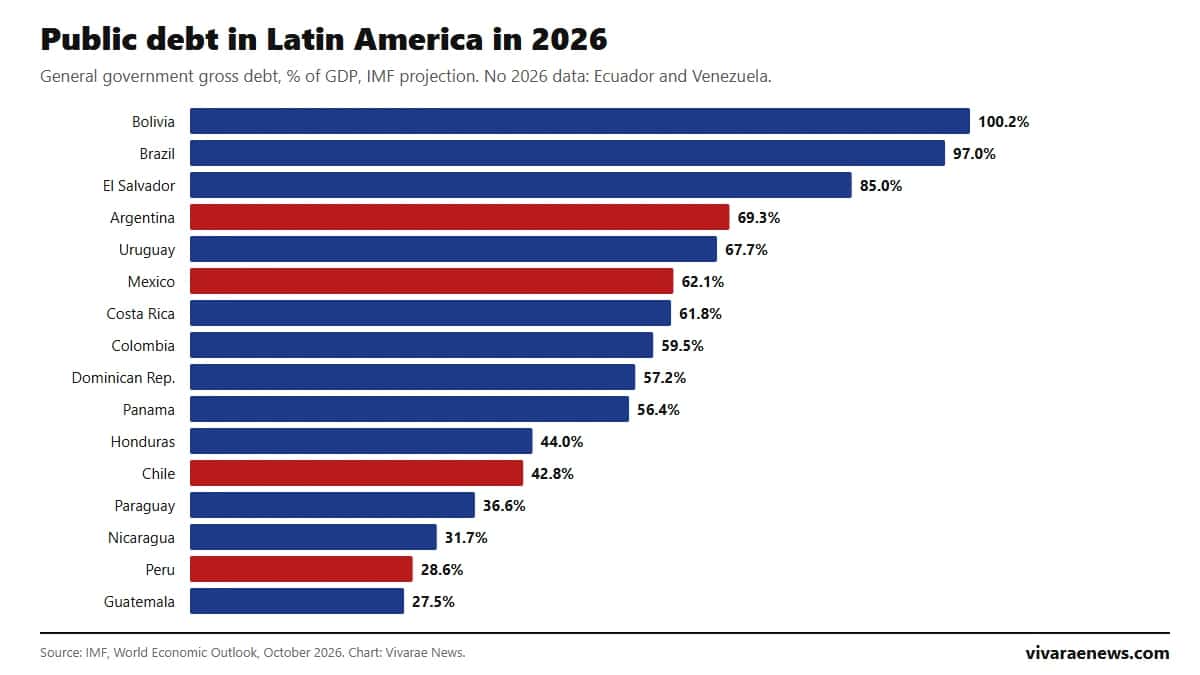
Bolivia will have Latin America's highest public debt in 2026, equal to 100.2% of its GDP, followed by Brazil (97.0%) and El Salvador (85.0%), according to the International Monetary Fund's October 2026 World Economic Outlook (WEO) database ([IMF](https://www.imf.org/external/datamapper/GGXWDG_NGDP@WEO/OEMDC/ADVEC/WEOWORLD)). At the other end are Guatemala (27.5%) and Peru (28.6%). Chile stands at 42.8%, Mexico at 62.1% and Argentina at 69.3%.
The indicator is general government gross debt as a percentage of GDP, the IMF's standard measure for comparing countries. The world average is 94.6% of GDP, pushed up by advanced economies (107.8%); the average for emerging market and developing economies is 76.2%.
Latin America public debt ranking for 2026
| Rank | Country | 2019 | 2025 | 2026 (projection) | 2027 (projection) |
|---|---|---|---|---|---|
| 1 | Bolivia | 48.9% | 83.3% | 100.2% | 95.1% |
| 2 | Brazil | 87.1% | 93.3% | 97.0% | 99.3% |
| 3 | El Salvador | 77.9% | 87.6% | 85.0% | 89.2% |
| 4 | Argentina | 89.8% | 80.1% | 69.3% | 70.4% |
| 5 | Uruguay | 59.6% | 65.6% | 67.7% | 68.7% |
| 6 | Mexico | 51.9% | 61.7% | 62.1% | 62.9% |
| 7 | Costa Rica | 56.1% | 60.4% | 61.8% | 62.8% |
| 8 | Colombia | 51.0% | 59.9% | 59.5% | 62.9% |
| 9 | Dominican Republic | 53.5% | 59.0% | 57.2% | 55.3% |
| 10 | Panama | 42.5% | 56.6% | 56.4% | 55.9% |
| 11 | Honduras | 44.1% | 40.3% | 44.0% | 42.3% |
| 12 | Chile | 28.3% | 41.5% | 42.8% | 44.5% |
| 13 | Paraguay | 25.8% | 38.2% | 36.6% | 37.9% |
| 14 | Nicaragua | 44.2% | 34.6% | 31.7% | 28.8% |
| 15 | Peru | 26.5% | 30.1% | 28.6% | 29.0% |
| 16 | Guatemala | 26.4% | 26.7% | 27.5% | 28.4% |
Source: IMF, October 2026 WEO database, indicator "general government gross debt, % of GDP" (IMF DataMapper). The IMF does not publish a 2026 projection for Ecuador (54.5% in 2025) or data for Venezuela, so they are not ranked. Figures may differ from those published by each government, because the IMF uses the "general government" definition (including local governments and other entities) while countries usually report central government debt.
Who borrowed most since 2019
| Country | 2019 | 2026 | Change (percentage points of GDP) |
|---|---|---|---|
| Bolivia | 48.9% | 100.2% | +51.3 |
| Chile | 28.3% | 42.8% | +14.5 |
| Panama | 42.5% | 56.4% | +13.9 |
| Paraguay | 25.8% | 36.6% | +10.8 |
| Mexico | 51.9% | 62.1% | +10.2 |
| Brazil | 87.1% | 97.0% | +9.9 |
| Colombia | 51.0% | 59.5% | +8.5 |
| Uruguay | 59.6% | 67.7% | +8.1 |
| El Salvador | 77.9% | 85.0% | +7.1 |
| Costa Rica | 56.1% | 61.8% | +5.7 |
| Dominican Republic | 53.5% | 57.2% | +3.7 |
| Peru | 26.5% | 28.6% | +2.1 |
| Guatemala | 26.4% | 27.5% | +1.1 |
| Honduras | 44.1% | 44.0% | -0.1 |
| Nicaragua | 44.2% | 31.7% | -12.5 |
| Argentina | 89.8% | 69.3% | -20.5 |
Our calculation using IMF data. 2019 is the last year before the pandemic, which raised debt in almost the whole region. Bolivia is the extreme case: its debt rises from 48.9% to 100.2% of GDP, partly because its dollar GDP falls in 2026 (see the region's GDP per capita). Chile added 14.5 points and Panama 13.9. Argentina, Nicaragua and Honduras are the only ones with less debt today than in 2019, in Argentina's case because of fiscal adjustment and nominal GDP growth after devaluation.

Latin America's public debt compared with the world
| Region or country (IMF) | 2025 | 2026 |
|---|---|---|
| World | 94.0% | 94.6% |
| Advanced economies | 108.2% | 107.8% |
| United States | 124.4% | 126.8% |
| China | 98.6% | 104.4% |
| Emerging market and developing economies | 73.7% | 76.2% |
| Western Hemisphere (includes U.S. and Canada) | 74.1% | 72.9% |
Source: IMF DataMapper. Latin American countries, except Bolivia and Brazil, have less debt relative to GDP than the world average. But the level is not everything: emerging countries pay higher interest rates and hold more foreign-currency debt, so the same ratio weighs more. That helps explain why Argentina, at 69.3%, has country risk above 700 points (see what country risk is), despite having less debt relative to GDP than Brazil or El Salvador.
Debt in Chile, Mexico, Argentina and Peru
Chile starts from a low level but is one of the countries where debt grew most: from 28.3% of GDP in 2019 to 42.8% in 2026, and the IMF projects 44.5% in 2027. Mexico has been stable around 62% since 2025, above its pre-pandemic level (51.9%). Argentina is the exception to the trend: it fell from 89.8% in 2019 to 69.3% in 2026, although the market still doubts its ability to pay in dollars. Peru has one of the lowest debt levels in the region, 28.6% of GDP, slightly lower than in 2025 (IMF). In Brazil, with the second-highest debt, the IMF expects it to keep rising to 99.3% in 2027.
How to read Latin America's public debt
First, the 2026 and 2027 figures are projections the IMF revises every April and October. Second, debt as a share of GDP moves with both the numerator and the denominator: a devaluation can raise it if much of the debt is in dollars, and inflation can lower it by inflating nominal GDP. Third, gross debt does not net out state assets: Chile, for example, has sovereign wealth funds that are not subtracted in this indicator. To follow the budgets behind these figures, see Chile's 2027 budget and Mexico's rating downgrade.

How to cite this data
You may use the figures and chart on this page by citing the original source (IMF, World Economic Outlook, October 2026) and Vivarae News. Suggested citation: "Public debt in Latin America: 2026 ranking by country according to the IMF", Vivarae News, updated October 23, 2026, https://vivaraenews.com/en/public-debt-in-latin-america-ranking-by-country-2026/. We update this page at the same address when the IMF releases new figures (April and October).
Frequently asked questions
Which Latin American country has the most public debt?
Bolivia, with 100.2% of GDP in 2026 according to the IMF, followed by Brazil (97.0%) and El Salvador (85.0%).
Which country has the least debt?
Guatemala, with 27.5% of GDP, and Peru, with 28.6%.
How much debt does Chile have?
42.8% of GDP in 2026, under the IMF's general government measure.
How much debt does Mexico have?
62.1% of GDP in 2026.
How much debt does Argentina have?
69.3% of GDP in 2026, down from 89.8% in 2019.