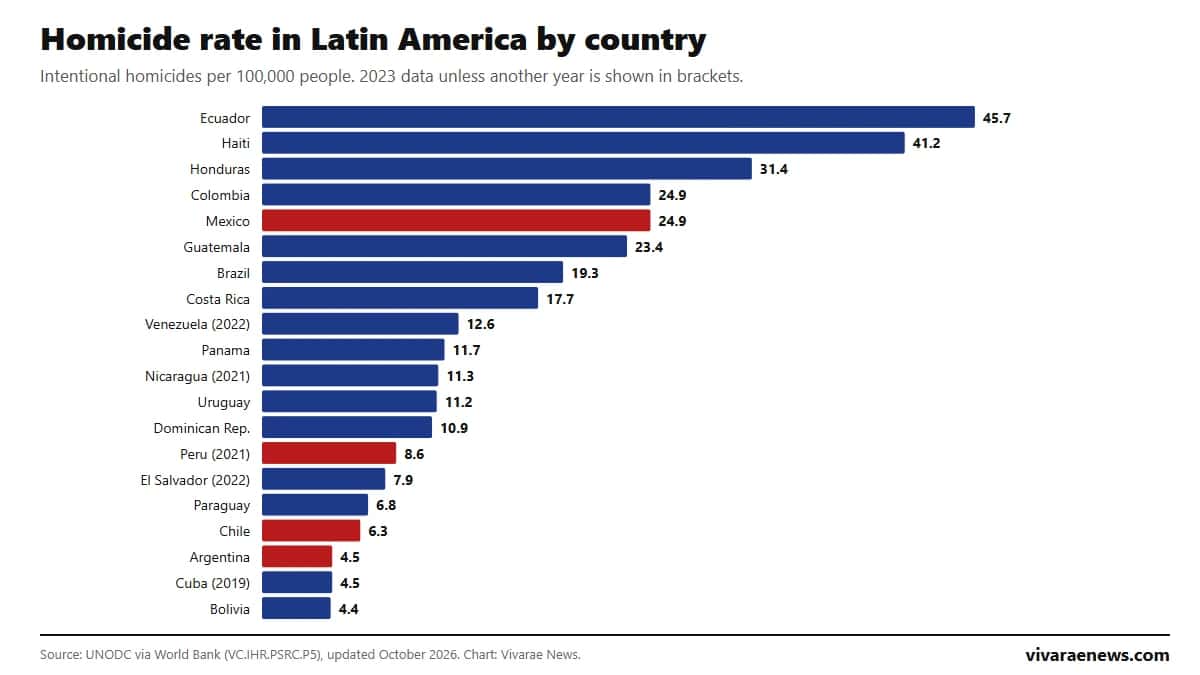
Ecuador has the highest homicide rate in Latin America: 45.7 intentional homicides per 100,000 people in 2023, according to data from the United Nations Office on Drugs and Crime (UNODC) published by the [World Bank](https://data.worldbank.org/indicator/VC.IHR.PSRC.P5) and updated in October 2026. It is followed by Haiti (41.2) and Honduras (31.4). At the other end, Bolivia (4.4), Argentina (4.5) and Chile (6.3) have the lowest rates in the region.
Latin America and the Caribbean recorded 19.7 homicides per 100,000 people in 2023, almost four times the world average of 5.2. This ranking uses the UNODC series because it is the only one comparable across countries; it will be updated on this same page when the World Bank publishes new data.
Homicide rate ranking in Latin America
| Rank | Country | Rate per 100,000 | Year of data | In 2019 |
|---|---|---|---|---|
| 1 | Ecuador | 45.7 | 2023 | 6.9 |
| 2 | Haiti | 41.2 | 2023 | 11.4 (2020) |
| 3 | Honduras | 31.4 | 2023 | 41.0 |
| 4 | Colombia | 24.9 | 2023 | 23.4 |
| 5 | Mexico | 24.9 | 2023 | 29.2 |
| 6 | Guatemala | 23.4 | 2023 | 25.9 |
| 7 | Brazil | 19.3 | 2023 | 21.2 |
| 8 | Costa Rica | 17.7 | 2023 | 11.3 |
| 9 | Venezuela | 12.6 | 2022 | 41.0 |
| 10 | Panama | 11.7 | 2023 | 11.3 |
| 11 | Nicaragua | 11.3 | 2021 | 7.9 |
| 12 | Uruguay | 11.2 | 2023 | 11.6 |
| 13 | Dominican Republic | 10.9 | 2023 | 9.4 |
| 14 | Peru | 8.6 | 2021 | 7.3 |
| 15 | El Salvador | 7.9 | 2022 | 38.5 |
| 16 | Paraguay | 6.8 | 2023 | 8.5 |
| 17 | Chile | 6.3 | 2023 | 4.8 |
| 18 | Argentina | 4.5 | 2023 | 5.1 |
| 19 | Cuba | 4.5 | 2019 | 4.5 |
| 20 | Bolivia | 4.4 | 2023 | 4.3 |
Source: UNODC via the World Bank, indicator VC.IHR.PSRC.P5, latest year available for each country. Mexico and Colombia tie when rounded (24.86 and 24.91). Haiti has no 2019 data; the 2020 figure is shown. Countries with data older than 2023 may have changed a lot since then: El Salvador, for example, reports even lower official figures for 2024 and 2025, which are not in this series.
How the homicide rate in Latin America has changed since 2010
| Country | 2010 | 2015 | 2019 | Latest data | Trend |
|---|---|---|---|---|---|
| Ecuador | 17.4 | 6.5 | 6.9 | 45.7 (2023) | Up sevenfold since 2019 |
| Honduras | 74.5 | 55.7 | 41.0 | 31.4 (2023) | Down by more than half |
| El Salvador | 65.7 | 107.6 | 38.5 | 7.9 (2022) | The region's biggest drop |
| Venezuela | 45.4 | 51.2 | 41.0 | 12.6 (2022) | Sharp fall |
| Mexico | 22.7 | 17.2 | 29.2 | 24.9 (2023) | Rises until 2018, then falls |
| Costa Rica | 11.6 | 11.6 | 11.3 | 17.7 (2023) | Series record in 2023 |
| Chile | 3.2 | 2.3 | 4.8 | 6.3 (2023) | Doubled since 2010 |
| Latin America and the Caribbean | 23.9 | 22.7 | 21.1 | 19.7 (2023) | Slow decline |
| World | 6.1 | 5.9 | 5.4 | 5.2 (2023) | Stable |
Source: World Bank (UNODC); trends are our own calculation. Ecuador is the most abrupt change: it went from one of the lowest rates in South America in 2017 (5.8) to the highest in the region in 2023, amid a war between drug-trafficking gangs in ports and prisons.

The homicide rate in Chile, Mexico, Argentina and Peru
- Mexico (24.9): down from its peak of 29.5 in 2018, but still five times the world average.
- Chile (6.3): rose from 3.2 in 2010 to 6.8 in 2022, the series peak, and fell slightly in 2023. It is still the third lowest in the region.
- Argentina (4.5): the second lowest in Latin America, with a steady decline from 7.5 in 2014.
- Peru (8.6 in 2021): UNODC's most recent figure is from 2021, when it rose from 5.8 in 2020; there is no newer comparable figure in this series.
| Comparison country or region | Rate per 100,000 | Year |
|---|---|---|
| Jamaica | 49.4 | 2023 |
| South Africa | 43.7 | 2022 |
| Latin America and the Caribbean | 19.7 | 2023 |
| United States | 5.8 | 2023 |
| World | 5.2 | 2023 |
| Philippines | 4.3 | 2023 |
| Spain | 0.7 | 2023 |
Source: World Bank (UNODC). For perspective: with 6.3 homicides per 100,000 people, Chile is slightly above the United States (5.8) and far from Spain (0.7). Jamaica, in the English-speaking Caribbean, exceeds every Latin American country in the ranking. The link between security and migration, one of the axes of Chile's debate, is covered in migrant expulsions in 2026.

How to read this ranking
- It measures intentional homicides: deaths deliberately caused by another person. It does not include deaths in armed conflict or those caused by police in the lawful performance of their duty, according to UNODC's definition.
- The rate per 100,000 people is used to compare countries of different sizes.
- Official national figures may differ from UNODC's because of differences in definition or later revisions.
- Each country has a different latest year: the table shows the year of each figure.
Other rankings of the region with official data: inequality by Gini coefficient, unemployment, life expectancy and population.
How to cite this data
Vivarae News (2026). "Homicide rate in Latin America 2026: ranking by country according to the UN". Updated on October 28, 2026. Available at https://vivaraenews.com/en/homicide-rate-in-latin-america-ranking-by-country-2026/. The data may be reproduced citing Vivarae News and linking to this page; each country's figures belong to UNODC and the World Bank.
Frequently asked questions
Which Latin American country has the most homicides?
Ecuador, with 45.7 homicides per 100,000 people in 2023, according to UNODC and the World Bank. It is followed by Haiti (41.2) and Honduras (31.4).
Which Latin American country has the fewest homicides?
Bolivia (4.4), Argentina (4.5) and Cuba (4.5, with 2019 data).
What is Chile's homicide rate?
6.3 per 100,000 people in 2023, the third lowest in Latin America.
What is Mexico's homicide rate?
24.9 per 100,000 people in 2023, tied with Colombia and below its 2018 peak.
How many times does Latin America exceed the world average?
Almost four: 19.7 per 100,000 people versus 5.2 worldwide in 2023.