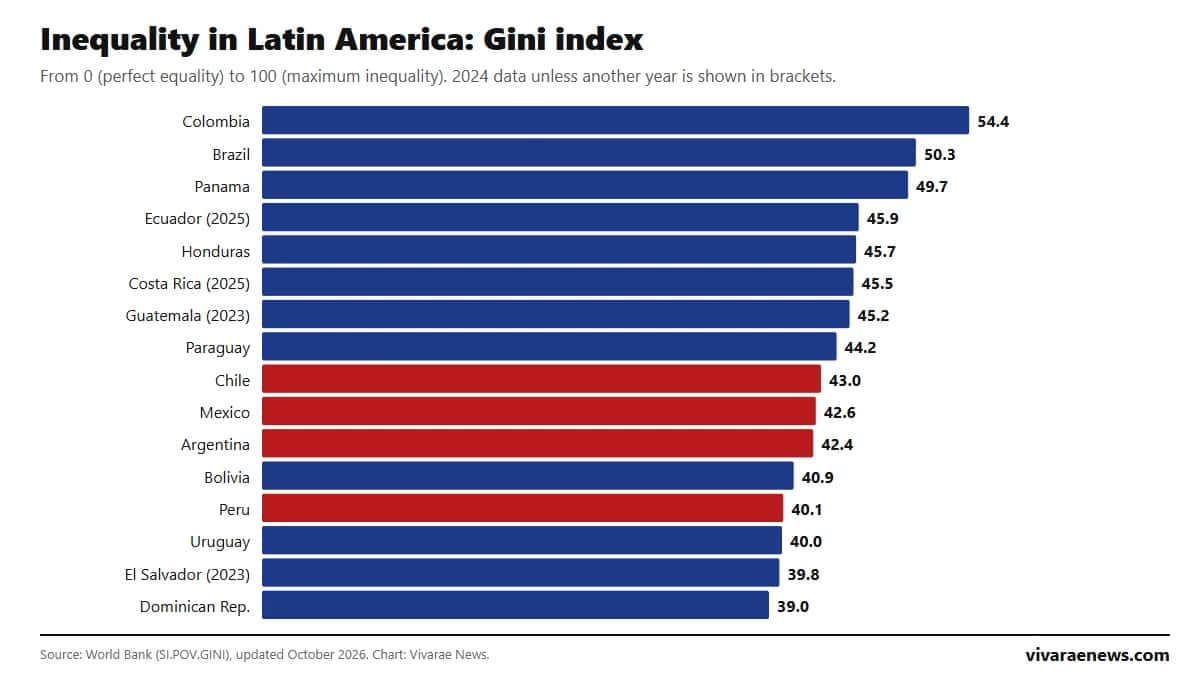
Colombia is the most unequal country in Latin America, with a Gini coefficient of 54.4 in 2024, according to [World Bank](https://data.worldbank.org/indicator/SI.POV.GINI) data updated in October 2026. It is followed by Brazil (50.3) and Panama (49.7). The least unequal are the Dominican Republic (39.0), El Salvador (39.8) and Uruguay (40.0). Chile scores 43.0; Mexico, 42.6; Argentina, 42.4; and Peru, 40.1.
The Gini coefficient is the most widely used measure of income or consumption inequality: it ranges from 0, if everyone had the same, to 100, if a single person had everything. This ranking brings together the latest figure for 16 countries in the region and will be updated on this same page when the World Bank publishes new data.
Gini coefficient ranking in Latin America
| Rank | Country | Gini | Year of data | A decade earlier |
|---|---|---|---|---|
| 1 | Colombia | 54.4 | 2024 | 53.6 (2014) |
| 2 | Brazil | 50.3 | 2024 | 52.1 (2014) |
| 3 | Panama | 49.7 | 2024 | 50.5 (2014) |
| 4 | Ecuador | 45.9 | 2025 | 45.0 (2014) |
| 5 | Honduras | 45.7 | 2024 | 49.9 (2014) |
| 6 | Costa Rica | 45.5 | 2025 | 48.6 (2014) |
| 7 | Guatemala | 45.2 | 2023 | 48.3 (2014) |
| 8 | Paraguay | 44.2 | 2024 | 50.7 (2014) |
| 9 | Chile | 43.0 | 2024 | 46.8 (2013) |
| 10 | Mexico | 42.6 | 2024 | 48.9 (2014) |
| 11 | Argentina | 42.4 | 2024 | 41.8 (2014) |
| 12 | Bolivia | 40.9 | 2024 | 47.8 (2014) |
| 13 | Peru | 40.1 | 2024 | 43.1 (2014) |
| 14 | Uruguay | 40.0 | 2024 | 40.1 (2014) |
| 15 | El Salvador | 39.8 | 2023 | 41.6 (2014) |
| 16 | Dominican Republic | 39.0 | 2024 | 44.3 (2014) |
Source: World Bank, indicator SI.POV.GINI, latest year available for each country. Not included: Venezuela and Cuba, which have no data in the series, and Nicaragua (46.2 in 2014) and Haiti (41.1 in 2012), whose data are too old. In Argentina, the household survey covers only urban areas.
What the Gini coefficient is and how it is calculated
The index compares how income (or consumption) is distributed among all households against a perfectly equal distribution. It is calculated from each country's household surveys, such as Casen in Chile, ENIGH in Mexico, EPH in Argentina or Enaho in Peru, which the World Bank harmonizes. That is why you need to look at the year of each figure and not compare it with figures from other sources without checking their method.
| Gini value | What it indicates | Examples (latest data) |
|---|---|---|
| Below 30 | Low inequality | Slovakia (23.8) |
| 30 to 40 | Moderate | Spain (33.4), Portugal (33.9), Dominican Republic (39.0) |
| 40 to 50 | High | United States (41.8), Chile (43.0), Mexico (42.6) |
| Above 50 | Very high | Brazil (50.3), Colombia (54.4), South Africa (54.1) |
Source: World Bank; the brackets are a reading guide, not an official classification. Latin America remains one of the most unequal regions in the world: 11 of the 16 countries in the ranking exceed the United States.

Inequality fell in almost all of Latin America
In a decade, 13 of the 16 countries reduced their Gini coefficient. The biggest drops were in Bolivia (−6.9 points), Paraguay (−6.5), Mexico (−6.3) and the Dominican Republic (−5.3). Inequality rose in Colombia (+0.8), Ecuador (+0.9) and Argentina (+0.6), according to our calculation with World Bank data.
| Country | Change in a decade (points) | Reading |
|---|---|---|
| Bolivia | −6.9 | The region's biggest drop |
| Paraguay | −6.5 | From 50.7 to 44.2 |
| Mexico | −6.3 | From 48.9 to 42.6 |
| Dominican Republic | −5.3 | Becomes the least unequal |
| Chile | −3.8 | Since 2013 |
| Peru | −3.0 | — |
| Argentina | +0.6 | Practically unchanged |
| Colombia | +0.8 | Still the most unequal |
Source: World Bank; own calculation using the latest figure versus 2014 (2013 for Chile). A lower Gini does not always mean everyone is better off: it can happen because high incomes fell more than low ones, as occurred in several countries during the 2020 pandemic.

Inequality in Chile, Mexico, Argentina and Peru
- Chile (43.0): fell over the long term, with a jump in 2020 (47.0) due to the pandemic, and ranks ninth.
- Mexico (42.6): one of the biggest drops of the decade, alongside real increases in the minimum wage (see Mexico's minimum wage).
- Argentina (42.4): stable, between 40.7 and 43.7 since 2010, despite inflation crises.
- Peru (40.1): among the least unequal, although with high labor informality, which surveys only partly capture.
Inequality is only one side of the picture: a country can have low inequality and still be poor. To compare income levels, see GDP per capita in Latin America, the minimum wage by country and the homicide rate, another variable that studies often associate with inequality.
How to cite this data
Vivarae News (2026). "Inequality in Latin America 2026: ranking by country by Gini coefficient". Updated on October 28, 2026. Available at https://vivaraenews.com/en/inequality-in-latin-america-ranking-by-country-by-gini-coefficient-2026/. The data may be reproduced citing Vivarae News and linking to this page; each country's figures belong to the World Bank.
Frequently asked questions
What is the most unequal country in Latin America?
Colombia, with a Gini coefficient of 54.4 in 2024, according to the World Bank. It is followed by Brazil (50.3) and Panama (49.7).
What is the least unequal country in Latin America?
The Dominican Republic (39.0), followed by El Salvador (39.8) and Uruguay (40.0).
What is Chile's Gini coefficient?
43.0 in 2024, according to the World Bank, compared with 46.8 in 2013.
What do a Gini coefficient of 0 and of 100 mean?
0 is perfect equality (everyone has the same income) and 100 is maximum inequality (a single person has everything).
Has inequality fallen in Latin America?
Yes, in 13 of 16 countries over the last decade; it rose slightly in Colombia, Ecuador and Argentina.