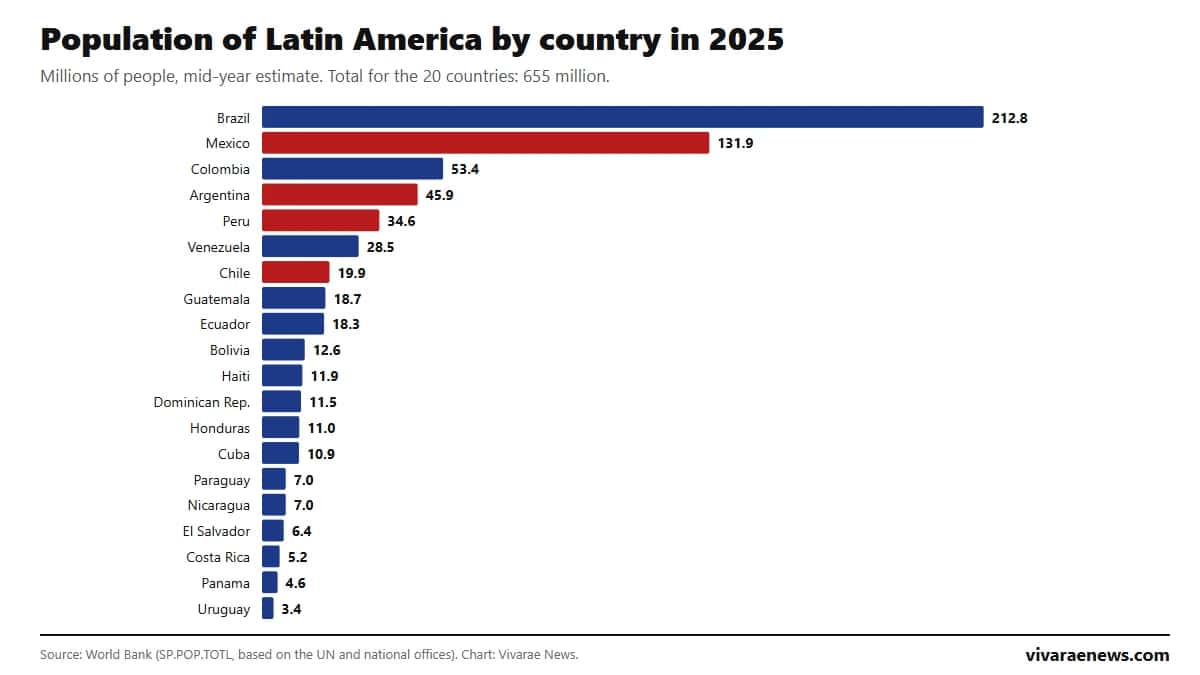
The 20 countries of Latin America had 655.4 million inhabitants in 2025, 47.8 million more than in 2015, according to [World Bank](https://data.worldbank.org/indicator/SP.POP.TOTL) estimates. Brazil (212.8 million) and Mexico (131.9 million) account for more than half. At the other end, Venezuela and Cuba have fewer people than ten years ago, and Chile has the region's lowest fertility rate: 1.14 children per woman in 2024.
The ranking uses the World Bank's total population series, which combines UN projections (World Population Prospects) with national statistics offices. It is comparable across countries, although it may differ from recent censuses: in Chile, for example, the 2024 Census counted fewer people than the international estimate. It will be updated at this same URL.
Ranking of Latin America's population in 2025
| Rank | Country | Population 2025 (million) | Change 2015-2025 |
|---|---|---|---|
| 1 | Brazil | 212.81 | +5.5% |
| 2 | Mexico | 131.95 | +9.0% |
| 3 | Colombia | 53.43 | +13.7% |
| 4 | Argentina | 45.85 | +5.5% |
| 5 | Peru | 34.58 | +13.5% |
| 6 | Venezuela | 28.52 | −6.7% |
| 7 | Chile | 19.86 | +10.0% |
| 8 | Guatemala | 18.69 | +17.0% |
| 9 | Ecuador | 18.29 | +12.4% |
| 10 | Bolivia | 12.58 | +14.2% |
| 11 | Haiti | 11.91 | +13.1% |
| 12 | Dominican Republic | 11.52 | +10.4% |
| 13 | Honduras | 11.01 | +19.1% |
| 14 | Cuba | 10.94 | −3.0% |
| 15 | Paraguay | 7.01 | +13.9% |
| 16 | Nicaragua | 7.01 | +14.0% |
| 17 | El Salvador | 6.37 | +2.9% |
| 18 | Costa Rica | 5.15 | +7.0% |
| 19 | Panama | 4.57 | +15.4% |
| 20 | Uruguay | 3.38 | +0.5% |
| Total | 655.41 | +7.9% |
Source: World Bank, SP.POP.TOTL, mid-year estimate; changes are our own calculation. Paraguay (7,013,078) narrowly exceeds Nicaragua (7,007,502). English-speaking Caribbean countries and territories are not included.
Fertility and ageing in Latin America
| Country | Children per woman 2024 | Children per woman 2014 | Aged 65+ in 2025 |
|---|---|---|---|
| Chile | 1.14 | 1.77 | 14.6% |
| Costa Rica | 1.32 | 1.80 | 12.8% |
| Uruguay | 1.40 | 2.03 | 16.3% |
| Cuba | 1.45 | 1.66 | 17.0% |
| Argentina | 1.50 | 2.39 | 12.6% |
| Brazil | 1.61 | 1.77 | 11.5% |
| Colombia | 1.63 | 1.82 | 10.2% |
| Mexico | 1.89 | 2.21 | 8.5% |
| Peru | 1.97 | 2.27 | 9.5% |
| Guatemala | 2.29 | 3.09 | 5.0% |
| Bolivia | 2.52 | 2.95 | 5.7% |
| Haiti | 2.63 | — | 4.8% |
Source: World Bank, fertility rate (SP.DYN.TFRT.IN) and population aged 65 and over (SP.POP.65UP.TO.ZS). At 2.1 children per woman a population replaces itself without migration: 12 of the 20 countries are already below that. For Chile, the INE has published even lower rates from vital statistics; the World Bank figure is a modeled estimate.

Brazil and Mexico together hold 52.6% of the population of the 20 countries (32.5% and 20.1%), followed by Colombia (8.2%) and Argentina (7.0%). The region is also highly urban: Uruguay has 95.7% of its population in cities and Argentina 92.4%, while Haiti (55.6%) and Guatemala (56.3%) are the least urbanized, according to the World Bank's urban population indicator. Shares are our own calculation.
Latin American countries that are losing population
Venezuela went from 30.6 million inhabitants in 2015 to 28.5 million in 2025 (−6.7%), due to emigration. Cuba fell from 11.3 to 10.9 million (−3.0%), due to emigration and low birth rates. Uruguay (+0.5%) and El Salvador (+2.9%) barely grew. The fastest growers were Honduras (+19.1%), Guatemala (+17.0%) and Panama (+15.4%).
The population of Chile, Mexico, Argentina and Peru
| Country | Population 2025 (World Bank) | Latest census or national estimate | Urban |
|---|---|---|---|
| Mexico | 131.95 million | INEGI publishes its own projections | 80.0% |
| Argentina | 45.85 million | Indec 2022 Census | 92.4% |
| Peru | 34.58 million | INEI publishes its own projections | 85.6% |
| Chile | 19.86 million | 2024 Census: 18,480,432 people (INE) | 89.2% |
Source: World Bank and urban population (SP.URB.TOTL.IN.ZS). The gap of almost 1.4 million in Chile between the 2024 Census and the international estimate is explained in our story on Chile's population; this ranking will be adjusted once international series incorporate the census.

How to read this ranking
- These are mid-year estimates, not counts: each country's census may give different figures.
- The UN revises its projections every two years; figures can change retroactively.
- Fertility and the older population help explain the future: more spending on pensions and health and fewer students.
Other rankings with official data: life expectancy, remittances and GDP per capita.
How to cite this data
Vivarae News (2026). "Population of Latin America 2025: ranking by country, growth and fertility". Updated October 27, 2026. Available at https://vivaraenews.com/en/population-of-latin-america-ranking-by-country-2025/. The data may be reproduced citing Vivarae News and linking to this page; each country's figures belong to the World Bank.
Frequently asked questions
How many people live in Latin America?
The 20 Latin American countries have 655.4 million inhabitants in 2025, according to the World Bank.
What is the most populous country in Latin America?
Brazil, with 212.8 million in 2025, followed by Mexico (131.9 million) and Colombia (53.4 million).
What is the least populous country?
Of the 20 countries in the ranking, Uruguay, with 3.4 million inhabitants.
Which Latin American countries are losing population?
Venezuela (−6.7% between 2015 and 2025) and Cuba (−3.0%).
Which country has the lowest fertility?
Chile, with 1.14 children per woman in 2024, according to the World Bank.