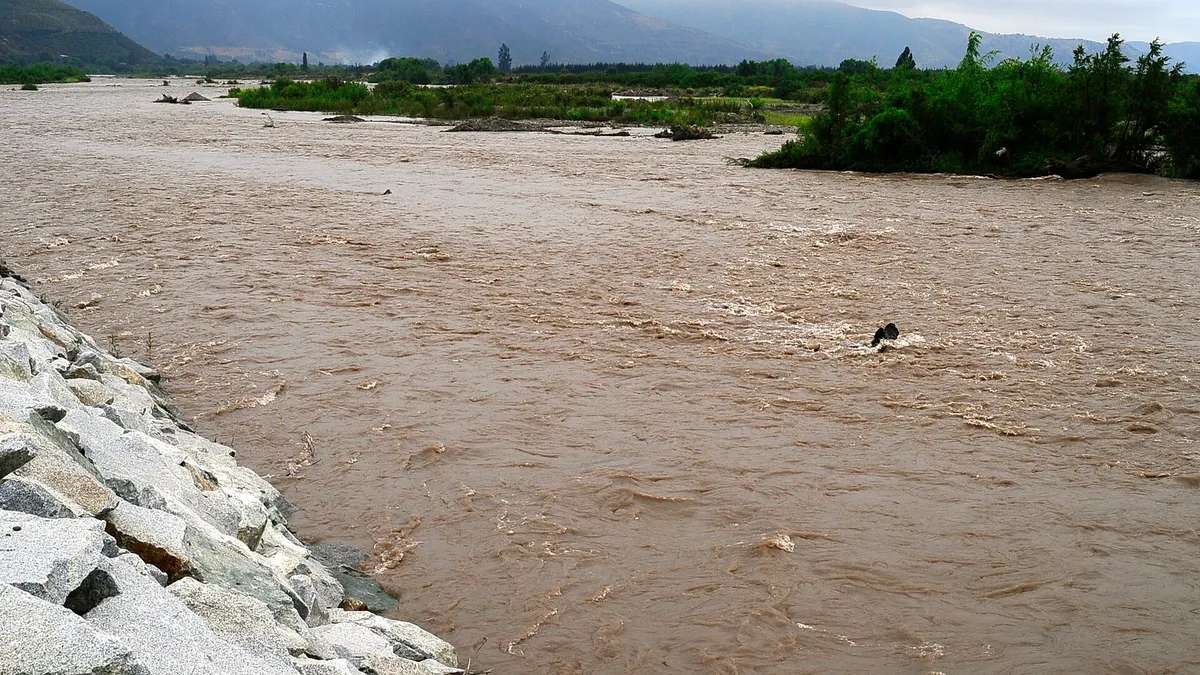
Chile's National Disaster Prevention and Response Service (Senapred) declared a red alert in Concón, Quintero, Quillota and Limache, in the Valparaíso region, over the risk of the Aconcagua River overflowing, according to La Tercera and BioBioChile. The measure has been in force since the night of Sunday, November 15, and will remain "until conditions warrant otherwise". In Los Andes and San Esteban, upstream, a yellow alert for the rising river remains in place.
The alert was triggered by data from the General Water Directorate (DGA): the "Aconcagua River at Puente Colmo" gauging station, near the river mouth in Concón, recorded a flow of 224.16 cubic meters per second, above the red threshold for that point. The DGA also warned that the station's sensor is malfunctioning, so the current flow cannot be known precisely, according to Pauta.
View the data as a table
| Flow at Puente Colmo | 224.16 m³/s |
| Flow at Chacabuquito (Nov 12) | 177.85 m³/s |
| Towns on red alert | 4 |
| Snow at Portillo (Nov 11) | 169 cm |
Which towns are on red alert over the Aconcagua River
The red alert covers the four towns along the lower Aconcagua, between Quillota and the river mouth in Concón, where the river runs past populated areas, roads and farmland. Senapred called for stepped-up monitoring and surveillance of critical points along the banks. In the upper course, in Los Andes province, the yellow alert applies.
View the data as a table
| Concón | Red alert | |
| Quintero | Red alert | |
| Quillota | Red alert | |
| Limache | Red alert | |
| Los Andes | Yellow alert | |
| San Esteban | Yellow alert |
| Town | Province | Current alert | Since |
|---|---|---|---|
| Concón | Valparaíso | Red | November 15 |
| Quintero | Valparaíso | Red | November 15 |
| Quillota | Quillota | Red | November 15 |
| Limache | Marga Marga | Red | November 15 |
| Los Andes | Los Andes | Yellow | coverage updated November 16 |
| San Esteban | Los Andes | Yellow | coverage updated November 16 |
Source: La Tercera and Pauta, with Senapred information. Alerts may change at any time; the official status is published at senapred.cl.
Why the Aconcagua River rose in November
The rise has been building for days. On November 11 Senapred declared an early preventive alert over the rising flow of the Aconcagua and the Putaendo River, and on the 13th it extended it to San Felipe province and the four lower-course towns, according to Puranoticia. On Thursday the 12th, at 8:54 p.m., the Aconcagua station at Chacabuquito, near Los Andes, recorded 177.85 m³/s. Senapred then reported rising flows in the Juncal, Juncalillo, Colorado, Riecillos and Blanco rivers, and active ravines between Río Blanco and Portillo.
Snow in the Andes is part of the explanation, although Senapred did not quantify it: at Portillo, snow depth fell from 209 to 169 centimeters between November 5 and 11, but the agency said that figure does not show how much melting contributed to river flows. The Colbún canal that feeds the Los Quilos power plant is also out of service, and Senapred is monitoring its effect on the Colorado River, a tributary of the Aconcagua.
- Nov 5-11Snow drops at PortilloFrom 209 to 169 cm deep.
- Nov 11Early preventive alertOver the rising Aconcagua and Putaendo rivers.
- Nov 12, 8:54 p.m.177,85 m³/sAt the Chacabuquito station, near Los Andes.
- Nov 13Alert is extendedTo San Felipe and the four lower-course towns.
- Nov 15, nightRed alertPuente Colmo records 224.16 m³/s; the sensor is faulty.
- Nov 16Yellow alert only in Los Andes and San EstebanSenapred updates the yellow alert's coverage.
This is not the first red alert for the Aconcagua River
This is the second time this year that the same four towns have been placed on red alert over the Aconcagua. On the night of July 20, 2026, Senapred declared a red alert in Limache, Quintero, Concón and Quillota because the Puente Colmo station reached red-threshold values, according to Meganoticias. At the time, Senapred's regional director, Christian Cardemil, asked residents "living between Puente Colmo and the La Isla or La Boca de Concón area" to keep a close eye on the river level. On June 23, 2023, during the storm in central Chile, Senapred declared a red alert in Quillota province when the Aconcagua station at Romeral reached 320.1 m³/s, according to BioBioChile.
| Date | Towns or provinces on red alert | Reason |
|---|---|---|
| June 23, 2023 | Quillota province | Storm; 320.1 m³/s at Romeral |
| July 20, 2026 | Limache, Quintero, Concón, Quillota | Red threshold at Puente Colmo |
| November 15, 2026 | Concón, Quintero, Quillota, Limache | 224.16 m³/s at Puente Colmo |
The weather outlook for central Chile this week
The forecast does not help bring the river down. According to meteorologist Laura Batista of Meteored, quoted by BioBioChile, rain and possible thunderstorms reach central Chile this week, with milder temperatures. Tuesday the 17th will be the most unstable day, and on Thursday the 19th rain returns between the Metropolitan Region and Biobío, with possible showers in the Valparaíso foothills.
| Day | Forecast for central Chile |
|---|---|
| Monday 16 | Rain from Ñuble and Biobío spreading in the afternoon; highs of 20-23 °C; possible lightning |
| Tuesday 17 | Most unstable day: showers with possible thunderstorms; 15-25 mm in the Ñuble and Biobío foothills |
| Wednesday 18 | A pause: rain eases |
| Thursday 19 | Rain returns between Santiago and Biobío; 10-20 mm in parts of Santiago and O'Higgins; possible showers in the Valparaíso foothills |
| Friday 20 | Rain eases and temperatures rise slightly |
Source: Meteored via BioBioChile, November 16, 2026. For official warnings, check Chile's Meteorological Directorate. In October, another frontal system led to a red alert in 10 Santiago districts and school closures.
What a red alert means and what to do if you live near the Aconcagua River
Senapred's system has three alert levels: early preventive, which steps up monitoring; yellow, when the threat grows and resources are readied; and red, the highest level, which allows all available resources to be mobilized to respond. A red alert does not by itself mean an evacuation: evacuations are ordered separately, through the SAE emergency text message to mobile phones or by authorities on the ground. For those living near the riverbanks, the usual recommendations are:
- Do not go near the riverbed or cross it on foot or by vehicle, even if it looks shallow.
- Follow official information from Senapred, the regional presidential delegation and the municipality.
- Keep an emergency kit at hand: water, flashlight, battery radio, documents and medicines.
- Identify the highest route and meeting point in your area.
- If an SAE message arrives or authorities say so, evacuate immediately.
Frequently asked questions
Which towns are on red alert over the Aconcagua River?
Concón, Quintero, Quillota and Limache, in the Valparaíso region, since the night of November 15, 2026. Los Andes and San Esteban remain on yellow alert.
How much water is the Aconcagua carrying?
The DGA's Puente Colmo station recorded 224.16 m³/s, above the red threshold, but its sensor is faulty and the current figure cannot be measured precisely.
Are there evacuations because of the Aconcagua River?
As of the morning of November 16, the sources consulted reported no evacuations. The red alert allows resources to be mobilized; an evacuation is ordered separately, via SAE message or by authorities.
How long will the red alert last?
Senapred said it will remain until conditions warrant otherwise. It depends on the river flow and this week's rain forecast.