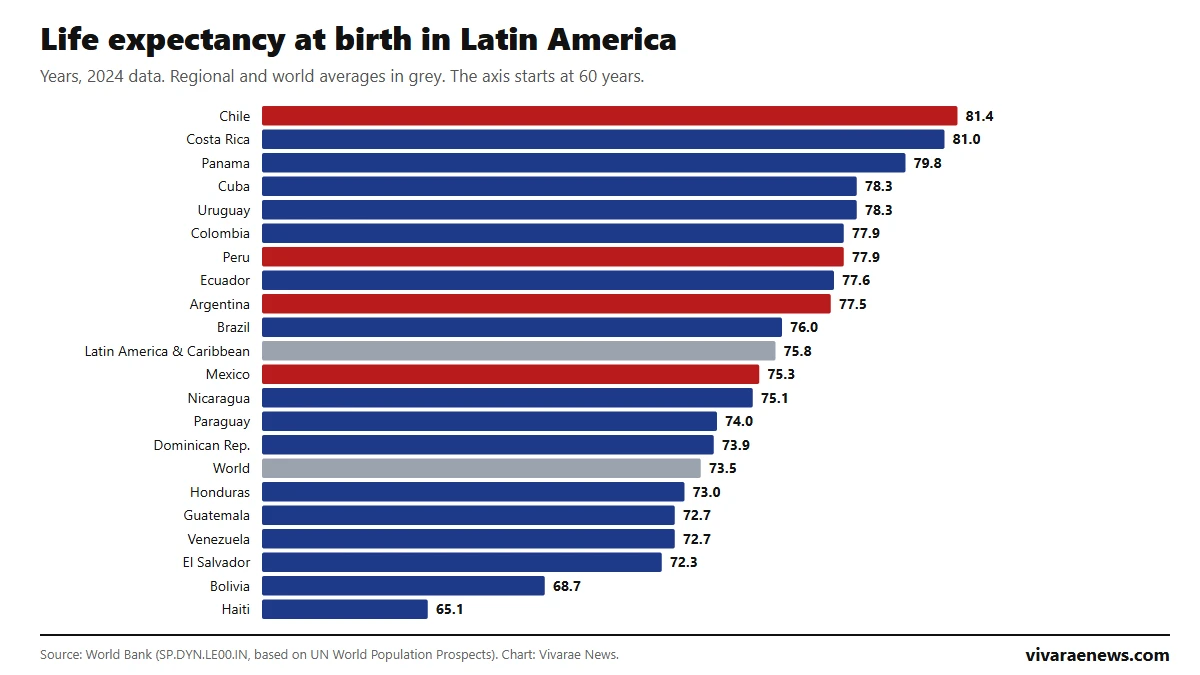
Chile has the highest life expectancy at birth in Latin America, 81.4 years, followed by Costa Rica at 81 years and Panama at 79.8, according to 2024 data from the [World Bank](https://data.worldbank.org/indicator/SP.DYN.LE00.IN) published on October 8, 2026. At the other end are Haiti, with 65.1 years, and Bolivia, with 68.7. The Latin America and Caribbean average is 75.8 years, above the world average of 73.5.
Life expectancy at birth indicates how many years a newborn would live on average if that year's mortality conditions held. This ranking covers 20 countries with comparable data, and we will update it on this same page when the World Bank publishes new figures.
Life expectancy ranking in Latin America
| Rank | Country | Life expectancy (2024) | Men | Women |
|---|---|---|---|---|
| 1 | Chile | 81.4 | 79.5 | 83.2 |
| 2 | Costa Rica | 81.0 | 78.4 | 83.6 |
| 3 | Panama | 79.8 | 76.9 | 82.7 |
| 4 | Cuba | 78.3 | 75.9 | 80.7 |
| 4 | Uruguay | 78.3 | 74.4 | 82.0 |
| 6 | Colombia | 77.9 | 75.2 | 80.6 |
| 6 | Peru | 77.9 | 75.6 | 80.3 |
| 8 | Ecuador | 77.6 | 74.9 | 80.3 |
| 9 | Argentina | 77.5 | 75.0 | 80.0 |
| 10 | Brazil | 76.0 | 73.0 | 79.1 |
| 11 | Mexico | 75.3 | 72.4 | 78.0 |
| 12 | Nicaragua | 75.1 | 72.5 | 77.6 |
| 13 | Paraguay | 74.0 | 71.0 | 77.1 |
| 14 | Dominican Republic | 73.9 | 70.7 | 77.1 |
| 15 | Honduras | 73.0 | 70.5 | 75.7 |
| 16 | Guatemala | 72.7 | 70.4 | 75.0 |
| 16 | Venezuela | 72.7 | 68.9 | 76.7 |
| 18 | El Salvador | 72.3 | 67.8 | 76.5 |
| 19 | Bolivia | 68.7 | 66.3 | 71.3 |
| 20 | Haiti | 65.1 | 61.9 | 68.5 |
| Ref. | Latin America & Caribbean | 75.8 | 72.9 | 78.7 |
| Ref. | World | 73.5 | 71.1 | 76.0 |
Source: World Bank, indicators SP.DYN.LE00.IN, SP.DYN.LE00.MA.IN and SP.DYN.LE00.FE.IN, downloaded from its API on October 26, 2026. The World Bank takes these estimates from the UN's World Population Prospects, so they may differ from the figures of each country's statistics office.
The gap between men and women in Latin America
Women live longer in every country, but the gap varies widely. The largest is in El Salvador (8.7 years), followed by Venezuela (7.8) and Uruguay (7.7); the smallest is in Chile (3.8 years). On the regional average, women live 5.8 years longer than men (our calculation with World Bank data).

The pandemic's blow to life expectancy in Latin America
| Country | 2019 | 2021 | Drop | 2024 | Recovered? |
|---|---|---|---|---|---|
| Bolivia | 67.8 | 61.4 | −6.4 | 68.7 | Yes |
| Paraguay | 73.7 | 68.1 | −5.6 | 74.0 | Yes |
| Peru | 76.3 | 71.6 | −4.7 | 77.9 | Yes |
| Mexico | 74.5 | 69.8 | −4.7 | 75.3 | Yes |
| Ecuador | 77.3 | 72.7 | −4.6 | 77.6 | Yes |
| Cuba | 77.4 | 73.2 | −4.2 | 78.3 | Yes |
| Colombia | 76.8 | 72.7 | −4.1 | 77.9 | Yes |
| Chile | 80.3 | 78.9 | −1.4 | 81.4 | Yes |
| Latin America & Caribbean | 75.2 | 71.8 | −3.4 | 75.8 | Yes |
Source: World Bank. Differences are our calculation. Between 2019 and 2021 the region lost 3.4 years of life expectancy, more than the world average, which fell from 72.9 to 71.2. By 2024 every country in the table was above its pre-pandemic level.
How much it has risen since 1960
| Country | 1960 | 2024 | Gain |
|---|---|---|---|
| Nicaragua | 46.4 | 75.1 | +28.7 years |
| Peru | 50.6 | 77.9 | +27.3 |
| Guatemala | 45.8 | 72.7 | +26.9 |
| Bolivia | 43.3 | 68.7 | +25.4 |
| Chile | 57.2 | 81.4 | +24.2 |
| Mexico | 53.6 | 75.3 | +21.7 |
| Argentina | 64.2 | 77.5 | +13.3 |
| Uruguay | 67.7 | 78.3 | +10.6 |
Source: World Bank. The countries that started lowest, such as Nicaragua, Peru or Guatemala, gained the most years. Argentina and Uruguay, which led the region in 1960, advanced less and were overtaken. Chile's trend, with national statistics data, is in life expectancy in Chile.
Life expectancy in Chile, Mexico, Argentina and Peru
| Country | Life expectancy (2024) | Difference from the regional average | Rank |
|---|---|---|---|
| Chile | 81.4 | +5.6 years | 1st |
| Peru | 77.9 | +2.1 years | 6th |
| Argentina | 77.5 | +1.7 years | 9th |
| Mexico | 75.3 | −0.5 years | 11th |
Source: World Bank; differences are our calculation. Mexico is the only one of the four below the regional average, partly because the pandemic cut 4.7 years between 2019 and 2021, the largest drop of the four. Peru, which in 1960 had one of the lowest life expectancies in the region (50.6 years), now ranks above Argentina.
How to read the ranking
- It is an estimate from the UN model, not a death register: each country's statistics office may publish somewhat different figures.
- A difference of 0.1 or 0.2 years between countries is not significant.
- It measures one year's mortality conditions; it does not predict how long a specific person will live.
Other regional rankings with official data: GDP per capita, unemployment and minimum wage.
How to cite this data
Vivarae News (2026). "Life expectancy in Latin America 2026: ranking by country". Updated October 26, 2026. Available at https://vivaraenews.com/en/life-expectancy-in-latin-america-ranking-by-country-2026/. The data may be reproduced by citing Vivarae News and linking to this page; each country's figures belong to their original source.
Frequently asked questions
Which Latin American country has the highest life expectancy?
Chile, with 81.4 years in 2024, according to the World Bank. It is followed by Costa Rica (81) and Panama (79.8).
Which country has the lowest life expectancy?
Haiti, with 65.1 years, followed by Bolivia, with 68.7.
What is the average life expectancy in Latin America?
75.8 years in 2024: 72.9 for men and 78.7 for women.
What is life expectancy in Mexico, Argentina and Peru?
Mexico 75.3 years, Argentina 77.5 and Peru 77.9, according to the World Bank.
Has life expectancy recovered after the pandemic?
Yes. The region went from 75.2 years in 2019 to 71.8 in 2021 and 75.8 in 2024.