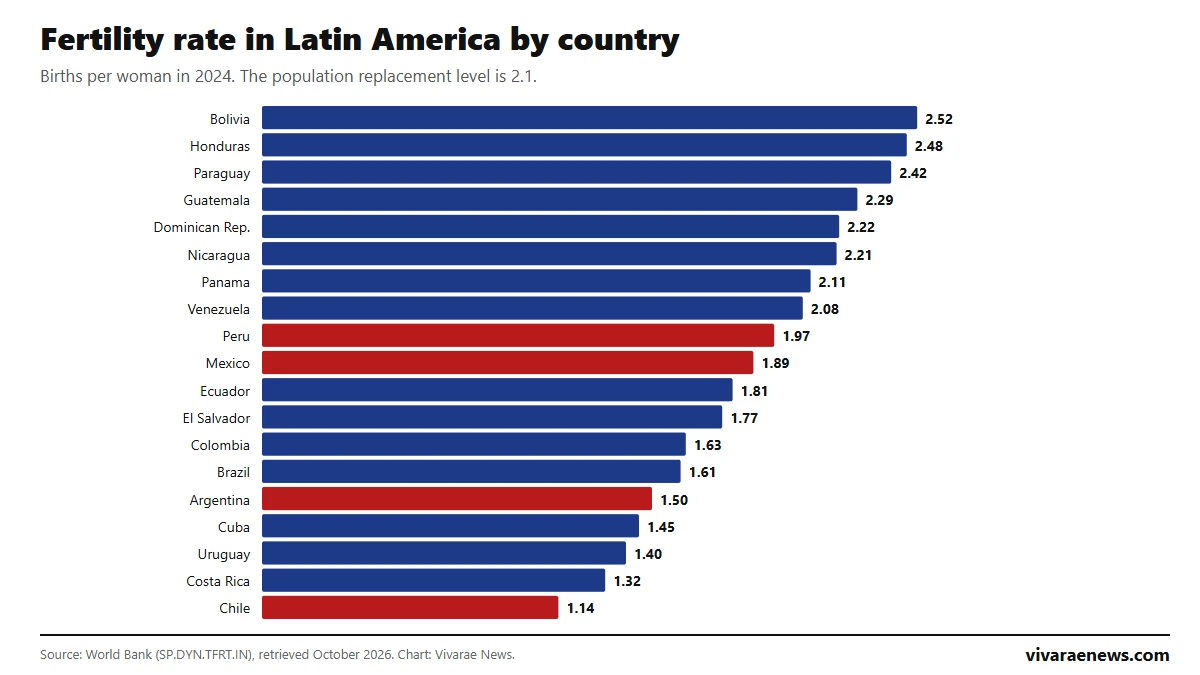
Chile has the lowest fertility rate in Latin America: 1.14 births per woman in 2024, according to World Bank data retrieved in October 2026. It is followed by Costa Rica (1.32) and Uruguay (1.40). At the other end, Bolivia (2.52), Honduras (2.48) and Paraguay (2.42) have the highest rates in the region.
Only seven of the 19 countries in the ranking remain above 2.1 births per woman (Panama only just), the so-called replacement level that keeps a population stable over the long term without migration. The average for Latin America and the Caribbean is 1.79, below the global average (2.19). This ranking will be updated on this same page when the World Bank publishes new data.
Ranking of the fertility rate in Latin America
| Rank | Country | Births per woman (2024) | In 2000 | Change |
|---|---|---|---|---|
| 1 | Bolivia | 2.52 | 3.99 | −1.47 |
| 2 | Honduras | 2.48 | 4.29 | −1.81 |
| 3 | Paraguay | 2.42 | 3.51 | −1.09 |
| 4 | Guatemala | 2.29 | 4.58 | −2.29 |
| 5 | Dominican Republic | 2.22 | 2.87 | −0.65 |
| 6 | Nicaragua | 2.21 | 3.12 | −0.91 |
| 7 | Panama | 2.11 | 2.74 | −0.63 |
| 8 | Venezuela | 2.08 | 2.79 | −0.71 |
| 9 | Peru | 1.97 | 2.85 | −0.88 |
| 10 | Mexico | 1.89 | 2.71 | −0.82 |
| 11 | Ecuador | 1.81 | 3.10 | −1.29 |
| 12 | El Salvador | 1.77 | 3.08 | −1.31 |
| 13 | Colombia | 1.63 | 2.57 | −0.94 |
| 14 | Brazil | 1.61 | 2.25 | −0.64 |
| 15 | Argentina | 1.50 | 2.59 | −1.09 |
| 16 | Cuba | 1.45 | 1.61 | −0.16 |
| 17 | Uruguay | 1.40 | 2.20 | −0.80 |
| 18 | Costa Rica | 1.32 | 2.41 | −1.09 |
| 19 | Chile | 1.14 | 2.05 | −0.91 |
Source: World Bank, indicator SP.DYN.TFRT.IN, 2024 estimates; change is our own calculation. The total fertility rate is the average number of children a woman would have over her lifetime if that year's age-specific birth rates held. Figures from national statistics institutes may differ slightly from the World Bank's, which uses a common methodology to compare countries.
How fertility has fallen in Latin America since 2000
| Country or region | 2000 | 2010 | 2020 | 2024 |
|---|---|---|---|---|
| Guatemala | 4.58 | 3.38 | 2.47 | 2.29 |
| Mexico | 2.71 | 2.34 | 1.99 | 1.89 |
| Argentina | 2.59 | 2.41 | 1.60 | 1.50 |
| Peru | 2.85 | 2.42 | 2.06 | 1.97 |
| Chile | 2.05 | 1.84 | 1.31 | 1.14 |
| Latin America and the Caribbean | n/a | n/a | n/a | 1.79 |
| OECD members | n/a | n/a | n/a | 1.48 |
| World | n/a | n/a | n/a | 2.19 |
Source: World Bank. Guatemala has fallen the most this century: from 4.58 to 2.29 births per woman, half. Argentina had the sharpest drop of the last decade: from 2.35 in 2015 to 1.50 in 2024. Chile was already below the replacement level in 2000, and in 2024 its rate is lower than the OECD average.

The fertility rate in Chile, Mexico, Argentina and Peru
- Chile (1.14): the lowest in the region and below the OECD average (1.48). It fell from 1.31 in 2020; births have been declining for years and the population is ageing fast.
- Argentina (1.50): the fastest fall of the decade among the large countries, from 2.35 in 2015, with a sharp drop in teenage pregnancy.
- Mexico (1.89): below replacement level since the late 2010s, but still above the regional average.
- Peru (1.97): very close to replacement level, with 0.88 fewer births per woman than in 2000.
| Comparison | Births per woman (2024) |
|---|---|
| World | 2.19 |
| Latin America and the Caribbean | 1.79 |
| OECD members | 1.48 |
| Chile | 1.14 |
Source: World Bank. Falling fertility is one reason the region's population is growing ever more slowly and ageing: see Latin America's population by country, Chile's population and life expectancy in the region.

Which Latin American countries are below replacement level
| Group | Countries | How many |
|---|---|---|
| Above 2.1 births per woman | Bolivia, Honduras, Paraguay, Guatemala, Dominican Republic, Nicaragua and Panama | 7 |
| Between 1.5 and 2.1 | Venezuela, Peru, Mexico, Ecuador, El Salvador, Colombia, Brazil and Argentina | 8 |
| Below 1.5 (very low fertility) | Cuba, Uruguay, Costa Rica and Chile | 4 |
Source: World Bank, 2024 data; our own grouping. Argentina is right on the line, at 1.50. Being below replacement level does not mean a country's population starts shrinking immediately: because of demographic momentum and migration, it can keep growing for years, but ever more slowly and with more older adults.
Why fertility is falling in Latin America
- More years of study and work for women: motherhood is postponed and women have fewer children.
- Falling teenage pregnancy: in several countries, such as Argentina and Chile, it has dropped sharply over the last decade.
- Housing and childcare costs: they make starting a family more expensive in big cities.
- Urbanization: people in cities have fewer children than in rural areas; countries with larger rural populations, such as Bolivia, Honduras and Guatemala, have higher rates.
These are trends described in the demographic literature; the weight of each factor varies by country. Other regional rankings with official data: unemployment, GDP per capita and military spending.
How to cite this data
Vivarae News (2026). "Fertility rate in Latin America 2026: ranking by country according to the World Bank". Updated October 29, 2026. Available at https://vivaraenews.com/en/fertility-rate-in-latin-america-ranking-by-country-2026/. The data may be reproduced by citing Vivarae News and linking to this page; each country's figures belong to the World Bank.
Frequently asked questions
Which Latin American country has the lowest fertility rate?
Chile, at 1.14 births per woman in 2024, according to the World Bank. It is followed by Costa Rica (1.32) and Uruguay (1.40).
Which Latin American country has the most births per woman?
Bolivia, at 2.52, followed by Honduras (2.48) and Paraguay (2.42).
What is the replacement level?
About 2.1 births per woman: the number that keeps a population stable over the long term, not counting migration.
What is Mexico's fertility rate?
1.89 births per woman in 2024, compared with 2.71 in 2000.
What is Argentina's fertility rate?
1.50 births per woman in 2024, one of the fastest falls in the region since 2015.