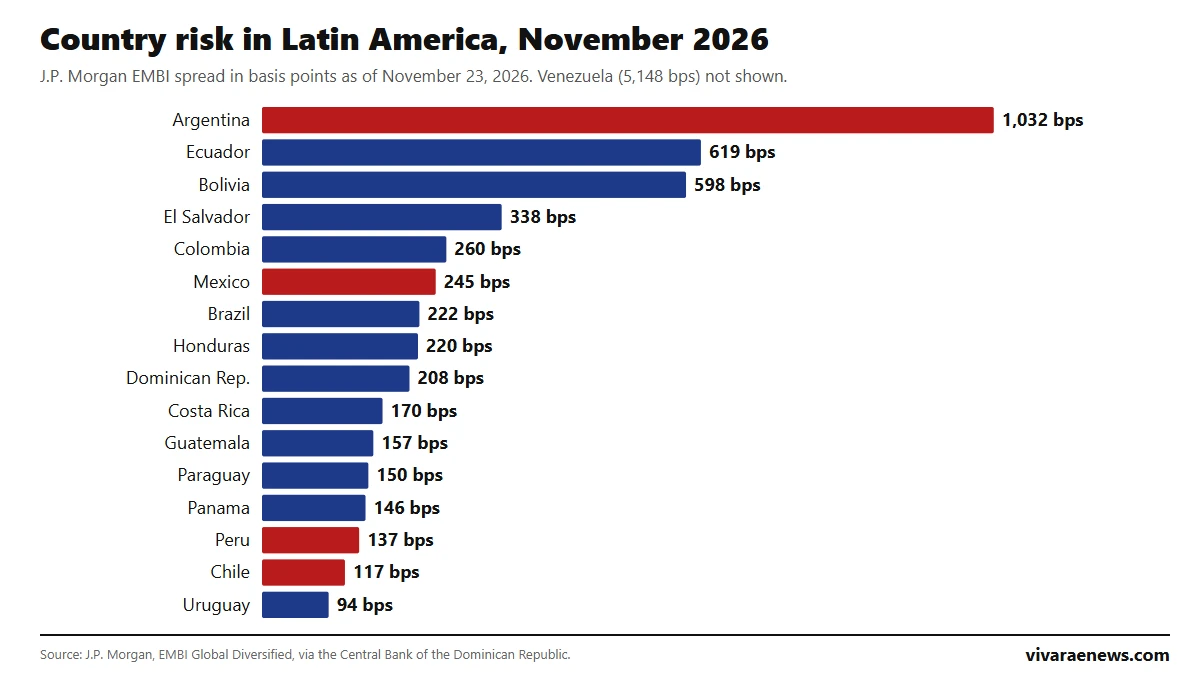
Argentina has the highest country risk in Latin America, excluding Venezuela: 1,032 basis points as of November 23, 2026, according to J.P. Morgan's EMBI index. It rose 324 points in a month and sits close to its high of the year, 1,065 points on November 20. At the other end are Uruguay (94 points) and Chile (117), the two countries that pay the smallest premium over the United States to borrow in dollars. The data is the daily EMBI Global Diversified series published by the Central Bank of the Dominican Republic.
Venezuela remains off the scale at 5,148 points, though far below the 12,741 it ended 2025 with. The whole region got more expensive in November: the EMBI Latin America sub-index went from 200 to 231 points in a month. This page is updated monthly; the indicator is explained in what country risk is and why it rises.
View the data as a table
| Argentina | 1,032 bps |
| Latin America (sub-index) | 231 bps |
| Chile | 117 bps |
| Uruguay | 94 bps |
Latin America country risk ranking, November 2026
These are the 17 Latin American countries in the EMBI, ranked from highest to lowest spread. Country risk measures how many basis points (hundredths of a percentage point) more than US Treasury bonds each government's dollar bonds yield: 100 points means paying 1 extra percentage point of interest.
View the data as a table
| Venezuela | 5,148 |
| Argentina | 1,032 |
| Ecuador | 619 |
| Bolivia | 598 |
| El Salvador | 338 |
| Colombia | 260 |
| Mexico | 245 |
| Brazil | 222 |
| Honduras | 220 |
| Dominican Republic | 208 |
| Costa Rica | 170 |
| Guatemala | 157 |
| Paraguay | 150 |
| Panama | 146 |
| Peru | 137 |
| Chile | 117 |
| Uruguay | 94 |
| # | Country | Country risk (bps), Nov 23, 2026 | A month ago | A year ago | 12-month change |
|---|---|---|---|---|---|
| 1 | Venezuela | 5,148 | 4,447 | 12,275 | -7,127 |
| 2 | Argentina | 1,032 | 708 | 634 | +398 |
| 3 | Ecuador | 619 | 587 | 631 | -12 |
| 4 | Bolivia | 598 | 502 | 772 | -174 |
| 5 | El Salvador | 338 | 309 | 356 | -18 |
| 6 | Colombia | 260 | 230 | 269 | -9 |
| 7 | Mexico | 245 | 223 | 233 | +12 |
| 8 | Brazil | 222 | 161 | 203 | +19 |
| 9 | Honduras | 220 | 196 | 304 | -84 |
| 10 | Dominican Republic | 208 | 188 | 191 | +17 |
| 11 | Costa Rica | 170 | 153 | 172 | -2 |
| 12 | Guatemala | 157 | 138 | 160 | -3 |
| 13 | Paraguay | 150 | 125 | 129 | +21 |
| 14 | Panama | 146 | 130 | 180 | -34 |
| 15 | Peru | 137 | 120 | 129 | +8 |
| 16 | Chile | 117 | 101 | 100 | +17 |
| 17 | Uruguay | 94 | 81 | 75 | +19 |
Source: J.P. Morgan, EMBI Global Diversified, published by the Central Bank of the Dominican Republic. "A month ago" is October 23, 2026, and "a year ago" is November 24, 2025. At the close of November 23, the global EMBI (all emerging markets) stood at 229 points.

Why country risk rose in Latin America in November
All 17 countries ended the month with a wider spread than on October 23. It was not only a Latin American phenomenon: the global EMBI rose from 205 to 229 points over the same period, during weeks of stock market declines driven by doubts about artificial intelligence stocks and a stronger dollar; on November 24, for example, the dollar in Chile jumped 20 pesos as copper erased its gains for the year, according to Diario Financiero. November 20 was the worst day: that Friday almost every country posted its high for the month.
Argentina was the extreme case. Its country risk stood at 403 points on July 7, the low of the year, and reached 1,065 on November 20. Bloomberg Línea links it to the exchange-rate gap and investor doubts, even though confidence in the government rebounded. It had already passed 800 points early in the month (see our November 3 story). These were the biggest moves of the past month:
| Country | 2026 low (bps) | Date | 2026 high (bps) | Date |
|---|---|---|---|---|
| Argentina | 403 | Jul 7 | 1,065 | Nov 20 |
| Chile | 80 | May 15 | 121 | Nov 20 |
| Mexico | 190 | Aug 13 | 252 | Nov 20 |
| Peru | 102 | Sep 24 | 145 | Mar 3 |
| Latin America (sub-index) | 168 | Sep 11 | 316 | Mar 30 |
Source: J.P. Morgan, EMBI Global Diversified, published by the Central Bank of the Dominican Republic, daily closes from January 1 to November 23, 2026.
Venezuela's country risk: from 12,741 to 5,148 points
Venezuela is a special case: its bonds have been in default since 2017, so its spread is measured in thousands of points. In 2026 it fell by more than half. According to Bloomberg Línea, the drop began after the United States captured Nicolás Maduro in January and continued with the announcement, in May, of an external debt restructuring process. Over the past month, however, it rose from 4,447 to 5,148 points. Because of its scale, Venezuela does not appear in the bar charts.
Latin America's country risk since 2015
In annual averages, 2026 is the year of lowest country risk for the region in the whole series available since 2015: the Latin America sub-index averages 253 points, compared with 388 in 2025 and 465 in 2020, the pandemic year. Chile averages 91 points in 2026, its lowest average since 2015, and Argentina 553, far from the more than 2,000 of 2020, 2022 and 2023.
View the data as a table
| Argentina | Latin America | Mexico | Colombia | Peru | Chile | |
|---|---|---|---|---|---|---|
| 2015 | 589 | 433 | 251 | 250 | 201 | 186 |
| 2016 | 475 | 448 | 303 | 278 | 199 | 200 |
| 2017 | 412 | 362 | 256 | 194 | 145 | 130 |
| 2018 | 547 | 390 | 272 | 184 | 147 | 133 |
| 2019 | 1,312 | 396 | 318 | 184 | 129 | 136 |
| 2020 | 2,241 | 465 | 477 | 263 | 174 | 198 |
| 2021 | 1,580 | 363 | 354 | 262 | 166 | 141 |
| 2022 | 2,177 | 446 | 404 | 395 | 209 | 178 |
| 2023 | 2,226 | 411 | 378 | 358 | 184 | 140 |
| 2024 | 1,369 | 413 | 319 | 310 | 159 | 125 |
| 2025 | 752 | 388 | 277 | 311 | 145 | 113 |
| 2026 | 553 | 253 | 211 | 230 | 120 | 91 |
| Year | Latin America | Argentina | Brazil | Chile | Colombia | Mexico | Peru |
|---|---|---|---|---|---|---|---|
| 2015 | 433 | 589 | 361 | 186 | 250 | 251 | 201 |
| 2016 | 448 | 475 | 394 | 200 | 278 | 303 | 199 |
| 2017 | 362 | 412 | 264 | 130 | 194 | 256 | 145 |
| 2018 | 390 | 547 | 265 | 133 | 184 | 272 | 147 |
| 2019 | 396 | 1,312 | 235 | 136 | 184 | 318 | 129 |
| 2020 | 465 | 2,241 | 318 | 198 | 263 | 477 | 174 |
| 2021 | 363 | 1,580 | 282 | 141 | 262 | 354 | 166 |
| 2022 | 446 | 2,177 | 297 | 178 | 395 | 404 | 209 |
| 2023 | 411 | 2,226 | 229 | 140 | 358 | 378 | 184 |
| 2024 | 413 | 1,369 | 211 | 125 | 310 | 319 | 159 |
| 2025 | 388 | 752 | 210 | 113 | 311 | 277 | 145 |
| 2026* | 253 | 553 | 182 | 91 | 230 | 211 | 120 |
Source: J.P. Morgan, EMBI Global Diversified, published by the Central Bank of the Dominican Republic. Annual averages of daily closes, in basis points. *2026 through November 23.
View the data as a table
| 2015 | 2016 | 2017 | 2018 | 2019 | 2020 | 2021 | 2022 | 2023 | 2024 | 2025 | 2026 | |
|---|---|---|---|---|---|---|---|---|---|---|---|---|
| Argentina | 589 | 475 | 412 | 547 | 1,312 | 2,241 | 1,580 | 2,177 | 2,226 | 1,369 | 752 | 553 |
| Ecuador | 995 | 993 | 622 | 641 | 692 | 2,387 | 912 | 1,140 | 1,777 | 1,335 | 953 | 456 |
| Bolivia | 298 | 167 | 173 | 241 | 283 | 541 | 475 | 562 | 1,305 | 2,020 | 1,599 | 496 |
| El Salvador | 497 | 599 | 520 | 423 | 453 | 762 | 834 | 2,128 | 1,112 | 640 | 401 | 310 |
| Colombia | 250 | 278 | 194 | 184 | 184 | 263 | 262 | 395 | 358 | 310 | 311 | 230 |
| Mexico | 251 | 303 | 256 | 272 | 318 | 477 | 354 | 404 | 378 | 319 | 277 | 211 |
| Brazil | 361 | 394 | 264 | 265 | 235 | 318 | 282 | 297 | 229 | 211 | 210 | 182 |
| Honduras | 440 | 422 | 305 | 268 | 274 | 392 | 325 | 643 | 477 | 380 | 338 | 185 |
| Dominican Republic | 385 | 415 | 314 | 314 | 331 | 489 | 352 | 425 | 326 | 220 | 202 | 177 |
| Costa Rica | 448 | 478 | 376 | 397 | 459 | 678 | 493 | 437 | 286 | 216 | 191 | 139 |
| Guatemala | 254 | 261 | 204 | 205 | 236 | 316 | 247 | 285 | 232 | 206 | 181 | 127 |
| Paraguay | 298 | 311 | 229 | 218 | 222 | 282 | 225 | 277 | 218 | 169 | 149 | 112 |
| Panama | 200 | 197 | 144 | 133 | 139 | 195 | 173 | 232 | 231 | 273 | 239 | 130 |
| Peru | 201 | 199 | 145 | 147 | 129 | 174 | 166 | 209 | 184 | 159 | 145 | 120 |
| Chile | 186 | 200 | 130 | 133 | 136 | 198 | 141 | 178 | 140 | 125 | 113 | 91 |
| Uruguay | 236 | 263 | 189 | 173 | 172 | 201 | 135 | 139 | 99 | 86 | 83 | 70 |

What country risk means for each economy
Low country risk makes credit cheaper for the government and, by extension, for banks and companies that issue debt abroad. In practice, these are the readings analysts use most:
- Under 150 points: countries with the cheapest financing in the region (Uruguay, Chile, Peru and Panama).
- Between 150 and 300 points: normal market access at a middling cost (Mexico, Brazil, Colombia, Costa Rica and others).
- Between 300 and 1,000 points: expensive financing; each issue depends on market mood (El Salvador, Bolivia, Ecuador).
- Over 1,000 points: in practice the country is shut out of international debt markets (Argentina today, and Venezuela).
These brackets are market references, not official rules. Country risk moves together with each central bank's interest rate, public debt and the value of each currency against the dollar.
| Venezuela | 5,148 | 12,741 | 6,374 | 23,912 |
| Argentina | 1,032 | 561 | 553 | 2,241 |
| Ecuador | 619 | 492 | 456 | 2,387 |
| Bolivia | 598 | 673 | 496 | 541 |
| El Salvador | 338 | 326 | 310 | 762 |
| Colombia | 260 | 275 | 230 | 263 |
| Mexico | 245 | 222 | 211 | 477 |
| Brazil | 222 | 196 | 182 | 318 |
| Honduras | 220 | 234 | 185 | 392 |
| Dominican Republic | 208 | 169 | 177 | 489 |
| Costa Rica | 170 | 141 | 139 | 678 |
| Guatemala | 157 | 141 | 127 | 316 |
| Paraguay | 150 | 101 | 112 | 282 |
| Panama | 146 | 155 | 130 | 195 |
| Peru | 137 | 135 | 120 | 174 |
| Chile | 117 | 89 | 91 | 198 |
| Uruguay | 94 | 68 | 70 | 201 |
How to cite this data: "Country risk in Latin America: ranking by country, November 2026", Vivarae News, November 24, 2026, https://vivaraenews.com/en/country-risk-in-latin-america-ranking-by-country-november-2026/. We will update this ranking every month on this same page.
Frequently asked questions
Which country has the highest country risk in Latin America?
Venezuela, at 5,148 basis points as of November 23, 2026, because its bonds are in default. Excluding Venezuela, Argentina, at 1,032 points.
What is Chile's country risk?
117 basis points as of November 23, 2026, the second lowest in the region after Uruguay (94). A year ago it was 100 points.
What is the EMBI?
It is J.P. Morgan's Emerging Markets Bond Index, which measures the yield gap between emerging countries' dollar bonds and US Treasuries. That gap, in basis points, is what is known as country risk.
Why can Argentina's figure differ from the one in the Argentine press?
Because outlets often quote closes or index versions taken at different times or from different providers. This page always uses the same series, the EMBI Global Diversified published by the Central Bank of the Dominican Republic, so countries are comparable.
How often is this ranking updated?
Every month, on this same page, with the latest available EMBI data.