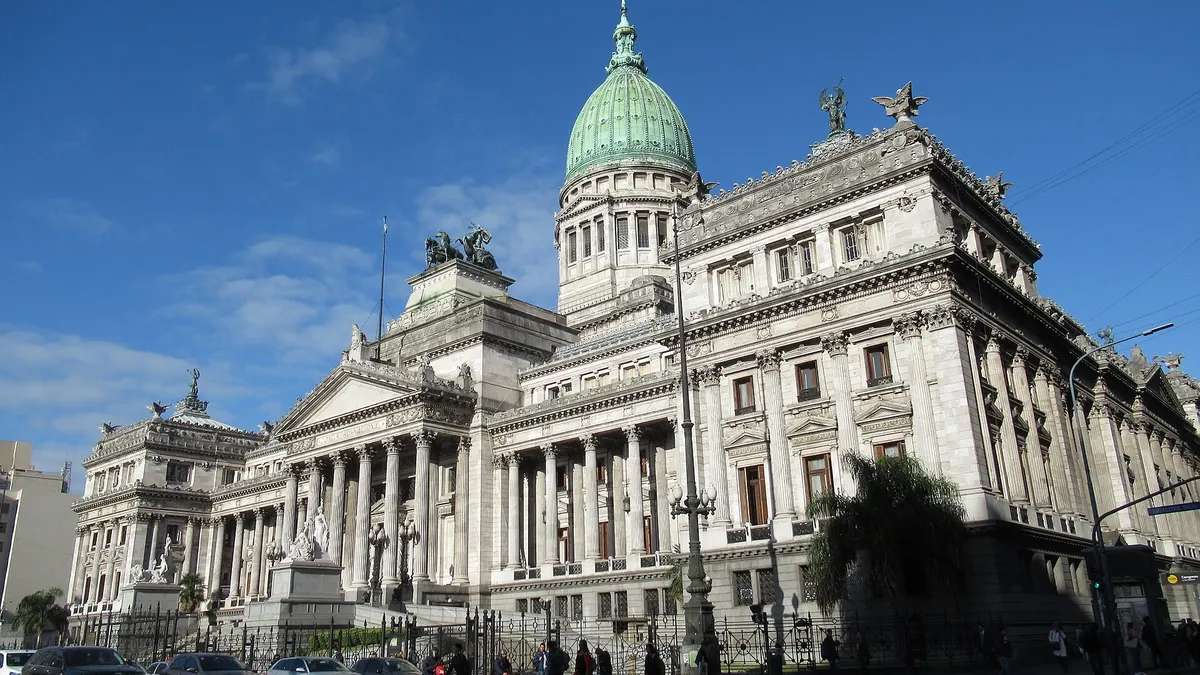
Argentina's Senate approved on Thursday, November 19, by 47 votes to 22, the country's accession to the Patent Cooperation Treaty (PCT), turning the bill into law, according to La Nación. The treaty had been sent to Congress in 1997 and went almost three decades without approval. Accession was one of the Javier Milei government's commitments under its trade and investment agreement with the United States, and it divides local and foreign drugmakers because of its effect on medicines.
With accession, Argentina stops being one of four Latin American countries outside the PCT, along with Bolivia, Paraguay and Venezuela, according to the list kept by the World Intellectual Property Organization (WIPO), which has 159 contracting states. This is what was voted on, what changes for anyone who wants to patent an invention in Argentina and why the patent treaty met resistance.
View the data as a table
| Senate votes in favor | 47 |
| Votes in favor in the lower house | 147 |
| Years in Congress | 29 |
| PCT member states | 159 |
How Congress voted on the patent treaty
The Chamber of Deputies approved the text on August 27 by 147 votes to 93, with one change: a reservation on Chapter II of the treaty, requested by local drugmakers. Because of that change the bill went back to the Senate, which had approved it in 1998, and it was passed there on November 19 accepting the lower house's version. In the Senate, La Libertad Avanza (21), the UCR (10), PRO (3), Convicción Federal (3) and provincial blocs voted in favor; the Justicialista bloc (19), Frente Cívico por Santiago (2) and Justicia Social Federal (1) voted against, according to DeQuéSeTrata.
View the data as a table
| seats | |
|---|---|
| La Libertad Avanza | 21 |
| UCR | 10 |
| PRO | 3 |
| Other blocs in favor | 13 |
| Justicialista (against) | 19 |
| Others against | 3 |
| Absent | 3 |
| Total | 72 |
| Chamber | Date | In favor | Against | Absent |
|---|---|---|---|---|
| Chamber of Deputies | August 27, 2026 | 147 | 93 | 16 |
| Senate | November 19, 2026 | 47 | 22 | 3 |
Source: DeQuéSeTrata and La Nación.
What the patent treaty changes for applicants
The PCT does not create an "international patent." It allows applicants to file a single international application that has effect in all treaty countries, instead of a separate filing in each country, and gives more time to decide in which markets to protect the invention before paying for translations and national fees, the World Intellectual Property Organization (WIPO) explains. Each national office still decides whether to grant the patent under its own law; in Argentina, that is the National Institute of Industrial Property (INPI).
| Topic | Without the PCT | With the PCT |
|---|---|---|
| Filing in several countries | One filing per country | One international application |
| Prior-art search | Each office does its own | International search report |
| Who grants the patent | INPI | INPI (no change) |
| International preliminary examination (Chapter II) | Not applicable | Argentina made a reservation: it does not apply it |
Source: World Intellectual Property Organization (WIPO) and DeQuéSeTrata. According to a minority report cited by DeQuéSeTrata, among the treaty's states only Uruguay had made the same Chapter II reservation, which governs a non-binding technical examination in which the applicant can respond to objections and amend the application.
In practice, the PCT procedure has two phases, according to WIPO's guide. These are the steps for an Argentine company, university or inventor once the treaty is in force:
- File an international application with the receiving office (in Argentina, it would be the INPI) or directly with WIPO.
- Receive an international search report and a written opinion on whether the invention appears new and inventive.
- The application is published internationally 18 months after the priority date.
- Up to 30 months from the priority date, decide which countries to enter in the national phase and pay fees and translations there.

Why the patent treaty divides drugmakers
The Argentine Pharmaceutical Laboratories Industrial Chamber (CILFA), which groups Argentine-owned drugmakers, warned that the regime "could make it easier to extend patents on existing medicines" through minor changes, which could delay generics and raise prices, according to La Nación. Even so, it supported the bill because the lower house accepted its request for a reservation. The Argentine Chamber of Medicinal Specialties (CAEMe), which groups foreign-owned drugmakers, welcomed that accession "makes it easier to file and initially process international patent applications" and noted that the decision remains with national offices.
| Actor | Position | Main argument |
|---|---|---|
| CILFA | Support with reservation | Risk of extending patents on existing medicines |
| CAEMe | In favor | Makes it easier to file international applications |
| Ruling party | In favor | Simplifies procedures for SMEs and startups (Francisco Paoltroni) |
| Justicialista bloc | Against | "Clearly imposed by the United States" (Jorge Capitanich) |
Source: La Nación.

Patents in Argentina: almost 9 in 10 applications are foreign
In 2024, 3,591 patent applications were filed in Argentina: 445 by residents and 3,146 by non-residents, meaning 87.6% came from foreign companies or inventors, according to the World Bank, with WIPO data. It is the Latin American country with the third-most applications, behind Brazil and Mexico, as shown in the ranking of patent applications in Latin America. Resident applications have ranged between 393 and 930 a year over the past decade.
View the data as a table
| Non-residents | Residents | |
|---|---|---|
| 2015 | 3,579 | 546 |
| 2016 | 2,925 | 884 |
| 2017 | 3,050 | 393 |
| 2018 | 3,242 | 425 |
| 2019 | 3,260 | 442 |
| 2020 | 2,562 | 930 |
| 2021 | 3,263 | 406 |
| 2022 | 3,132 | 444 |
| 2023 | 2,997 | 421 |
| 2024 | 3,146 | 445 |
View the data as a table
| Brazil | 48 years · 9-Apr-1978 |
| Mexico | 31 years · 1-Jan-1995 |
| Cuba | 30 years · 16-Jul-1996 |
| Costa Rica | 27 years · 3-Aug-1999 |
| Colombia | 25 years · 28-Feb-2001 |
| Ecuador | 25 years · 7-May-2001 |
| Nicaragua | 23 years · 6-Mar-2003 |
| Honduras | 20 years · 20-Jun-2006 |
| El Salvador | 20 years · 17-Aug-2006 |
| Guatemala | 20 years · 14-Oct-2006 |
| Dominican Republic | 19 years · 28-May-2007 |
| Chile | 17 years · 2-Jun-2009 |
| Peru | 17 years · 6-Jun-2009 |
| Panama | 14 years · 7-Sep-2012 |
| Uruguay | 1 years · 7-Jan-2025 |
| Country | In the PCT since | Patent applications 2024 | % non-residents |
|---|---|---|---|
| Brazil | 1978 | 25,597 | 77.5% |
| Mexico | 1995 | 16,189 | 92.8% |
| Argentina | Approved Nov 19, 2026 | 3,591 | 87.6% |
| Chile | 2009 | 3,219 | 87.9% |
| Colombia | 2001 | 1,931 | 86.0% |
| Peru | 2009 | 1,295 | 83.5% |
| Uruguay | 2025 | 414 | 96.9% |
Source: World Intellectual Property Organization (WIPO) (dates) and World Bank, with WIPO data (resident and non-resident applications, 2024).
When the patent treaty takes effect in Argentina
The law must be promulgated by the executive and published in the Official Gazette; as of November 24 it had not been published. The government must then deposit the instrument of accession with WIPO, and the treaty takes effect for the country three months after that deposit. That is what happened with Uruguay, the last country in the region to join: it deposited its accession on October 7, 2024, and was bound from January 7, 2025, according to the World Intellectual Property Organization (WIPO).
- 1970The PCT is signed in Washington
- 1997The executive sends the treaty to Congress
- 1998First approval in the Senate
- Feb 2026Trade deal with the United States includes accession
- Aug 27, 2026Lower house approves it with Chapter II reservation
- Nov 19, 2026Senate passes it: 47-22
- PendingPromulgation, deposit with WIPO and entry into force 3 months later
For more on Argentina's economy, see October inflation according to INDEC and Toyota's investment in Zárate.
Frequently asked questions
What is the PCT?
The Patent Cooperation Treaty, administered by WIPO, lets applicants seek protection for an invention in 159 countries with a single international application.
When did Argentina approve the patent treaty?
The Senate passed it on November 19, 2026, by 47 votes to 22, after the lower house approved it on August 27.
Does the PCT raise drug prices?
That is CILFA's concern, as it warns of patent extensions; CAEMe and the ruling party argue it is a procedural treaty that does not change the criteria for granting patents.
Which Latin American countries are not in the PCT?
Bolivia, Paraguay and Venezuela. Argentina will leave the list once it deposits its accession with WIPO and three months pass.