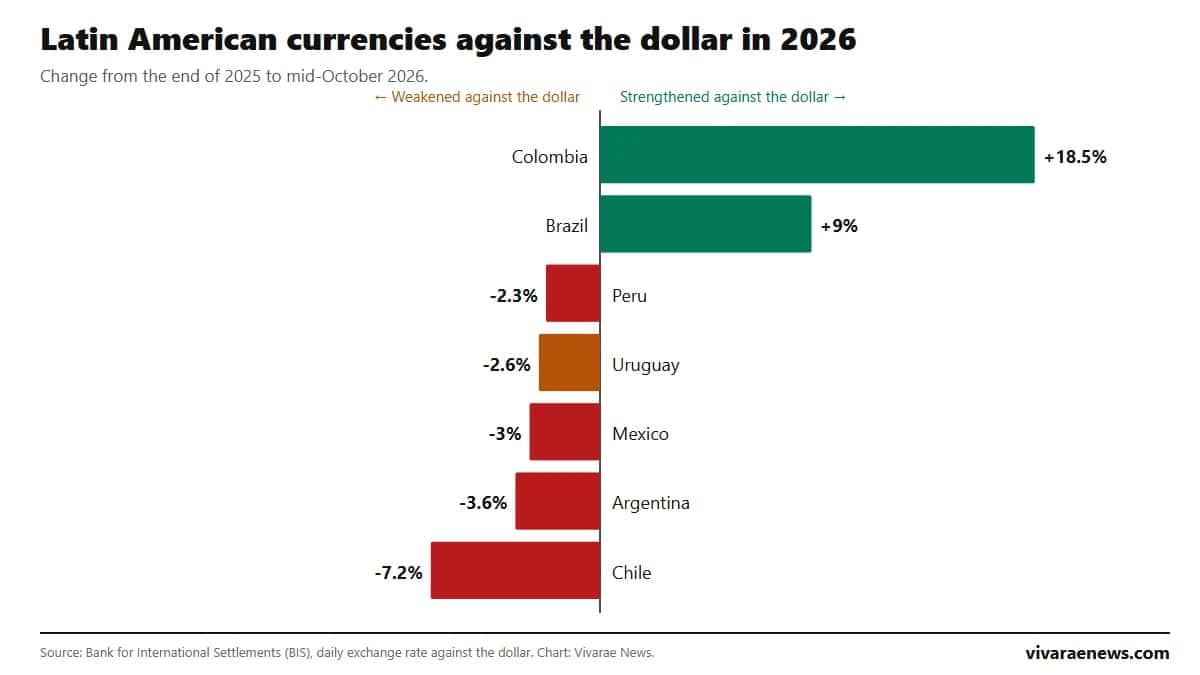
The Colombian peso is the Latin American currency that has strengthened the most against the dollar in 2026, up 18.5% since the end of 2025, and the Chilean peso the one that has weakened the most, down 7.2%, according to daily exchange rates from the [Bank for International Settlements](https://data.bis.org/topics/XRU) (BIS) through mid-October. The Brazilian real, up 9%, is the other currency in the group gaining ground this year.
The ranking compares seven currencies with daily BIS data and will be updated monthly on this same page. A currency's change shows how many more (or fewer) dollars the same amount of local currency buys today compared with the end of 2025.
The ranking of Latin American currencies in 2026
| Rank | Country and currency | Dollar at end of 2025 | Dollar in October 2026 | Currency change in 2026 |
|---|---|---|---|---|
| 1 | Colombia (peso) | 3,757.08 | 3,170.46 (Oct. 16) | +18.5% |
| 2 | Brazil (real) | 5.478 | 5.024 (Oct. 20) | +9.0% |
| 3 | Peru (sol) | 3.363 | 3.441 (Oct. 19) | −2.3% |
| 4 | Uruguay (peso) | 39.04 | 40.10 (Oct. 16) | −2.6% |
| 5 | Mexico (peso) | 17.97 | 18.52 (Oct. 20) | −3.0% |
| 6 | Argentina (peso, official) | 1,459.42 | 1,514.57 (Oct. 14) | −3.6% |
| 7 | Chile (peso) | 911.18 | 981.86 (Oct. 20) | −7.2% |
Source: BIS, daily exchange rates against the dollar (daily average), downloaded on October 24, 2026. Change is our own calculation. Each country's latest figure is on a different date, between October 14 and 20. Figures may differ slightly from each country's official exchange rate.
The Chilean peso, the weakest currency of the group in 2026
The dollar rose 7.8% in Chile this year according to the BIS, from 911 pesos at the end of 2025 to 982 on October 20. It kept rising afterwards: on Friday the 23rd it closed at 995 pesos on the interbank market, its highest since April 2025, and exchange houses were already selling above 1,000, according to Cooperativa. Our sister outlet La Tendencia analyzed why it worries Chile's Finance Ministry; the central bank's observed dollar had already hit its high for the year (see the observed dollar at 987 pesos).
Chile's case contrasts with 2025, when the peso strengthened 8.9% against the dollar. A pricier dollar passes through to the prices of imported goods and fuels (see the fuel price increase).

Latin American currencies over 12 months and in 2025
| Currency | Change in 2026 (to October) | 12-month change | Change in 2025 |
|---|---|---|---|
| Colombian peso | +18.5% | +20.1% | +17.4% |
| Brazilian real | +9.0% | +7.6% | +12.9% |
| Peruvian sol | −2.3% | −2.0% | +11.9% |
| Uruguayan peso | −2.6% | −0.8% | +12.9% |
| Mexican peso | −3.0% | −0.7% | +15.4% |
| Argentine peso (official) | −3.6% | −3.4% | −29.3% |
| Chilean peso | −7.2% | −2.2% | +8.9% |
Source: BIS. Our calculation. "12 months" compares with October 20, 2025. In 2025, six of the seven currencies strengthened against the dollar; the exception was the Argentine peso. In 2026, only the Colombian peso and the real keep that trend.
What it means for your pocket
A simple way to see the effect is to calculate how much local currency it takes to buy US$1,000, for example for a trip or an online purchase, at the end of 2025 and today:
| Country | US$1,000 at end of 2025 | US$1,000 in October 2026 | Difference |
|---|---|---|---|
| Chile | 911,180 pesos | 981,860 pesos | +70,680 pesos |
| Mexico | 17,973 pesos | 18,522 pesos | +549 pesos |
| Argentina (official) | 1,459,417 pesos | 1,514,566 pesos | +55,149 pesos |
| Peru | S/ 3,363 | S/ 3,441 | +S/ 78 |
| Uruguay | 39,041 pesos | 40,097 pesos | +1,056 pesos |
| Brazil | R$ 5,478 | R$ 5,024 | −R$ 454 |
| Colombia | 3,757,080 pesos | 3,170,460 pesos | −586,620 pesos |
Our calculation with the BIS rates in the main table. It excludes fees and exchange-house spreads; in Chile, exchange houses already sell dollars above 1,000 pesos. For a Colombian, traveling or importing is now cheaper than at the start of the year; for a Chilean, more expensive.
What the rising currencies have in common
Colombia and Brazil, the two strongest currencies, also have the region's highest interest rates: 12.25% and 13.75% (see the Latin American interest rate ranking). High rates tend to attract capital seeking higher returns in local currency, but the coincidence alone does not prove that is the cause: exchange rates also depend on commodity prices, fiscal conditions and each country's politics.
Argentina: official and parallel
The BIS figure for Argentina is the official exchange rate. In the parallel market, the "blue" dollar traded at 1,555 pesos and the official at 1,535 on October 19, according to our coverage (see the dollar today in Argentina). In Mexico, the peso has fallen for several weeks (see why the Mexican peso is falling).
How to cite this data
Vivarae News (2026). "Latin American currencies against the dollar in 2026". Updated October 24, 2026. Available at https://vivaraenews.com/en/latin-american-currencies-against-the-dollar-ranking-2026/. The data may be reproduced by citing Vivarae News and linking to this page; each country's figures belong to their original source.
Frequently asked questions
Which Latin American currency has strengthened the most in 2026?
The Colombian peso, up 18.5% against the dollar since the end of 2025, according to the BIS.
Which has weakened the most?
The Chilean peso, down 7.2% against the dollar this year, among the seven currencies in the ranking.
How much has the dollar risen in Chile in 2026?
7.8%, from 911 pesos at the end of 2025 to 982 on October 20, according to the BIS. On October 23 it closed at 995.
How is a currency's change calculated?
Divide the starting exchange rate by the current one and subtract one. If the dollar rises 7.8%, the local currency loses 7.2% of its dollar value.
How often is this ranking updated?
Every month, on this same page, with daily data from the Bank for International Settlements.