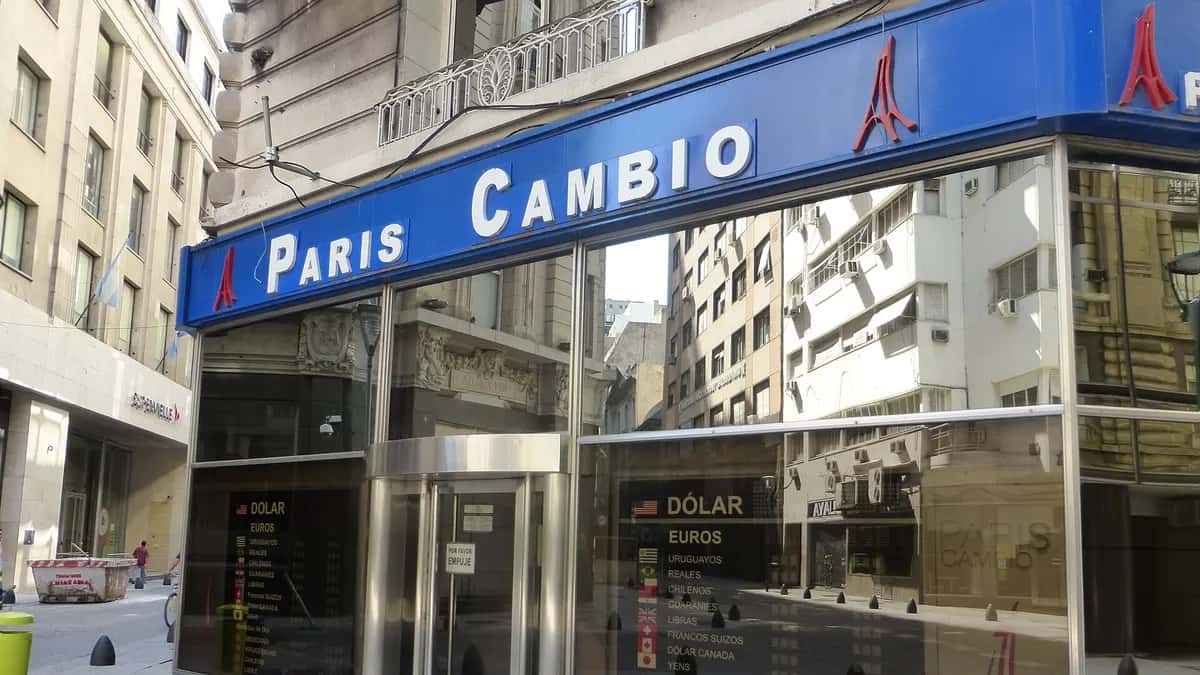
Argentina's official dollar opens the week at 1,535 pesos (selling) at Banco Nación and the informal "blue" dollar at 1,555 pesos, according to rates published by [Perfil](https://perfil.com/noticias/economia/a-cuanto-cotiza-el-dolar-blue-hoy-lunes-19-de-octubre-a50-bgd.phtml) early on Monday 19 October 2026. The gap between the official rate and the "contado con liquidación" rate is around 5%, amid an open debate within the government itself over whether the peso is too strong.
Economist Alberto Ades told the cabinet that the exchange rate is 29% below its average of the past 23 years, according to Infobae. The economic team rules out a devaluation. Here are all of today's rates and the key points of the debate.
Dollar exchange rates in Argentina today
| Dollar type | Buy | Sell |
|---|---|---|
| Official (Banco Nación) | 1,485.00 | 1,535.00 |
| Blue (informal) | 1,535 | 1,555 |
| MEP | 1,535.80 | 1,537.00 |
| Contado con liquidación (CCL) | 1,620.50 | 1,621.20 |
| Crypto | 1,620.38 | 1,622.12 |
| Card | — | 1,995.50 |
These are the opening values reported by Perfil at 7:00 on Monday, in Argentine pesos, and they change during the day. Banco Nación publishes the official retail rate and the Central Bank the wholesale rate. The card dollar includes the tax withholdings charged on purchases in foreign currency.
What each rate is for
- Official: the price at which banks sell dollars to individuals, with Banco Nación as the benchmark.
- Blue: the informal market dollar, traded in unauthorized exchange houses.
- MEP: obtained by buying and selling bonds in pesos and dollars within the country; it is legal.
- Contado con liquidación (CCL): similar to MEP, but the dollars land in an account abroad; used mainly by companies.
- Card: the official rate plus tax withholdings on purchases abroad.
With the blue, MEP and official rates less than 2% apart, the market signals calm: at other times the gap exceeded 100%.
Why people talk about an overvalued dollar rate in Argentina
President Javier Milei himself opened the debate by inviting Alberto Ades, former chief economist at Goldman Sachs, to address the cabinet. According to Infobae, Ades warned: "The exchange rate is 29% below the average of the past 23 years". He also said the current level "will have to be validated", and that the situation differs from 2017 because the country now has a trade surplus and a positive current account.
The economic team closed the door on devaluation. "Why would we need a higher dollar if this year we will have record exports?" is the argument they repeat, according to Infobae. Deputy Economy Minister José Luis Daza said nobody can know the equilibrium real exchange rate, "simply because it is impossible to know".
| Argument | Who makes it |
|---|---|
| The dollar is 29% below its 23-year average | Alberto Ades, to the cabinet |
| No need to devalue: exports will hit a record | Economic team |
| The equilibrium exchange rate cannot be known | José Luis Daza, deputy economy minister |
| Brazil's real strengthened from 6 to under 5 per dollar | Context cited by Infobae |
The dollar in Argentina and the real economy
The strong peso coexists with a cooling economy. Infobae describes a "technical recession" after two consecutive quarters of decline, while Chequeado notes that, on available official data, GDP fell 0.6% in the second quarter and a further fall in the third is possible but not confirmed. Inflation in the City of Buenos Aires was 1.8% in September; national inflation, measured by INDEC, is analyzed in our inflation series since 1998.
For year-end, BBVA Research projects an official dollar of 1,630 pesos, according to its October report. That would imply a rise of just over 6% from today's 1,535 (our calculation).
How many reserves the government has
The Central Bank has been buying dollars in the market. Infobae reported on 11 October that purchases totaled about US$15 billion and, on 17 October, that they exceeded US$17 billion so far in 2026. The figures differ because of each article's cut-off date. Even so, "net" reserves remain far below the US$29 billion in debt payments the Central Bank and the Treasury must make next year, according to Infobae.
Economy Minister Luis Caputo said the government can use the US$20 billion swap with the US Treasury "if it wants". It is one of four parts of the dollar "bazooka" that Milei put at US$75 billion on 27 September (later raised to US$125 billion): reserves, the US swap, the China swap and futures positions. Country risk remains above 600 points (see what country risk is).
What to watch this week
- The gap: with the official rate at 1,535 and the CCL at 1,621, the gap is 5.6% (our calculation). A small gap reduces the incentive to turn to the blue market.
- Central Bank purchases: the daily pace shows how much it can add to reserves before 2027 maturities.
- Activity data: INDEC's monthly activity estimator is key to confirming or ruling out a technical recession.
- US midterm elections (3 November): they may influence financial support from the US Treasury.
To see how the exchange rate hits household budgets, read the September basic basket and the minimum wage month by month.
Frequently asked questions
What is the blue dollar rate today?
On Monday 19 October 2026 it opened at 1,535 pesos (buy) and 1,555 pesos (sell), according to Perfil.
What is the official dollar rate today?
1,485 pesos (buy) and 1,535 pesos (sell) at Banco Nación at the opening on 19 October.
What does an overvalued exchange rate mean?
It means the exchange rate is below what is considered its equilibrium level, making imports cheaper and exports more expensive. Alberto Ades estimates the current rate is 29% below its 23-year average.
Will the government devalue?
The economic team rules it out and argues that exports will hit a record in 2026.