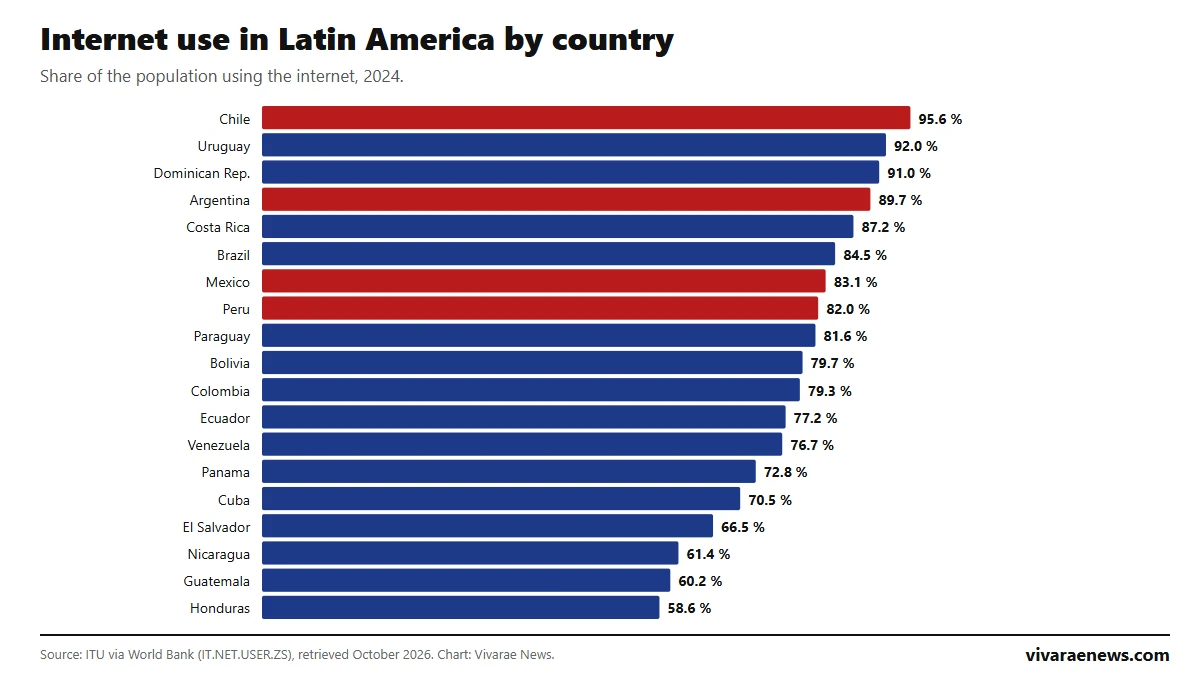
Chile is the Latin American country where the most people use the internet: 95.6% of the population in 2024, according to International Telecommunication Union (ITU) data published by the World Bank and retrieved in October 2026. It is followed by Uruguay (92.0%) and the Dominican Republic (91.0%). At the other end are Honduras (58.6%), Guatemala (60.2%) and Nicaragua (61.4%).
Using those percentages and each country's population, some 115 million people in the 19 countries of the ranking were still not using the internet in 2024 (our own calculation). The Latin America and Caribbean average reached 83.7% in 2025, above the world average (73.6%). This ranking will be updated on this same page when the World Bank and the ITU publish new data.
Ranking of internet use in Latin America
| Rank | Country | % of population using the internet (2024) | In 2015 | Change (points) |
|---|---|---|---|---|
| 1 | Chile | 95.6% | 76.6% | +19.0 |
| 2 | Uruguay | 92.0% | 64.6% | +27.4 |
| 3 | Dominican Republic | 91.0% | 54.2% | +36.8 |
| 4 | Argentina | 89.7% | 68.0% | +21.6 |
| 5 | Costa Rica | 87.2% | 59.8% | +27.4 |
| 6 | Brazil | 84.5% | 58.3% | +26.1 |
| 7 | Mexico | 83.1% | 57.4% | +25.7 |
| 8 | Peru | 82.0% | 40.9% | +41.1 |
| 9 | Paraguay | 81.6% | 49.7% | +31.9 |
| 10 | Bolivia | 79.7% | 37.5% | +42.2 |
| 11 | Colombia | 79.3% | 55.9% | +23.4 |
| 12 | Ecuador | 77.2% | 48.9% | +28.2 |
| 13 | Venezuela | 76.7% | 58.0% | +18.7 |
| 14 | Panama | 72.8% | 51.2% | +21.6 |
| 15 | Cuba | 70.5% | 37.3% | +33.2 |
| 16 | El Salvador | 66.5% | 26.8% | +39.7 |
| 17 | Nicaragua | 61.4% | 19.7% | +41.7 |
| 18 | Guatemala | 60.2% | 28.8% | +31.4 |
| 19 | Honduras | 58.6% | 27.1% | +31.5 |
Source: World Bank, indicator IT.NET.USER.ZS, with ITU data; change is our own calculation. The indicator counts people who used the internet in the last three months from any device, including mobile phones. Many national figures are ITU estimates and may differ from each country's own surveys.
How many people are still offline in the region
The percentage does not tell the whole story: in large countries, one point less means millions of people. Brazil and Mexico account for almost half of the people in the region who do not use the internet.
| Country | Population 2024 (million) | People not using the internet (million) |
|---|---|---|
| Brazil | 212.0 | 32.9 |
| Mexico | 130.9 | 22.1 |
| Colombia | 52.9 | 10.9 |
| Guatemala | 18.4 | 7.3 |
| Venezuela | 28.4 | 6.6 |
| Peru | 34.2 | 6.2 |
| Argentina | 45.7 | 4.7 |
| Honduras | 10.8 | 4.5 |
| Ecuador | 18.1 | 4.1 |
| Chile | 19.8 | 0.9 |
| Total, 19 countries | — | ≈115 |
Our own calculation using World Bank population and the share of internet users for 2024. It is an approximation: it includes young children and older people who choose not to go online. For each country's full population, see the Latin America population ranking.

Internet use in Latin America has grown fast since 2019
| Country | 2019 | 2020 | 2021 | 2022 | 2023 | 2024 |
|---|---|---|---|---|---|---|
| Chile | 85.0% | 87.5% | 90.2% | 92.3% | 94.5% | 95.6% |
| Argentina | 79.9% | 85.5% | 87.2% | 88.4% | 89.2% | 89.7% |
| Brazil | 73.9% | 81.3% | 80.7% | 80.5% | 84.2% | 84.5% |
| Mexico | 69.6% | 71.5% | 75.6% | 78.6% | 81.2% | 83.1% |
| Peru | 60.0% | 65.3% | 71.1% | 74.7% | 79.5% | 82.0% |
| Colombia | 65.0% | 69.8% | 73.0% | 72.8% | 77.3% | 79.3% |
Source: World Bank and ITU. The pandemic accelerated connectivity in 2020. Peru and Bolivia have risen the most since 2015 (more than 40 points). Venezuela shows a jump from 49.1% in 2019 to 72.4% in 2020 that probably reflects a change in estimation, so its series should be read with caution.
Fixed broadband: where the internet gap in Latin America lies
Using the internet does not mean having a fixed connection at home: a large part of the region goes online only with mobile data. Fixed broadband, measured as subscriptions per 100 inhabitants, shows sharper differences.
| Country | Fixed broadband subscriptions per 100 inhabitants (2024) |
|---|---|
| Uruguay | 33.0 |
| Argentina | 26.1 |
| Brazil | 24.1 |
| Chile | 23.7 |
| Costa Rica | 23.3 |
| Mexico | 21.7 |
| Colombia | 17.2 |
| Peru | 11.7 |
| Guatemala | 5.3 |
| Honduras | 4.6 |
| Cuba | 3.1 |
Source: World Bank, IT.NET.BBND.P2, with ITU data. The Latin America and Caribbean average is 20.5 per 100 inhabitants (2025). Since each subscription usually serves a whole household, a figure of 20 to 25 can mean most households are connected. Panama (18.1) and Paraguay (12.9) only have 2023 data.

Connection quality is another story: Chile, first in internet use, is also among the fastest countries in the world for fixed broadband, as detailed in the internet speed ranking for Chile. For mobile phone use in payments and shopping, see what NFC on your phone is.
The gap between the Southern Cone and Central America
The map of the ranking is clear. The four countries with the lowest internet use are Central American: Honduras, Guatemala, Nicaragua and El Salvador, all below 67%. By contrast, Chile, Uruguay and Argentina exceed 89%. The difference between the first and last country in the ranking is 37 percentage points.
That gap narrowed partly over the last decade: Nicaragua rose 41.7 points since 2015 and El Salvador 39.7, more than the regional average. But the pace slowed in some cases, such as Honduras, which went from 58.1% in 2023 to 58.6% in 2024. The relationship with each country's income can be reviewed in the ranking of GDP per capita in Latin America and in the inequality ranking by country.
What this ranking measures and what it does not
- It measures: the share of people who used the internet at least once in the last three months, from any place and device.
- It does not measure: connection speed or quality, or how much time each person spends online.
- Origin of the figures: each country's household surveys where they exist and, otherwise, ITU estimates. That is why a sharp jump from one year to the next may be due to a change in method.
How to cite this data
Vivarae News (2026). "Internet use in Latin America 2026: ranking by country according to the World Bank and the ITU". Updated on October 30, 2026. Available at https://vivaraenews.com/en/internet-use-in-latin-america-ranking-by-country-2026/. The data may be reproduced by citing Vivarae News and linking to this page; each country's figures belong to the ITU and the World Bank.
Frequently asked questions
Which Latin American country has the most internet users?
Proportionally, Chile: 95.6% of the population used the internet in 2024. In number of people, Brazil, with about 179 million users.
Which Latin American country has the least internet access?
Honduras, with 58.6% of the population, followed by Guatemala (60.2%) and Nicaragua (61.4%).
How many people use the internet in Mexico?
83.1% of the population in 2024, according to the ITU and the World Bank. About 22 million Mexicans were still not using it.
What share of Latin America uses the internet?
83.7% in 2025, compared with 73.6% worldwide, according to the World Bank.
Which country has the most fixed broadband in Latin America?
Uruguay, with 33.0 subscriptions per 100 inhabitants in 2024.