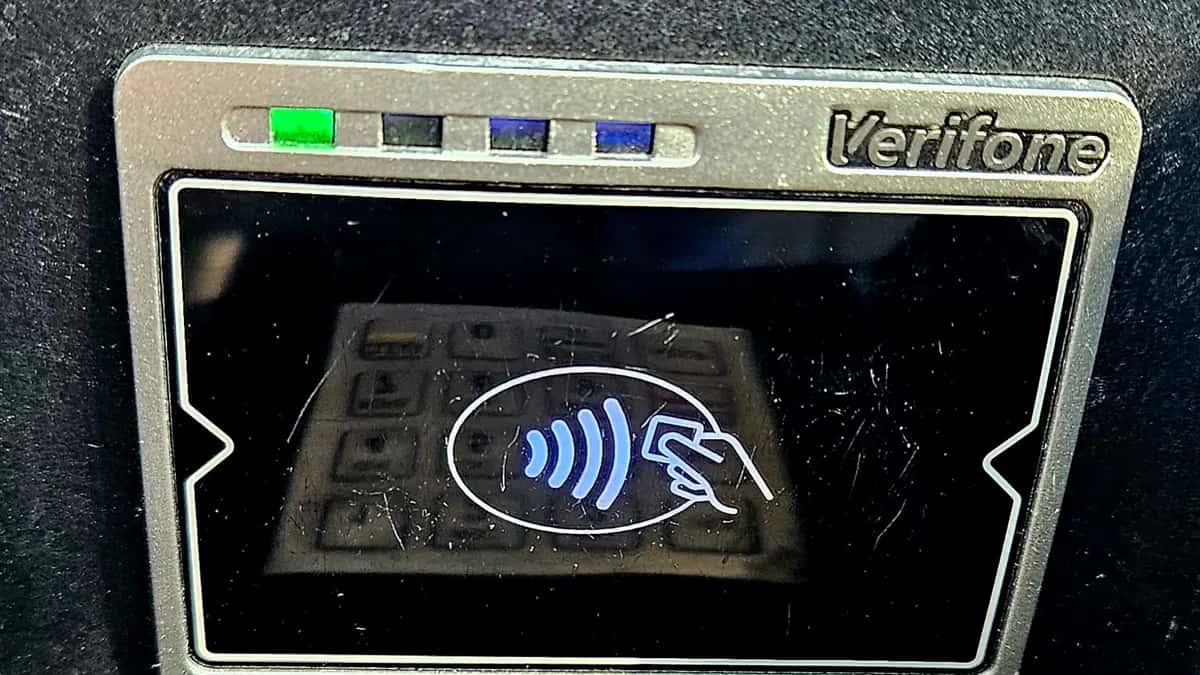
NFC is a very short-range wireless technology that lets two devices exchange data when they are brought within a couple of centimetres of each other. It is what makes it possible to pay by holding your phone to a reader, and also to activate a top-up on a transit card from the phone. The letters stand for Near Field Communication.
What NFC is, in plain terms
It is a small antenna inside the phone that communicates with another antenna when they are almost touching. According to the NFC Forum's technical overview, the organisation that defines the standard, it works at a frequency of 13.56 MHz and has a typical range of up to 2 centimetres. That very short distance is not a flaw: it is what makes it useful for paying, because nothing is transmitted unless you deliberately bring the phone close.
| Feature | NFC |
|---|---|
| Meaning | Near Field Communication |
| Frequency | 13.56 MHz |
| Typical range | Up to 2 centimetres |
| Prior pairing | Not required |
| Main uses | Payments, transport, tags, digital keys |
What NFC is for on a phone
- Paying with the phone. With a wallet such as Google Wallet or Apple Pay, the phone replaces the card at any contactless reader.
- Public transport. In Santiago, Chile, it is used to activate on the bip! card a top-up made online.
- Reading NFC tags. These are battery-free stickers or chips that, when touched with the phone, open a link, share the wifi or trigger an action.
- Connecting accessories. Some headphones and speakers pair with a tap.
- Keys and credentials. Opening doors, entering offices or using the digital key of a compatible car.
The three modes it works in
| Mode | What the phone does | Example |
|---|---|---|
| Card emulation | Behaves like a contactless card | Paying at a till |
| Reader and writer | Reads or writes a tag or a card | Activating a transit card top-up |
| Peer to peer | Two devices exchange data when they touch | Pairing an accessory |
How a bip! card top-up is activated with NFC
When you top up Santiago's bip! card online, the balance does not appear on its own: it has to be activated. With an Android phone with NFC this can be done from the Red app, as Meganoticias explains: you go to Centro Bip!, choose "Activa tu carga" and hold the card against the back of the phone. If the phone has no NFC, the top-up is activated at a kiosk in Metro stations.
How to tell if your phone has NFC
- On Android: open Settings and type "NFC" in the search box. If the option appears, the phone has it; you can turn it on or off right there. It is usually in the quick settings panel too.
- On iPhone: every model since the iPhone 6 has NFC. There is no switch: it turns on by itself when you use Apple Pay or read a tag.
- If it does not appear: the model does not include it. That is common on entry-level phones, and it cannot be added later.
NFC, Bluetooth and wifi: how they differ
| Technology | Range | What it is used for |
|---|---|---|
| NFC | A couple of centimetres | Brief exchanges that require bringing the device close: payments, access |
| Bluetooth | Several metres | Continuous connections with accessories: headphones, watches, speakers |
| Wifi | A house or office | Internet access and local networks |
They do not compete: they complement each other. NFC moves very little data, but it needs no pairing and no network search. That is why it is sometimes used only to start a connection that then continues over Bluetooth.
Is it safe to pay with NFC?
It has two protections by design. The first is distance: at 2 centimetres it is very hard for anyone to pick up the signal without you noticing. The second lies in digital wallets: to pay they ask you to unlock the phone with a fingerprint, face or passcode, and they do not give the merchant the real card number but a substitute code. If you lose the phone, you can also lock it remotely.
Is it worth turning off? If you do not use it, there is no harm in disabling it, but battery use is minimal because the antenna only works when it detects another device very close by.
More explainers: what is a prompt and what is a podcast. And if you want a better connection, where internet speed stands in Chile.
Frequently asked questions
What does NFC stand for?
Near Field Communication: a wireless connection between devices that are a couple of centimetres apart.
What is NFC for on a phone?
Above all, paying with the phone. Also topping up transit cards, reading tags, pairing accessories and using digital keys.
Does NFC drain the battery?
Very little: the antenna only works when another NFC device is centimetres away.
Can NFC be added to a phone that does not have it?
No. It is an antenna fitted at the factory; if the model does not have it, it cannot be added.