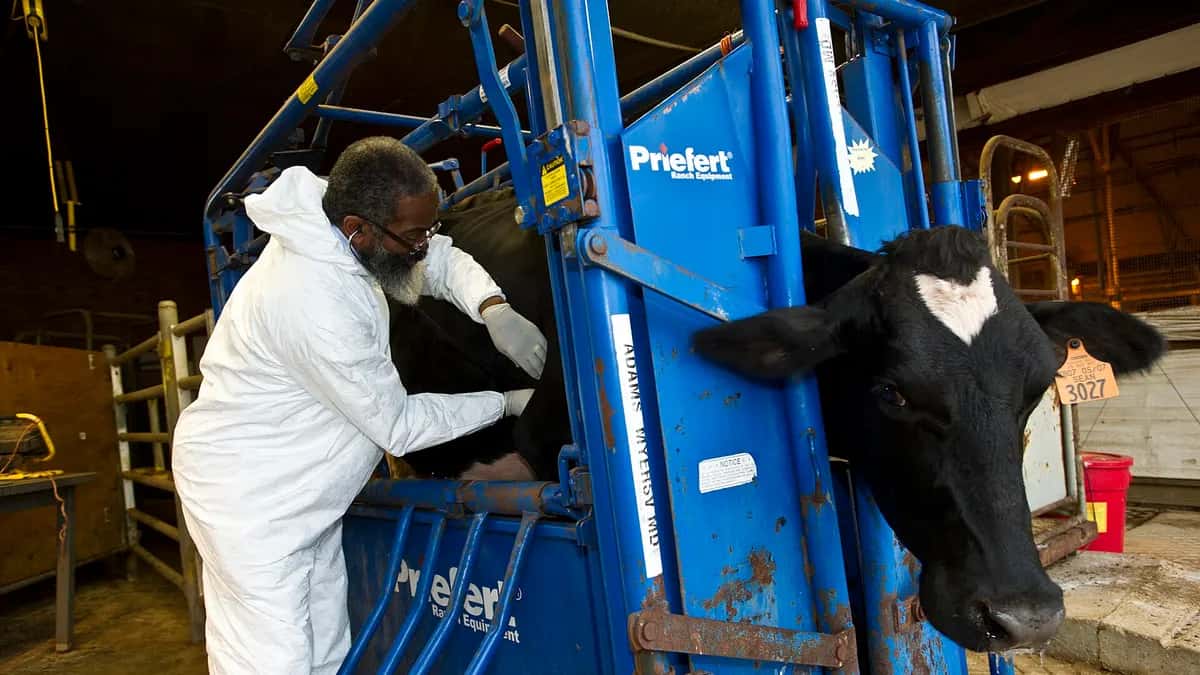
A veterinarian in Chile earns on average between 1.1 million and 1.6 million pesos gross a month in the fourth year after graduating, depending on the university, according to the Mi Futuro employability and income search tool, run by the Undersecretariat of Higher Education. The highest income goes to University of Chile graduates, with 1.5 to 1.6 million, followed by those from the Catholic University of Temuco, with 1.4 to 1.5 million.
Veterinary Medicine is one of the long health-related degrees with the lowest starting income: its top band sits below the bottom band of Dentistry. This guide shows how much a veterinarian earns in Chile by university, the degree's employability, how it compares with other professions and what moves pay after the first few years.
How much does a veterinarian earn in Chile by university
| University | Gross monthly income in year 4 (pesos) | Employability in year 1 | Employability in year 2 |
|---|---|---|---|
| University of Chile | 1.5 to 1.6 million | 74.7% | 77.1% |
| Catholic University of Temuco | 1.4 to 1.5 million | 73.2% | 69.3% |
| Austral University of Chile | 1.3 to 1.4 million | 77.5% | 77.6% |
| University of Concepción | 1.3 to 1.4 million | 67.3% | 73.2% |
| Mayor University | 1.3 to 1.4 million | 64.9% | 74.2% |
| Andrés Bello University | 1.2 to 1.3 million | 62.6% | 77.1% |
| University of the Americas | 1.2 to 1.3 million | 63.2% | 77.3% |
| Santo Tomás University | 1.2 to 1.3 million | 63.1% | 73.4% |
| University of Viña del Mar | 1.1 to 1.2 million | 44.0% | 67.3% |
| Del Alba and San Sebastián universities | No information | 73.8% and 57.6% | 70.9% and 76.3% |
Source: Mi Futuro, Veterinary Medicine, checked on November 2, 2026. Of 11 programs listed, 9 have income data; Del Alba and San Sebastián show "no information" because they lack the minimum number of cases. According to the methodology, the figure is the average gross monthly income of 2018, 2019 and 2020 graduates in their fourth year, calculated from SII tax data, in September 2025 pesos.
The gap between the best- and worst-paid university is small: about 400,000 pesos a month between the University of Chile and the University of Viña del Mar. Three of the nine schools with data sit in the 1.3 to 1.4 million band and another three in the 1.2 to 1.3 million band. None reaches 2 million in year four.

Employability of veterinarians in Chile
| Indicator | Range across universities | Simple average |
|---|---|---|
| Employability in year 1 | 44.0% (Viña del Mar) to 77.5% (Austral) | 65.6% |
| Employability in year 2 | 67.3% (Viña del Mar) to 77.6% (Austral) | 74.0% |
| Actual length of the degree | 11.7 (Andrés Bello) to 18.4 semesters (Concepción) | 15.0 semesters |
| First-year retention | 77.4% (Del Alba) to 93.9% (Mayor) | 88.0% |
Source: Mi Futuro; averages are our own calculation across the 11 programs. "Employability" is the share of graduates earning above the minimum wage according to SII data. Only two in three veterinarians achieving that in year one is one of the lowest figures among health degrees: in Nursing the average is 79.3%. In practice the degree takes about 15 semesters, or seven and a half years.
How much does a veterinarian earn compared with other degrees
| Degree | Gross income in year 4 (Mi Futuro, pesos) | Programs with data |
|---|---|---|
| Medicine | 3 million to over 3.5 million | 21 of 22 |
| Dentistry | 1.5 to 2.4 million | 17 of 20 |
| Nursing | 1.5 to 2.2 million | 39 of 43 |
| Agronomy | 1.1 to 2 million | 9 of 12 |
| Veterinary Medicine | 1.1 to 1.6 million | 9 of 11 |
| Veterinary technician | 700,000 to 800,000 | 3 of 5 |
Source: Mi Futuro, checked on November 2, 2026. The ceiling for Veterinary Medicine is below that of Agronomy, the closest degree in its farm-sector profile, and well below the human health degrees. More in how much a dentist earns in Chile, how much a nurse earns and how much a doctor earns.
Pay for a veterinarian with years of experience
Mi Futuro only measures year four. For a career-wide reference, the WageIndicator foundation publishes 2026 pay ranges for veterinarians in Chile, built from its salary survey and other sources. It is not an official record, but it shows the trend over time:
| Stage (WageIndicator, 2026) | Net monthly salary (pesos) | Hours |
|---|---|---|
| Starting in the job | 909,698 to 1,771,974 | 42 hours |
| After five years of service | 1,155,642 to 2,315,438 | 42 hours |
| Full range for the occupation | 909,698 to 3,030,733 | — |
Source: WageIndicator, veterinarians in Chile, checked on November 2, 2026. These are estimated net amounts, so they are not directly comparable with Mi Futuro's gross figures. For reference, the monthly minimum wage has been 553,553 pesos since May 1, 2026, as detailed in the history of Chile's minimum wage.
What makes a veterinarian's salary in Chile vary
- Field of work: pet clinics employ many young graduates; livestock production, the salmon industry and sanitary inspection have other pay scales.
- The public sector: the Agriculture and Livestock Service (SAG) and other agencies hire veterinarians by public pay grade, with salaries that depend on the post and the region.
- Specialization: postgraduate training in surgery, imaging, exotic-animal medicine or public health usually opens better-paid posts.
- Running a clinic: owners bear rent, equipment and supplies, but keep the margin.
To compare with other university professions, see how much a business engineer earns and how much a computer engineer earns.
Frequently asked questions
How much does a veterinarian earn in Chile a month?
In the fourth year after graduating, a veterinarian earns on average between 1.1 and 1.6 million pesos gross a month, depending on the university, according to Mi Futuro.
Which university has the best-paid veterinarians?
University of Chile graduates, with 1.5 to 1.6 million in year four, followed by those from the Catholic University of Temuco, with 1.4 to 1.5 million.
How much does a veterinary technician earn?
Between 700,000 and 800,000 pesos gross a month in the fourth year after graduating, according to the three programs with data in Mi Futuro.
Is it hard to find work as a veterinarian?
Employability in year one averages 65.6% across universities, ranging from 44.0% to 77.5%, and rises to 74.0% in year two, according to Mi Futuro.