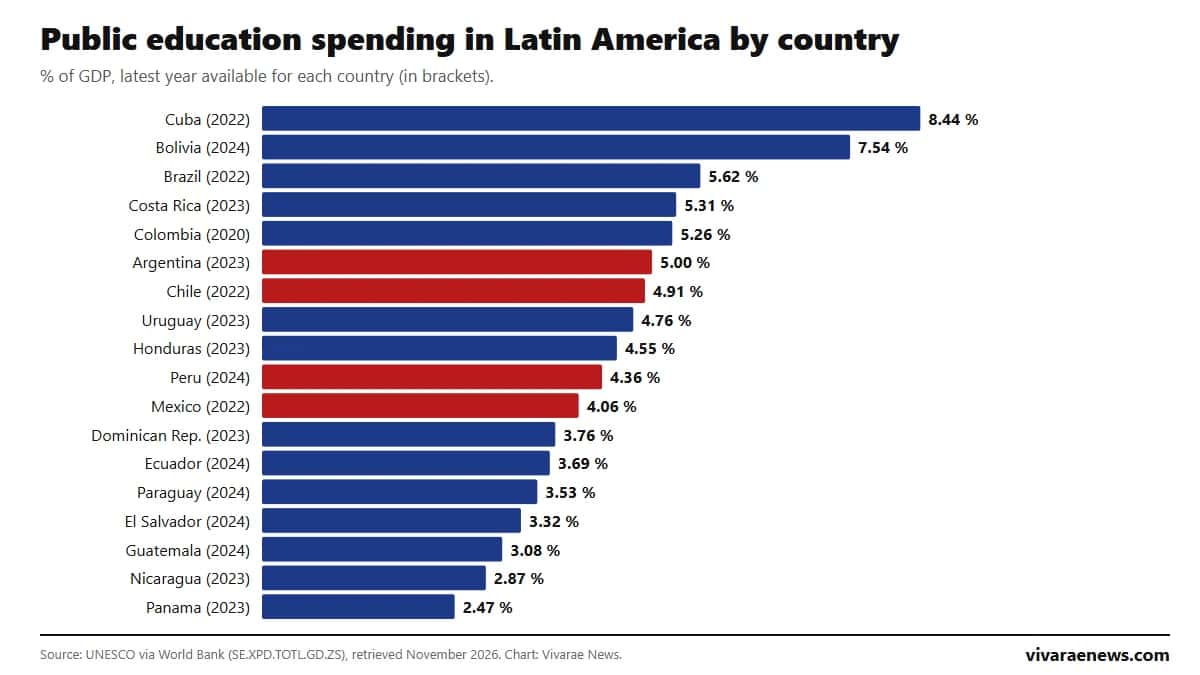
Cuba is the Latin American country that spends most on public education: 8.44% of its GDP, followed by Bolivia (7.54%) and Brazil (5.62%). Panama, at 2.47%, ranks last. These are the latest UNESCO figures published by the World Bank (indicator SE.XPD.TOTL.GD.ZS), retrieved on November 2, 2026. Chile spends 4.91% of GDP, Argentina 5.00%, Peru 4.36% and Mexico 4.06%.
The Latin America and Caribbean average is 3.82% of GDP in 2023, above the world average (3.57%) and below the OECD's (5.06% in 2022). Eleven of the 18 countries with data reach the 4% of GDP floor recommended by UNESCO's Education 2030 Framework for Action.
Ranking of education spending in Latin America by country
| Rank | Country | Education spending (% of GDP) | Data year | In 2015 |
|---|---|---|---|---|
| 1 | Cuba | 8.44% | 2022 | 8.96% |
| 2 | Bolivia | 7.54% | 2024 | 8.14% |
| 3 | Brazil | 5.62% | 2022 | 6.24% |
| 4 | Costa Rica | 5.31% | 2023 | 6.87% |
| 5 | Colombia | 5.26% | 2020 | 4.47% |
| 6 | Argentina | 5.00% | 2023 | 5.78% |
| 7 | Chile | 4.91% | 2022 | 4.90% |
| 8 | Uruguay | 4.76% | 2023 | 4.21% |
| 9 | Honduras | 4.55% | 2023 | 6.41% |
| 10 | Peru | 4.36% | 2024 | 3.97% |
| 11 | Mexico | 4.06% | 2022 | 5.05% |
| 12 | Dominican Republic | 3.76% | 2023 | 3.60% |
| 13 | Ecuador | 3.69% | 2024 | 5.11% |
| 14 | Paraguay | 3.53% | 2024 | 3.33% |
| 15 | El Salvador | 3.32% | 2024 | 3.91% |
| 16 | Guatemala | 3.08% | 2024 | 3.03% |
| 17 | Nicaragua | 2.87% | 2023 | 4.08% |
| 18 | Panama | 2.47% | 2023 | 3.27% |
Source: World Bank with data from the UNESCO Institute for Statistics, retrieved November 2, 2026. It is general government spending on all levels of education (current and capital), including transfers. Each country appears with its latest available year, so the comparison is approximate. Venezuela is left out: its latest figure is from 2009 (6.87%).
The 4% to 6% of GDP benchmark: who meets it
The Education 2030 Framework for Action, adopted in Incheon in 2015, recommends that countries spend 4% to 6% of GDP on education or 15% to 20% of total public expenditure. With the latest data, 11 of the 18 Latin American countries reach the 4% of GDP floor and only Cuba and Bolivia exceed the 6% ceiling.
| Group | Countries | How many |
|---|---|---|
| Above 6% of GDP | Cuba, Bolivia | 2 |
| Between 4% and 6% of GDP | Brazil, Costa Rica, Colombia, Argentina, Chile, Uruguay, Honduras, Peru, Mexico | 9 |
| Below 4% of GDP | Dominican Republic, Ecuador, Paraguay, El Salvador, Guatemala, Nicaragua, Panama | 7 |
Source: Vivarae with World Bank data. The "below 4%" group includes Central American countries with high informality and low tax revenue, which limits the size of the public budget.
Education spending as a share of the public budget
UNESCO's other indicator measures what share of total government spending goes to education. There the order changes: countries with small states, such as the Dominican Republic or Guatemala, devote a large portion of their budget even though, measured against GDP, they spend little.
| Country | Education, % of public spending | Year |
|---|---|---|
| Honduras | 23.16% | 2018 |
| Dominican Republic | 20.87% | 2025 |
| Costa Rica | 20.38% | 2023 |
| Bolivia | 20.16% | 2024 |
| Peru | 19.21% | 2024 |
| Chile | 18.38% | 2022 |
| Guatemala | 17.27% | 2025 |
| Panama | 16.28% | 2024 |
| Mexico | 14.24% | 2022 |
| Argentina | 13.22% | 2023 |
| Brazil | 12.93% | 2022 |
| Paraguay | 11.65% | 2025 |
Source: World Bank, indicator SE.XPD.TOTL.GB.ZS (UNESCO). Selected countries; the Latin America and Caribbean average is 16.56% (2024), versus 13.96% worldwide. In Argentina the figure is low because provinces carry much of education spending and the indicator may not fully capture it.
Chile, Argentina, Peru and Mexico in education spending
- Chile (4.91% of GDP, 2022): at the same level as in 2015 (4.90%), after a peak of 5.63% in 2019 and 2020. Education is 18.38% of public spending. For teachers' pay, see how much a teacher earns in Chile.
- Argentina (5.00%, 2023): below the 5.78% of 2015. Education Financing Law 26,075 of 2005 set a target of 6% of GDP for 2010, which the country does not sustain in UNESCO data.
- Peru (4.36%, 2024): one of the few rising steadily: 3.97% in 2015 and 4.36% in the latest figure. Teachers' salaries are in how much a teacher earns in Peru.
- Mexico (4.06%, 2022): down from 5.05% in 2015 and close to the 4% floor. Salary details in how much a teacher earns in Mexico.
How to read this ranking
Higher spending as a share of GDP does not mean more money per student: a country with a small GDP and many children can spend a high percentage and still invest little per pupil. Nor does it measure outcomes. To compare with each economy's capacity, see GDP per capita in Latin America, and to see how education competes with other state items, military spending by country and public debt. Vivarae will update this ranking at the same address when UNESCO publishes new data.
How to cite this data
Vivarae News (2026). "Education spending in Latin America 2026: ranking by country". Updated November 2, 2026. Available at https://vivaraenews.com/en/education-spending-in-latin-america-ranking-by-country-2026/. The data may be reproduced citing Vivarae News and linking to this page; each country's figures belong to UNESCO and the World Bank.
Frequently asked questions
Which Latin American country spends most on education?
Cuba, at 8.44% of GDP (2022), followed by Bolivia (7.54%, 2024) and Brazil (5.62%, 2022), according to UNESCO and the World Bank.
Which Latin American country spends least on education?
Panama, at 2.47% of GDP in 2023, followed by Nicaragua (2.87%) and Guatemala (3.08%).
How much does Chile spend on education?
4.91% of GDP in 2022, UNESCO's latest figure, and 18.38% of public spending. It ranks seventh among 18 countries.
What is the Latin American average?
3.82% of GDP in 2023, versus 3.57% worldwide and 5.06% in the OECD (2022).
How much does UNESCO recommend investing in education?
Between 4% and 6% of GDP, or between 15% and 20% of public spending, according to the Education 2030 Framework for Action.