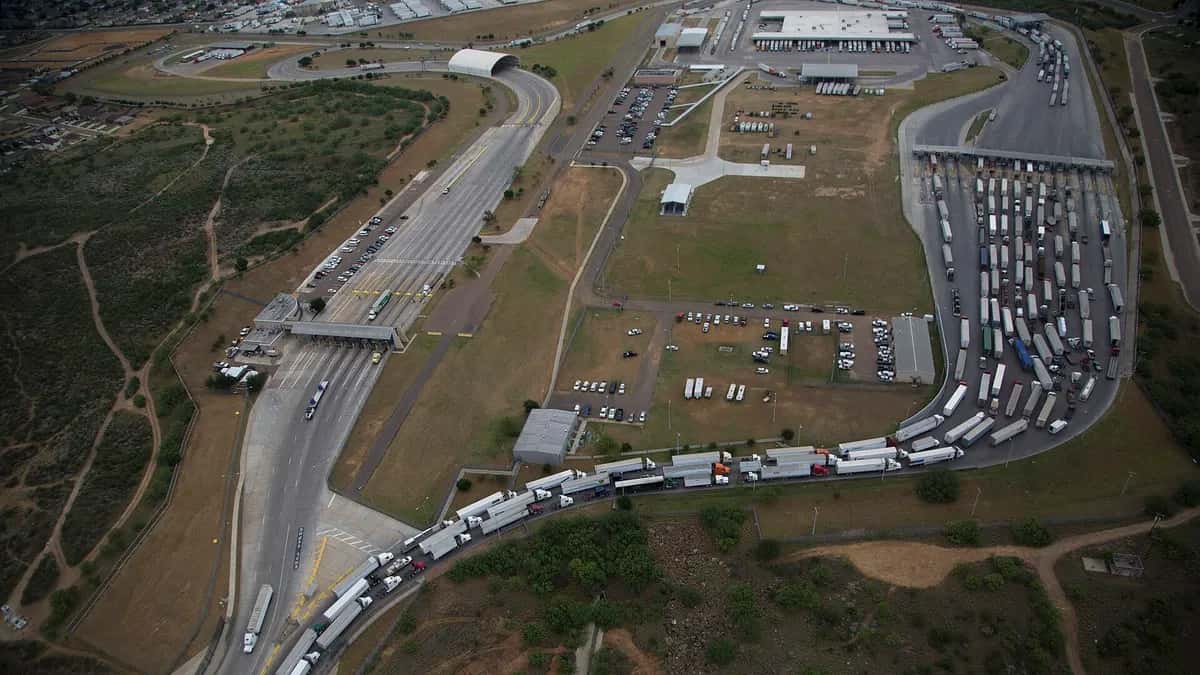
U.S. President Donald Trump threatened on Thursday, November 12, to "immediately" double tariffs on Mexico unless the country stops the migrant caravans heading north, according to Telemundo. "Mexico must stop them now," he wrote on Truth Social, adding that the warning had already been conveyed to the Mexican government. He did not specify which tariffs would be doubled or how.
President Claudia Sheinbaum replied at her morning press conference that since Trump returned to office in January 2025, "no migrant caravan has reached the northern border." The threat comes in the middle of negotiations to lower the tariffs Washington already charges on Mexican products. This is what Mexico pays today, how much it trades with the United States and what is at stake with the threat to double tariffs.
View the data as a table
| What Mexico sold to the US | US$ 534,315 M |
| What the US sold to Mexico | US$ 337,282 M |
| US deficit with Mexico | US$ 197,033 M |
| Mexican exports entering tariff-free | 82% |
What Trump said and how Sheinbaum responded
Trump's message targeted the caravans forming in southern Mexico. According to Telemundo, the first one left Arriaga, Chiapas, with 500 to 600 people and now has fewer than 100; a second one, formed in Honduras, has about 2,000 migrants, mostly Central Americans, according to the EFE news agency in Tapachula. Sheinbaum said most give up once it is explained that they will not be able to cross into the United States, and that the government offers safe return to their countries or conditional stays in Mexico.
According to El Financiero, the president said the caravan "will be deactivated" without the use of force. At the same press conference she announced that she will meet Chinese President Xi Jinping at the APEC summit on November 17-19.

What tariffs Mexico pays in the United States today
Most trade remains duty-free thanks to the agreement between Mexico, the United States and Canada (USMCA). Economy Secretary Marcelo Ebrard told the Chamber of Deputies in October that 82% to 85% of Mexican exports currently enter without paying tariffs, according to El Universal. The tariffs in force are concentrated in sectors Washington justified on national security grounds:
| Product | Tariff in force | What Mexico is asking for |
|---|---|---|
| Cars | 25% | Lower it to 15%, regardless of regional content |
| Steel (including derivatives) | 50% | Reduce it; Mexico submitted technical evidence |
| Aluminum (including derivatives) | 50% | Reduce it |
| USMCA-compliant products | 0% | Keep it |
Source: El Universal, with Ebrard's statements of October 16, 2026. Ebrard proposed lowering the auto tariff from 25% to 15%, like the rate South Korea obtained, and the government expects a deal before year-end, according to Telemundo. If Trump doubled the tariffs in force, cars would pay 50% and steel and aluminum 100%, although the White House has not said that would be the formula. To understand the mechanism, see what a tariff is.
How much Mexico sells to the United States
Mexico sold the United States US$534,315 million in goods in 2025 and bought US$337,282 million, bringing the US trade deficit with Mexico to US$197,033 million, the highest in the series, according to the U.S. Census Bureau, trade in goods with Mexico. Between January and September 2026, Mexican sales total US$481,586 million. Since 1994, when the first free trade agreement took effect, Mexican exports to the United States have multiplied by 10.8:
View the data as a table
| Mexico's sales to the US | US sales to Mexico | |
|---|---|---|
| 1994 | 49 | 51 |
| 2000 | 136 | 111 |
| 2005 | 170 | 120 |
| 2010 | 230 | 164 |
| 2015 | 296 | 236 |
| 2019 | 356 | 257 |
| 2020 | 323 | 213 |
| 2021 | 383 | 277 |
| 2022 | 452 | 327 |
| 2023 | 473 | 324 |
| 2024 | 503 | 334 |
| 2025 | 534 | 337 |
| Year | Mexico to US (US$ M) | US to Mexico (US$ M) | US balance (US$ M) |
|---|---|---|---|
| 1994 | 49,494 | 50,844 | 1,350 |
| 2000 | 135,926 | 111,349 | -24,577 |
| 2005 | 170,109 | 120,248 | -49,861 |
| 2010 | 229,986 | 163,665 | -66,321 |
| 2015 | 296,433 | 236,460 | -59,973 |
| 2019 | 356,094 | 256,677 | -99,417 |
| 2020 | 323,477 | 212,513 | -110,964 |
| 2021 | 382,569 | 277,195 | -105,375 |
| 2022 | 452,015 | 327,016 | -124,999 |
| 2023 | 472,899 | 324,426 | -148,473 |
| 2024 | 503,110 | 334,492 | -168,618 |
| 2025 | 534,315 | 337,282 | -197,033 |
| 2026 (Jan-Sep) | 481,586 | 297,567 | -184,019 |
Source: U.S. Census Bureau, trade in goods with Mexico; millions of current dollars, customs basis. The United States is the destination of the vast majority of Mexican exports. To see how much each country in the region depends on the US market, see the ranking of exports to the United States in Latin America.
Tariff threats against Mexico in 2025 and 2026
This is not the first time Trump has linked tariffs to migration. The difference now is the timing: Mexico wants to close relief for cars and steel before year-end, and the USMCA review remains open. A tariff hike would make Mexican products more expensive in the United States and could pressure the exchange rate and prices; inflation in Mexico already rose to 3.75% in October.
- Jan 2025Trump returns to the White HouseSince then no caravan has reached the border, according to Sheinbaum.
- Oct 16, 2026Ebrard asks to cut the auto tariff to 15%
- Nov 12, 2026Trump threatens to double tariffs
- Nov 12, 2026Sheinbaum: the caravan will be deactivated
- Nov 17-19, 2026APEC summitSheinbaum will meet Xi Jinping.
This article will be updated if Washington carries out the increase or if a tariff deal is reached. For other data on the Mexican economy, see Mexico's minimum wage.
Frequently asked questions
Why is Trump threatening to double tariffs on Mexico?
To pressure Mexico to stop migrant caravans heading north, according to his November 12, 2026 post on Truth Social.
What tariffs does Mexico pay today?
25% on cars and 50% on steel and aluminum, according to Ebrard; 82% to 85% of exports enter duty-free under the USMCA.
How much does Mexico sell to the United States?
US$534,315 million in goods in 2025, according to the U.S. Census Bureau.