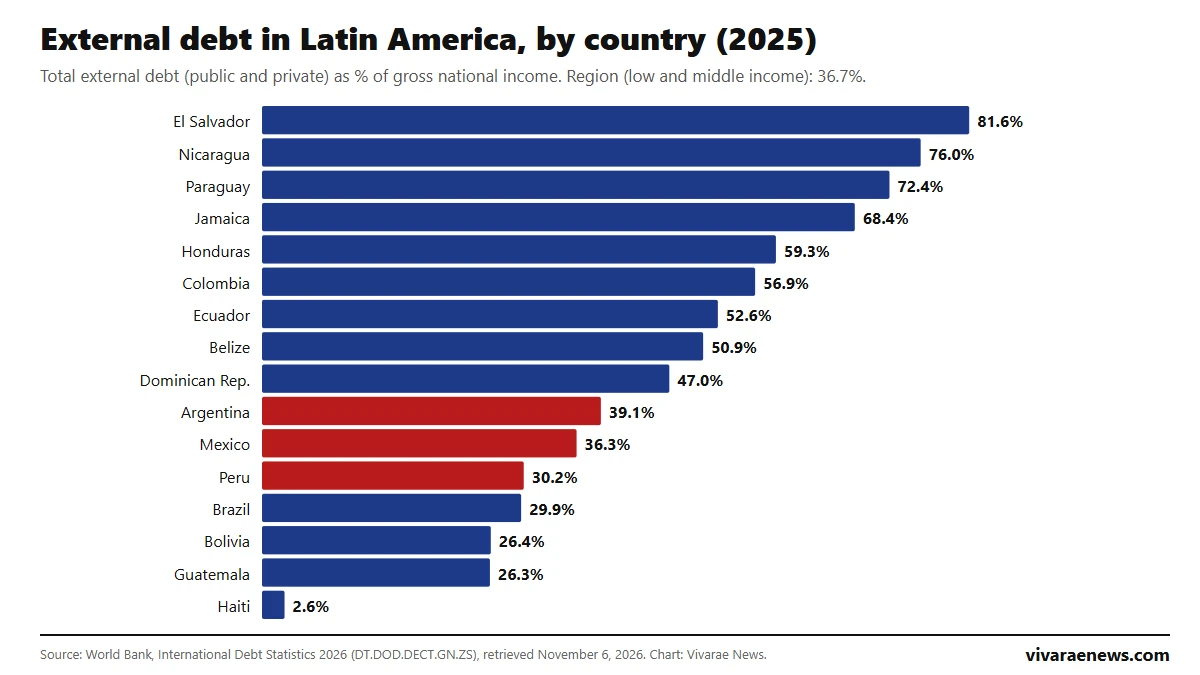
El Salvador is the Latin American country with the highest external debt relative to its economy: it equals 81.6% of its gross national income (GNI) in 2025, followed by Nicaragua (76.0%) and Paraguay (72.4%), according to the World Bank's International Debt Statistics 2026, published on November 5, 2026. The external debt of the region's low- and middle-income countries totaled $2.22 trillion, 9.3% more than in 2024, and reached 36.7% of their national income.
Worldwide, the external debt of low- and middle-income countries hit a record $9.4 trillion, up 5.5%, the largest increase since 2021, according to the report as cited by Bloomberg Línea. External debt includes what both governments and private companies and banks owe abroad, so it is not the same as public debt. This ranking brings together data for 16 countries with World Bank figures.
View the data as a table
| Regional external debt | US$ 2.22 trillion |
| As % of gross national income | 36.7% |
| Most indebted: El Salvador | 81.6% |
| Emerging world | US$ 9.45 trillion |
Ranking of external debt in Latin America as % of national income (2025)
| Rank | Country | External debt / GNI 2025 | Stock 2025 ($ million) |
|---|---|---|---|
| 1 | El Salvador | 81.6% | 27,926 |
| 2 | Nicaragua | 76.0% | 15,994 |
| 3 | Paraguay | 72.4% | 34,300 |
| 4 | Jamaica | 68.4% | 15,300 |
| 5 | Honduras | 59.3% | 21,674 |
| 6 | Colombia | 56.9% | 255,956 |
| 7 | Ecuador | 52.6% | 66,616 |
| 8 | Belize | 50.9% | 1,609 |
| 9 | Dominican Republic | 47.0% | 56,284 |
| 10 | Argentina | 39.1% | 261,653 |
| 11 | Mexico | 36.3% | 645,042 |
| 12 | Peru | 30.2% | 94,270 |
| 13 | Brazil | 29.9% | 659,803 |
| 14 | Bolivia | 26.4% | 16,630 |
| 15 | Guatemala | 26.3% | 31,997 |
| 16 | Haiti | 2.6% | 827 |
Source: World Bank, International Debt Statistics 2026, indicators DT.DOD.DECT.GN.ZS and DT.DOD.DECT.CD, retrieved November 6, 2026. The database covers only low- and middle-income countries that report to the Debtor Reporting System: it does not include Chile, Uruguay or Panama (high income), nor Costa Rica, Venezuela or Cuba. Haiti shows 2.6% because its external debt is small ($827 million).
View the data as a table
| El Salvador | 81.6% |
| Nicaragua | 76.0% |
| Paraguay | 72.4% |
| Jamaica | 68.4% |
| Honduras | 59.3% |
| Colombia | 56.9% |
| Ecuador | 52.6% |
| Belize | 50.9% |
| Dominican Republic | 47.0% |
| Argentina | 39.1% |
| Mexico | 36.3% |
| Peru | 30.2% |
| Brazil | 29.9% |
| Bolivia | 26.4% |
| Guatemala | 26.3% |
| Haiti | 2.6% |
The countries with the most external debt in dollars
In amounts, Brazil ($659.80 billion) and Mexico ($645.04 billion) account for more than half of the region's external debt. They are followed by Argentina ($261.65 billion) and Colombia ($255.96 billion). But the amount alone does not show how heavy it is: Mexico owes almost as much as Brazil with a smaller national income, and still its debt/GNI ratio (36.3%) is lower than that of much smaller countries.
| Country | 2024 ($ million) | 2025 ($ million) | Change |
|---|---|---|---|
| Brazil | 606,764 | 659,803 | +8.7% |
| Mexico | 597,750 | 645,042 | +7.9% |
| Argentina | 225,363 | 261,653 | +16.1% |
| Colombia | 224,857 | 255,956 | +13.8% |
| Peru | 94,449 | 94,270 | -0.2% |
| Ecuador | 65,472 | 66,616 | +1.7% |
| Dominican Republic | 53,433 | 56,284 | +5.3% |
| Paraguay | 29,960 | 34,300 | +14.5% |
| Guatemala | 27,063 | 31,997 | +18.2% |
| El Salvador | 24,993 | 27,926 | +11.7% |
Source: World Bank, International Debt Statistics 2026 (DT.DOD.DECT.CD).
Where external debt grew the most in 2025
Guatemala had the region's largest percentage increase (+18.2%), followed by Argentina (+16.1%), Paraguay (+14.5%) and Colombia (+13.8%). Peru and Haiti were the only ones to reduce their stock: Peru's fell 0.2%, to $94.27 billion, and its debt/GNI ratio dropped from 34.4% to 30.2%.
External debt of Mexico, Argentina and Peru
The three Vivarae regional editions with data in this database show different paths. In Argentina, external debt went from 30.4% of GNI in 2015 to a peak of 68.1% in 2020 and fell to 39.1% in 2025, although it rose again from 36.0% in 2024. Mexico fell from 56.8% in 2020 to 36.3%. Peru is at its lowest level of the decade, 30.2%. Chile does not appear in this database because the World Bank classifies it as a high-income country.
View the data as a table
| Mexico | Argentina | Peru | Region (low and middle income) | |
|---|---|---|---|---|
| 2015 | 45.5% | 27.9% | 37.0% | 36.4% |
| 2016 | 50.3% | 31.2% | 38.2% | 38.8% |
| 2017 | 49.9% | 34.3% | 33.9% | 36.8% |
| 2018 | 49.2% | 50.7% | 32.5% | 40.3% |
| 2019 | 48.7% | 59.8% | 29.5% | 41.8% |
| 2020 | 56.8% | 61.7% | 38.2% | 49.8% |
| 2021 | 46.9% | 46.7% | 42.6% | 44.1% |
| 2022 | 41.0% | 36.5% | 40.0% | 38.9% |
| 2023 | 34.2% | 36.4% | 37.1% | 35.7% |
| 2024 | 33.6% | 36.0% | 34.4% | 35.0% |
| 2025 | 36.3% | 39.1% | 30.2% | 36.7% |
| Country | 2015 | 2020 | 2024 | 2025 |
|---|---|---|---|---|
| Mexico | 45.5% | 56.8% | 33.6% | 36.3% |
| Argentina | 27.9% | 61.7% | 36.0% | 39.1% |
| Peru | 37.0% | 38.2% | 34.4% | 30.2% |
| Region (low and middle income) | 36.4% | 49.8% | 35.0% | 36.7% |
Source: World Bank. More context: what Argentina's country risk is and foreign direct investment by country.
Debt service: how much it costs to pay
The stock is not everything: what matters too is how much is paid each year in principal and interest compared with what the country sells abroad. El Salvador spent the equivalent of 79.2% of its exports on external debt service in 2025; Colombia, 45.4%; Brazil, 38.6%, and Argentina, 29.6%. Mexico, despite its large stock, paid 9.6%. Colombia also has the highest debt relative to its exports: 315%.
View the data as a table
| External debt / GNI | Debt service / exports | |
|---|---|---|
| Argentina | 39% | 30% |
| Bolivia | 26% | 14% |
| Brazil | 30% | 39% |
| Colombia | 57% | 45% |
| Dominican Republic | 47% | 24% |
| Ecuador | 53% | 23% |
| El Salvador | 82% | 79% |
| Guatemala | 26% | 9% |
| Honduras | 59% | 21% |
| Mexico | 36% | 10% |
| Nicaragua | 76% | 17% |
| Paraguay | 72% | 18% |
| Peru | 30% | 18% |
| Jamaica | 68% | 54% |
| Belize | 51% | 8% |
| El Salvador | 27.9 | 81.6% | 227.4% | 79.2% |
| Nicaragua | 16.0 | 76.0% | 171.6% | 16.5% |
| Paraguay | 34.3 | 72.4% | 171.1% | 17.5% |
| Jamaica | 15.3 | 68.4% | 209.5% | 53.9% |
| Honduras | 21.7 | 59.3% | 189.7% | 20.6% |
| Colombia | 256.0 | 56.9% | 315.3% | 45.4% |
| Ecuador | 66.6 | 52.6% | 159.0% | 22.8% |
| Belize | 1.6 | 50.9% | 95.7% | 7.7% |
| Dominican Republic | 56.3 | 47.0% | 178.2% | 23.5% |
| Argentina | 261.7 | 39.1% | 233.9% | 29.6% |
| Mexico | 645.0 | 36.3% | 85.7% | 9.6% |
| Peru | 94.3 | 30.2% | 87.2% | 17.7% |
| Brazil | 659.8 | 29.9% | 150.4% | 38.6% |
| Bolivia | 16.6 | 26.4% | 139.5% | 13.9% |
| Guatemala | 32.0 | 26.3% | 145.4% | 9.3% |
| Haiti | 0.8 | 2.6% | 99.3% | 5.9% |
"Low- and middle-income countries are borrowing more, paying more and, in many cases, leaving less for long-term development," warned Haishan Fu, the World Bank's chief statistician, as quoted by Bloomberg Línea. Bond issuance by public entities in these countries rose 35% to $251 billion, its highest level in five years.
How external debt is measured in this ranking
Total external debt is the sum of what a country's residents, whether the government, the central bank, banks or companies, owe to foreign creditors, including IMF loans. The World Bank compares it with gross national income (GNI), which is GDP plus net income the country receives from abroad, and with exports, because they are the main source of dollars to pay it. The 2025 data are the first published for that year and may be revised in later editions.
How to cite this data
VIVARAE NEWS (2026). "External debt in Latin America: ranking by country 2026". Updated November 6, 2026. Available at https://vivaraenews.com/en/external-debt-in-latin-america-ranking-by-country-2026/. The data may be reproduced by citing VIVARAE NEWS and linking to this page; each country's figures are from the World Bank (International Debt Statistics 2026).
Frequently asked questions
Which Latin American country has the most external debt?
In dollars, Brazil ($659.80 billion in 2025), followed by Mexico. As a percentage of national income, El Salvador (81.6%), Nicaragua (76.0%) and Paraguay (72.4%).
How much does Latin America owe abroad?
The region's low- and middle-income countries had $2.22 trillion in external debt in 2025, 36.7% of their national income, according to the World Bank.
Why isn't Chile included?
The World Bank database covers only low- and middle-income countries. Chile, Uruguay and Panama are high income; Costa Rica, Venezuela and Cuba have no data in it either.
Is external debt the same as public debt?
No. External debt includes what the state and also private companies and banks owe to non-residents. Public debt includes what the state owes to domestic creditors.
How often is this ranking updated?
The World Bank publishes the International Debt Statistics once a year; we will update this page at the same URL with each new edition.