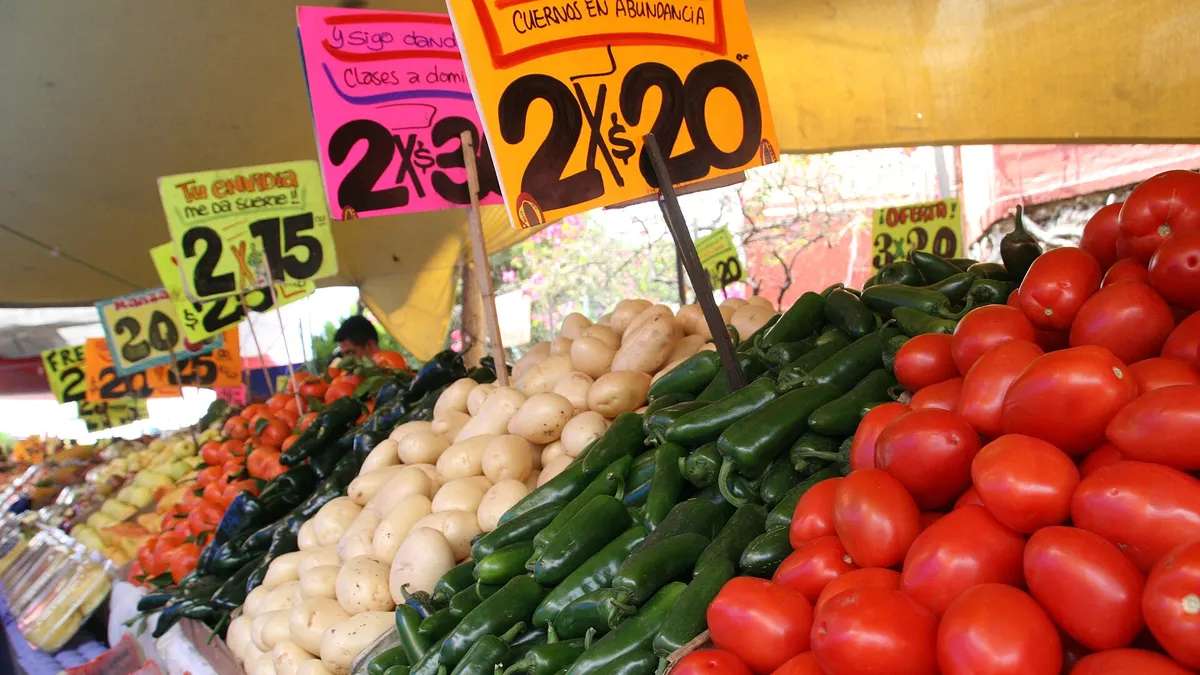
Mexico's annual inflation rose to 3.96% in the first half of November 2026, from 3.62% in the first half of October, according to the INEGI bulletin published on November 24. In just 15 days prices increased 0.54%, more than in the same fortnight of 2024 (0.37%) and 2025 (0.47%). Two items explain more than half of the jump: electricity, which rose 20.74% as the summer subsidy ended in 11 cities, and tomatoes, which became 28.95% more expensive.
The good news is in core inflation, which strips out the most volatile prices: it fell to 3.68% annually, from 4.32% a year ago, and dropped 0.10% in the fortnight. Headline inflation sits just below the ceiling of Banxico's range of 3% plus or minus one point. Here are the figures, the items that rose and fell the most, the cities with the biggest increases and what it means for interest rates.
View the data as a table
| Headline, annual | 3.96% |
| Core, annual | 3.68% |
| Non-core, annual | 4.90% |
| Rise in the fortnight | 0.54% |
Mexico inflation in the first half of November: INEGI's figures
| Indicator | Fortnightly | Annual 2026 | Annual 2025 |
|---|---|---|---|
| Headline inflation | +0.54% | 3.96% | 3.61% |
| Core | -0.10% | 3.68% | 4.32% |
| Goods | -0.25% | 3.16% | 4.13% |
| Services | +0.05% | 4.17% | 4.50% |
| Non-core | +2.72% | 4.90% | 1.29% |
| Fruits and vegetables | +5.50% | 20.05% | -10.87% |
| Energy | +3.69% | 2.59% | 0.89% |
| Government-set tariffs | +0.13% | 5.18% | 5.95% |
Source: INEGI bulletin, table 1. The headline index stood at 148.110 points. The contrast is clear: the stable part of prices (core) moderated, while the volatile part (non-core) rose 2.72% in the fortnight, driven by fruits and vegetables, which show an annual rise of 20.05%. INEGI's next release, with the second half of November and the monthly figure, will be on December 23, 2026, according to the same bulletin.
What rose and what fell: electricity and tomatoes push Mexico's inflation
INEGI identifies the items that weighed most on the result (their "incidence," in percentage points). Electricity alone contributed 0.283 of the fortnight's 0.54 points: the warm-season electricity tariff program ended in Mexicali, Ciudad Juárez, Culiacán, Chihuahua, Hermosillo, Matamoros, Colima, La Paz, Huatabampo, Jiménez and Esperanza. It is an effect that repeats every November. Tomatoes added another 0.199 points.
| Item | Fortnightly change | Incidence (pp) |
|---|---|---|
| Electricity | +20.74% | 0.283 |
| Tomatoes (jitomate) | +28.95% | 0.199 |
| Green tomatillo | +39.31% | 0.065 |
| Eggs | +6.59% | 0.054 |
| Chicken | +1.99% | 0.033 |
| Professional services | +6.76% | 0.016 |
| Onions | -16.88% | -0.062 |
| Air travel | -7.81% | -0.027 |
| Zucchini | -11.81% | -0.016 |
| Table wine | -4.00% | -0.010 |
| Hair products | -1.07% | -0.008 |
Source: INEGI bulletin, table 2. On the downside, onions (-16.88%), air travel (-7.81%), zucchini (-11.81%) and table wine (-4%) stand out. Cheaper flights contrast with the first half of October, when air travel was one of the items that rose the most, as we reported in inflation in the first half of October.
The cities with the highest inflation: Sonora and Sinaloa
Because the electricity subsidy is concentrated in the hottest northern cities, the fortnight's increase was very uneven. Sonora (3.51%) and Sinaloa (3.46%) were the states with the highest fortnightly inflation, followed by Baja California Sur (1.54%), Baja California (1.27%) and Morelos (0.98%). By contrast, Aguascalientes, the State of Mexico, Quintana Roo, Yucatán and Durango saw changes below the national average, according to table 3 of the bulletin.
Inflation by type of spending
INEGI also publishes inflation according to the international classification of individual consumption by purpose. Over one year, the biggest increases were in insurance and financial services (8.98%), alcoholic beverages and tobacco (8.58%), restaurants and accommodation (5.87%) and education (5.85%). Information and communication, which includes phone services, is the only group with lower prices than a year ago (-1.69%).
| Food and non-alcoholic beverages | 1.60% | 5.28% |
| Alcoholic beverages and tobacco | -1.25% | 8.58% |
| Clothing and footwear | -0.99% | 2.61% |
| Housing, water, electricity and gas | 1.47% | 3.67% |
| Furnishings and household maintenance | -0.39% | 2.37% |
| Health | 0.05% | 4.32% |
| Transport | -0.13% | 2.74% |
| Information and communication | -0.33% | -1.69% |
| Recreation, sport and culture | -0.25% | 3.20% |
| Education services | 0.00% | 5.85% |
| Restaurants and accommodation | 0.08% | 5.87% |
| Insurance and financial services | 0.92% | 8.98% |
| Personal care and other | 0.02% | 3.00% |
The minimum consumption basket, which tracks the prices of basic goods, rose 0.83% in the fortnight and 3.87% over the year, just below headline inflation.
How Mexico's inflation has changed since October
Headline inflation has risen reading after reading, but core inflation is moving the other way. In the first half of October headline stood at 3.62% and core at 3.78%; for the full month of October they reached 3.75% and 3.80%; and now headline hits 3.96% while core falls to 3.68%. In other words, for the first time in these three readings headline inflation is above core, because the push comes from electricity and fresh food.
| Period | Annual headline inflation | Annual core |
|---|---|---|
| First half of November 2024 | 4.56% | 3.58% |
| First half of November 2025 | 3.61% | 4.32% |
| First half of October 2026 | 3.62% | 3.78% |
| October 2026 (monthly) | 3.75% | 3.80% |
| First half of November 2026 | 3.96% | 3.68% |
View the data as a table
| Headline | Core | |
|---|---|---|
| 1H Oct | 3.62% | 3.78% |
| October | 3.75% | 3.80% |
| 1H Nov | 3.96% | 3.68% |
Source: INEGI bulletin and previous CPI bulletins, with the October data we reported at the time. A year ago the picture was the reverse: in November 2025 core (4.32%) was well above headline (3.61%), because fruits and vegetables were falling almost 11% a year. Today those same fruits and vegetables are up 20.05%.
What Mexico's inflation means for Banxico and interest rates
- The rate is at 6.25%. Banxico cut it by 0.25 points on November 5, effective on the 6th, in a split three-to-two vote, and said keeping it at that level for a prolonged period would help inflation converge to the target.
- Headline inflation is near the ceiling. At 3.96%, it is four hundredths of a point below the upper limit of the 2% to 4% range.
- Core inflation offers relief. The measure the central bank watches most fell to 3.68%, from 4.32% a year ago, suggesting the rise comes from volatile and seasonal prices.
- December decides. The last monetary policy decision of the year comes in December, with the second half of November data already published.
To compare with the rest of the region, see the Latin America inflation ranking, where Mexico stood at 3.75% in October, as we reported in Mexico's October inflation. Rising prices also weigh on the debate over the 2027 minimum wage.
Frequently asked questions
What was Mexico's inflation in the first half of November 2026?
3.96% annually and 0.54% from the previous fortnight, according to INEGI.
Why did electricity prices rise in November?
Because the warm-season electricity tariff subsidy ended in 11 cities, including Mexicali, Hermosillo, Culiacán and Ciudad Juárez. Electricity rose 20.74% in the fortnight.
What is core inflation?
It excludes the most volatile prices, such as fruits, vegetables, energy and government tariffs. In the first half of November it was 3.68% annually.
When is the next inflation figure released?
On December 23, 2026, with the second half and the monthly figure for November.