Chile is the OECD country with the largest share of teenagers who play video games for more than three hours a day on weekdays: 36% of 15-year-old students, against an average of 26% across the organization's members. The figure is part of the second volume of the 2026 Digital Economy and Society Outlook of the Organisation for Economic Co-operation and Development, which Secretary-General Mathias Cormann presented on Thursday, November 5, at the Tallinn Digital Summit in Estonia, according to BioBioChile.
The study, with data collected in 2025, also shows that 81% of 15-year-olds in the OECD play video games on a normal weekday and that 9% of Chilean students play more than seven hours a day. The OECD had announced the report for this date in a media advisory. This article brings together the available figures, what they say about school performance and what the report does not allow us to conclude.
What the OECD report says about video games
View the data as a table
| Play more than 3 hours on a weekday in Chile | 36% |
| OECD average | 26% |
| Play on a normal weekday (OECD) | 81% |
| Play more than 7 hours a day in Chile | 9% |
The OECD splits players into three groups according to the time they spend on video games on a typical weekday. On average, 19% of students do not play at all, 54% play up to three hours, a habit the organization considers "moderate", and 26% play more than three hours, which it calls "intensive gaming".
| Gaming time on a weekday | OECD average | OECD classification |
|---|---|---|
| Does not play | 19% | No gaming |
| Up to 3 hours | 54% | Moderate gaming |
| More than 3 hours | 26% (Chile: 36%) | Intensive gaming |
| More than 7 hours | 5% (Chile: 9%) | Part of intensive gaming |
Source: OECD, Digital Economy and Society Outlook 2026, volume 2, according to BioBioChile. The figures are what 15-year-old students themselves reported in 2025.
Chile and intensive video gaming: the OECD ranking
The share of students who play more than three hours ranges from 17% in Spain and 18% in Switzerland to 36% in Chile. In the United Kingdom, Sweden and Lithuania, about one in three students reported that level of gaming, while in Austria, Iceland and Italy the share is close to one in five. These are the countries for which the report, as published so far, gives an exact figure:
| Country | Play more than 3 hours on a weekday | Note |
|---|---|---|
| Chile | 36% | Highest in the OECD; 9% play more than 7 hours |
| United Kingdom, Sweden and Lithuania | About 1 in 3 | Fewer than 1 in 7 British students do not play at all |
| OECD average | 26% | 5% play more than 7 hours |
| Italy | 20% | |
| Austria and Iceland | 19% | In Iceland, under 3% play more than 7 hours |
| Switzerland | 18% | |
| Spain | 17% | The lowest |
| Slovakia, Czechia and Slovenia | No figure published | More than a quarter do not play at all on weekdays |
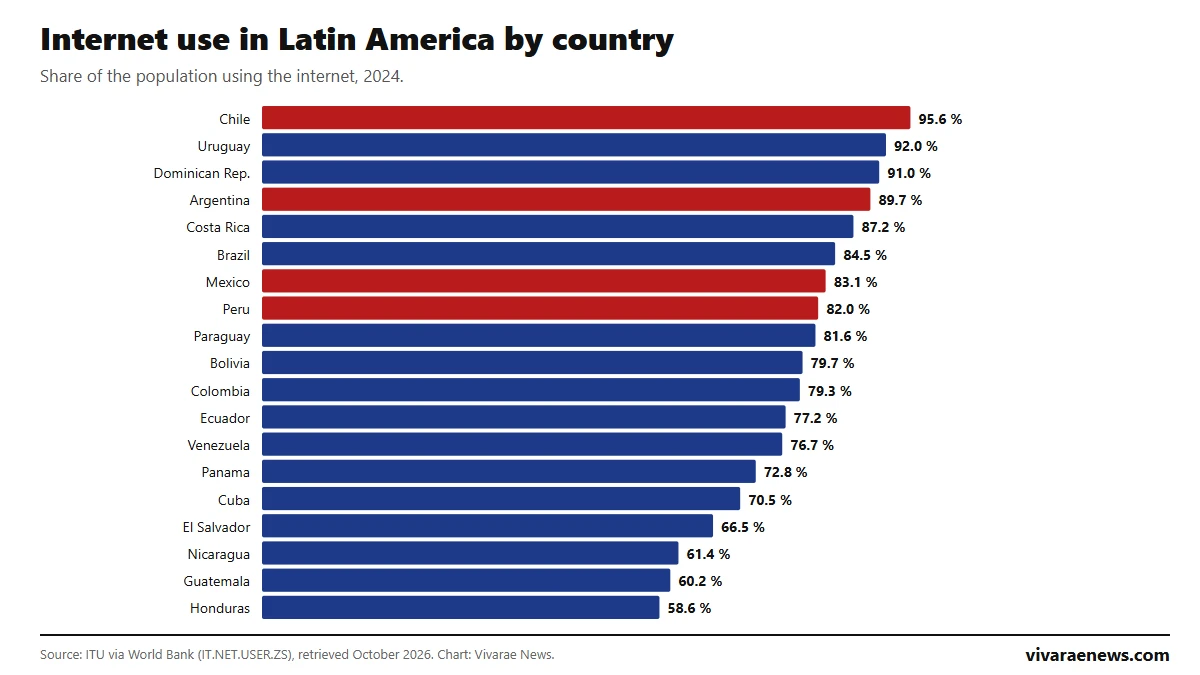
Source: OECD via BioBioChile. Chile also leads at the very top end: 9% of its students said they play more than seven hours on a weekday, compared with less than 3% in Australia and Iceland. For a sense of screen access in the region, see our ranking of internet use in Latin America, where Chile is among the most connected countries.

How many hours teens play video games by gender and socioeconomic background
The report shows that time spent on video games varies with gender and socioeconomic background. In 2025, boys from disadvantaged homes in the OECD spent on average 21 hours a week gaming, and girls from the same group 13 hours. Among students from advantaged homes, the figures drop to 17 hours for boys and 9 for girls.
| Group (OECD average, 2025) | Weekly hours of video games | Equivalent to |
|---|---|---|
| Boys from disadvantaged homes | 21 hours | 3 hours a day |
| Boys from advantaged homes | 17 hours | 2.4 hours a day |
| Girls from disadvantaged homes | 13 hours | 1.9 hours a day |
| Girls from advantaged homes | 9 hours | 1.3 hours a day |
Source: OECD via BioBioChile; the daily equivalent is our own calculation, dividing weekly hours by seven. The report as published so far does not give this breakdown for Chile.
Video games and school performance: where the limit is
The link between video games and grades is not linear. According to the OECD, students who play between one and three hours on a normal day perform similarly or slightly better in math, reading and science than those who play less. Above that level, weekday gaming is associated with worse results, with earlier and steeper declines among girls and students from advantaged homes.
"Video games can support cognitive skills, creativity and well-being, but intensive gaming is associated with lower academic performance, especially among girls and students from advantaged backgrounds," the organization warns, in the quote reported by BioBioChile.
| Gaming time on a weekday | Link with performance according to the OECD |
|---|---|
| Less than 1 hour | Comparison point |
| 1 to 3 hours | Similar or slightly higher performance in math, reading and science |
| More than 3 hours | Associated with worse academic results |
| More than 3 hours, girls and advantaged homes | The decline starts earlier and is steeper |
This is an association, not proof of cause: the report describes that both things appear together, but with these data it cannot be said that playing more is what lowers grades.

What is known about problem gaming
The intensive gaming measured by the OECD is not the same as addiction. The World Health Organization includes "gaming disorder" in its International Classification of Diseases (ICD-11) and describes it as a pattern of gaming with impaired control, in which gaming takes priority over other activities and continues despite negative consequences, normally for at least 12 months, according to its questions and answers page. The WHO notes that only a small proportion of people who play video games develop this disorder.
- Intensive gaming (OECD): more than three hours on a weekday, as reported by the student.
- Gaming disorder (WHO): a clinical diagnosis involving loss of control and impairment of personal, family, school or work life.
- What the report measures: gaming time and its link with performance, not diagnoses.
What the video game report does not allow us to conclude
Three limits are worth keeping in mind when reading the ranking. First, these are data reported by students, not measurements of actual screen time. Second, they refer to a weekday; weekends are not in these figures. Third, the sample is of 15-year-olds in school, so it does not describe all young Chileans.
Nor are there, in what has been published so far, figures for other Latin American OECD members such as Mexico, Colombia or Costa Rica. When the full report is available on the organization's website, this article will be updated with the country table. Meanwhile, other connectivity figures for the country are in our article on internet speed in Chile.
Frequently asked questions
What share of Chilean teenagers play video games more than three hours a day?
36% of 15-year-old students, on a weekday, according to the OECD report presented on November 5, 2026. It is the highest share among OECD countries, whose average is 26%.
Which OECD country plays the fewest video games?
Spain, with 17% of students playing more than three hours on a weekday, followed by Switzerland (18%), Austria and Iceland (19%).
Do video games lower grades?
According to the OECD, playing between one and three hours on a normal day is associated with similar or slightly better performance. Above that level, gaming is associated with worse results, especially among girls and students from advantaged homes. It is an association, not a proven causal link.
What is intensive gaming according to the OECD?
Playing video games for more than three hours on a typical weekday. Up to three hours is, for the organization, a moderate habit.