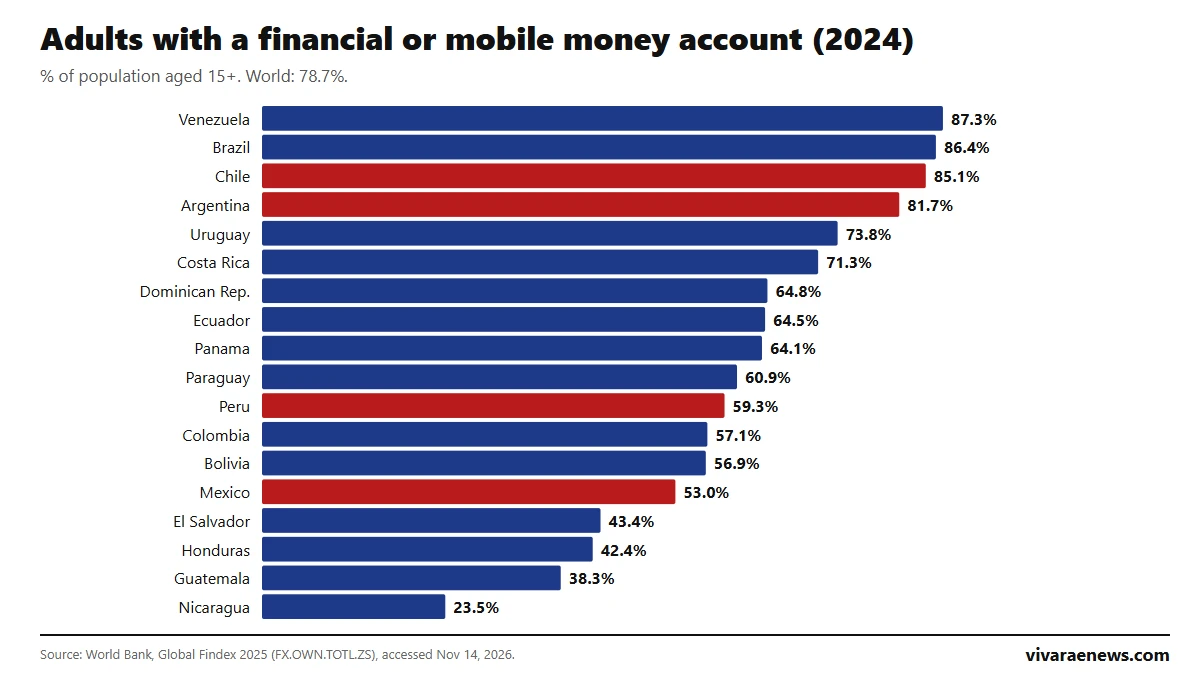
87.3% of adults in Venezuela and 86.4% in Brazil have an account at a bank or other financial institution, or a mobile money account, the highest shares in Latin America in 2024, according to the World Bank's Global Findex. Chile is third, with 85.1%, and Argentina fourth, with 81.7%. At the other end, only 23.5% of adults in Nicaragua and 38.3% in Guatemala have an account. Worldwide, the figure is 78.7%.
The Global Findex is the World Bank's survey of how adults save, pay and borrow in more than 140 economies. Its 2025 edition is based on 2024 interviews. This ranking of bank account ownership in Latin America, a key financial inclusion indicator, is updated on this same page when the World Bank publishes a new edition.
View the data as a table
| Chile | 85.1% |
| Mexico | 53.0% |
| Peru | 59.3% |
| World | 78.7% |
Ranking of bank account ownership in Latin America
| Rank | Country | Total | Women | Men | 2011 |
|---|---|---|---|---|---|
| 1 | Venezuela | 87.3% | 87.7% | 86.9% | 44.1% |
| 2 | Brazil | 86.4% | 82.3% | 90.8% | 55.9% |
| 3 | Chile | 85.1% | 83.2% | 87.1% | 42.2% |
| 4 | Argentina | 81.7% | 84.3% | 78.9% | 33.1% |
| 5 | Uruguay | 73.8% | 73.3% | 74.3% | 23.5% |
| 6 | Costa Rica | 71.3% | 68.3% | 74.5% | 50.4% |
| 7 | Dominican Rep. | 64.8% | 61.4% | 68.2% | 38.2% |
| 8 | Ecuador | 64.5% | 63.5% | 65.6% | 36.7% |
| 9 | Panama | 64.1% | 58.1% | 70.4% | 24.9% |
| 10 | Paraguay | 60.9% | 60.1% | 61.8% | 21.7% |
| 11 | Peru | 59.3% | 56.2% | 62.5% | 20.5% |
| 12 | Colombia | 57.1% | 51.0% | 63.7% | 30.4% |
| 13 | Bolivia | 56.9% | 53.5% | 60.3% | 28.0% |
| 14 | Mexico | 53.0% | 47.4% | 59.1% | 27.4% |
| 15 | El Salvador | 43.4% | 34.4% | 54.7% | 13.8% |
| 16 | Honduras | 42.4% | 34.1% | 52.8% | 20.5% |
| 17 | Guatemala | 38.3% | 32.5% | 44.6% | 22.3% |
| 18 | Nicaragua | 23.5% | 21.2% | 26.0% | 14.2% |
Source: World Bank, Global Findex database (FX.OWN.TOTL.ZS, adults aged 15+ with an account at a financial institution or mobile money provider), accessed November 14, 2026. 2024 data (2025 Findex edition); the 2011 column is from the first edition. Cuba is not in the survey. The indicator includes mobile money accounts, such as licensed digital wallets, and does not measure whether the account is used.
View the data as a table
| Venezuela | 87.3% |
| Brazil | 86.4% |
| Chile | 85.1% |
| Argentina | 81.7% |
| Uruguay | 73.8% |
| Costa Rica | 71.3% |
| Dominican Republic | 64.8% |
| Ecuador | 64.5% |
| Panama | 64.1% |
| Paraguay | 60.9% |
| Peru | 59.3% |
| Colombia | 57.1% |
| Bolivia | 56.9% |
| Mexico | 53.0% |
| El Salvador | 43.4% |
| Honduras | 42.4% |
| Guatemala | 38.3% |
| Nicaragua | 23.5% |
How access to bank accounts has grown since 2011
In 13 years, account access doubled in much of the region. Chile went from 42.2% in 2011 to 85.1% in 2024; Peru from 20.5% to 59.3%; Argentina from 33.1% to 81.7%; and Uruguay from 23.5% to 73.8%. Mexico advanced less, from 27.4% to 53.0%. In Chile, BancoEstado's CuentaRUT is open to anyone with an ID card; in Brazil, the Central Bank launched the Pix instant payment system in 2020.
View the data as a table
| Chile | Brazil | Argentina | Peru | Mexico | |
|---|---|---|---|---|---|
| 2011 | 42.2% | 55.9% | 33.1% | 20.5% | 27.4% |
| 2014 | 63.3% | 68.1% | 50.2% | 29.0% | 39.1% |
| 2017 | 74.3% | 70.0% | 48.7% | 42.6% | 36.0% |
| 2021 | 87.1% | 84.0% | 71.6% | 57.5% | 49.0% |
| 2024 | 85.1% | 86.4% | 81.7% | 59.3% | 53.0% |
| Country | 2011 | 2014 | 2017 | 2021 | 2024 |
|---|---|---|---|---|---|
| Chile | 42.2% | 63.3% | 74.3% | 87.1% | 85.1% |
| Brazil | 55.9% | 68.1% | 70.0% | 84.0% | 86.4% |
| Argentina | 33.1% | 50.2% | 48.7% | 71.6% | 81.7% |
| Uruguay | 23.5% | 45.6% | 63.9% | 74.1% | 73.8% |
| Peru | 20.5% | 29.0% | 42.6% | 57.5% | 59.3% |
| Colombia | 30.4% | 39.0% | 45.8% | 59.7% | 57.1% |
| Mexico | 27.4% | 39.1% | 36.0% | 49.0% | 53.0% |
Source: World Bank, Global Findex database (FX.OWN.TOTL.ZS, adults aged 15+ with an account at a financial institution or mobile money provider), accessed November 14, 2026. Chile dipped slightly between 2021 (87.1%) and 2024 (85.1%), a difference that may be within a survey's margin of error. Colombia also fell back, from 59.7% to 57.1%.
The gap between men and women in bank account ownership
In almost every country, more men than women have an account. The largest gap is in El Salvador (20.3 points), Honduras (18.7) and Colombia (12.7). In Mexico it is 11.7 points and in Chile 3.9. Argentina and Venezuela are the exceptions: there, women outnumber men, in Argentina by 5.3 points. Worldwide, the gap is 4.2 points.
Source: World Bank, Global Findex database (FX.OWN.TOTL.ZS, adults aged 15+ with an account at a financial institution or mobile money provider), accessed November 14, 2026. For other gaps in the region, see the rankings of female labor force participation in Latin America and internet use, which also helps explain the rise of digital wallets.
Frequently asked questions
What share of Chileans have a bank account?
85.1% of adults aged 15+ in 2024, according to the World Bank's Global Findex: 83.2% of women and 87.1% of men.
Which Latin American country has the most people with a bank account?
Venezuela (87.3%) and Brazil (86.4%), followed by Chile (85.1%).
How many Mexicans have a bank account?
53.0% of adults in 2024, one of the lowest shares in the region.
How often is this ranking updated?
With each edition of the Global Findex, which the World Bank publishes every three or four years. It is updated at this same URL.
How to cite this data
Vivarae News (2026). "Bank account ownership in Latin America: ranking by country 2026". Updated November 14, 2026. Available at https://vivaraenews.com/en/bank-account-ownership-in-latin-america-ranking-by-country-2026/. The data may be reproduced by citing Vivarae News and linking to this page; each country's figures come from the World Bank's Global Findex.