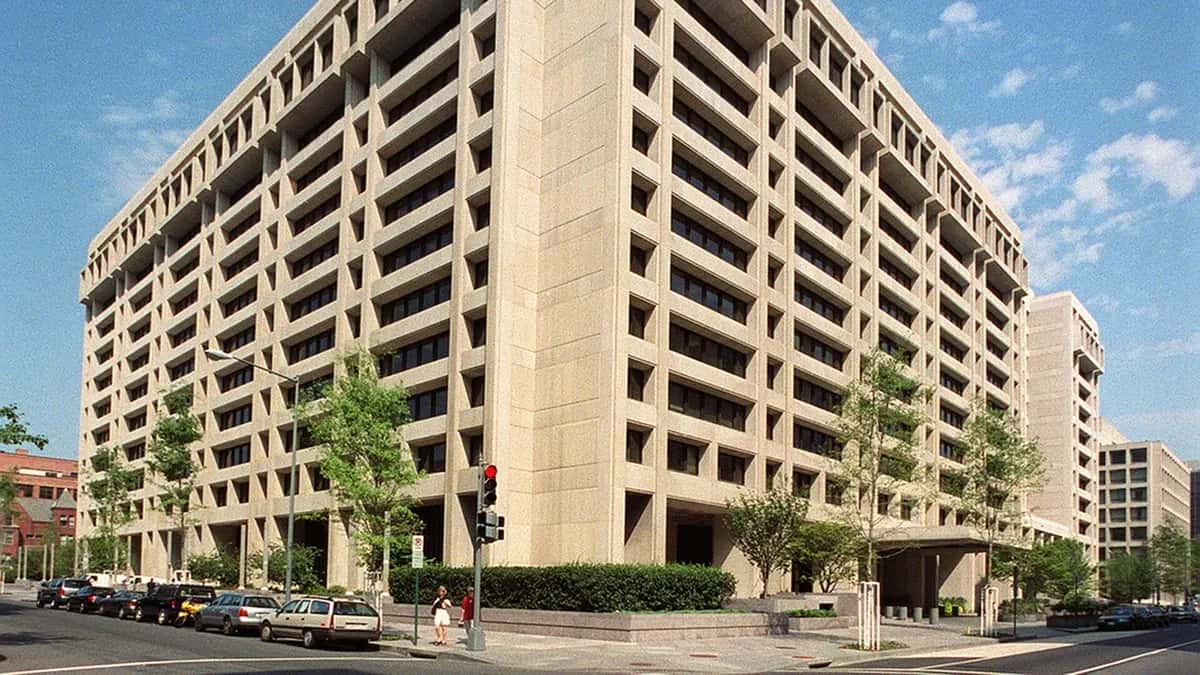
The board of the International Monetary Fund (IMF) approved on November 11, 2026 cutting Mexico's Flexible Credit Line (FCL) from 200% to 150% of its quota, equivalent to SDR 13.369 billion (special drawing rights), about US$18 billion, according to the IMF press release. The previous amount was about US$24 billion. The reduction was requested by the Mexican government itself and announced by the Foreign Exchange Commission, made up of the Finance Ministry and the Bank of Mexico, according to Bloomberg Línea and Reuters.
It is another cut to a line that reached US$88 billion in 2017. At the same time, the IMF concluded the mid-term review of the arrangement, approved on November 13, 2025 for two years, and its annual Article IV consultation on the Mexican economy. This is what changes with the cut to Mexico's flexible credit line and what the Fund said.
View the data as a table
| New FCL amount | US$ 18 B |
| Previous amount | US$ 24 B |
| Mexico's international reserves | US$ 257.9 B |
| Projected GDP growth in 2026 | 1.5% |
What Mexico's flexible credit line with the IMF is
The Flexible Credit Line is an insurance policy: a loan the IMF keeps available for countries with economic policies it considers "very strong," which they can draw on if they suffer a severe external shock, such as capital flight. Mexico was the first country to obtain one, in 2009, in the middle of the financial crisis, and has renewed it ever since without ever using it. The authorities treat it as "precautionary" and say it complements international reserves, according to the Foreign Exchange Commission as quoted by Bloomberg Línea.
Having the line has a cost: Mexico pays a fee on the available amount even if it does not use it, which is why recent governments have been reducing it as reserves grow. Deputy Finance Minister María del Carmen Bonilla said before the announcement that "the level of international reserves today is four or five times what that Flexible Credit Line is worth," according to Bloomberg Línea.
How Mexico's flexible credit line has changed since 2009
| Year | Approximate FCL amount | Mexico's international reserves | Reserves / FCL |
|---|---|---|---|
| 2009 | US$ 47,000 million | US$ 99,889 million | 2.1 times |
| 2012 | US$ 73,000 million | US$ 167,076 million | 2.3 times |
| 2017 | US$ 88,000 million | US$ 175,470 million | 2.0 times |
| 2021 | US$ 50,000 million | US$ 207,799 million | 4.2 times |
| 2023 | US$ 35,000 million | US$ 214,317 million | 6.1 times |
| 2025 | US$ 24,000 million | US$ 256,179 million | 10.7 times |
| 2026 | US$ 18,000 million | US$ 257,905 million | 14.3 times |
Source: Approximate dollar amounts according to 2009, 2012, 2017, 2021, 2023, 2025, 2026. Reserves: World Bank (FI.RES.TOTL.CD, total reserves including gold) at each year-end; 2026, Bank of Mexico as of November 6, according to Bloomberg Línea. FCL dollar amounts change with the SDR exchange rate; the IMF uses US$1 = SDR 0.739958 as of November 11, 2026. We do not include every intermediate renewal because press sources disagree on some amounts.
View the data as a table
| International reserves | Flexible credit line | |
|---|---|---|
| 2009 | 100 | 47 |
| 2012 | 167 | 73 |
| 2017 | 176 | 88 |
| 2021 | 208 | 50 |
| 2023 | 214 | 35 |
| 2025 | 256 | 24 |
| 2026 | 258 | 18 |
What the IMF said about Mexico's economy
The board concluded that Mexico still meets the FCL requirements thanks to its "very strong" policies and institutional frameworks, adequate reserves and some moderation of external risks, according to the IMF press release. It projects that GDP, which grew 0.5% in 2025, will rise 1.5% in 2026 and 1.8% in 2027. Headline inflation is close to the Bank of Mexico's 3% target, but underlying pressures and expectations above the target are delaying convergence.
| Indicator | IMF figure or recommendation |
|---|---|
| GDP growth | 0.5% in 2025; 1.5% in 2026; 1.8% in 2027 |
| Inflation | Close to the 3% target; expectations above target |
| Fiscal deficit | Narrowed in 2025 and would keep falling in 2026 |
| Public debt | Rising moderately, stabilizing around 2031 |
| Monetary policy | Keep a moderately restrictive stance |
| Fiscal recommendation | Faster adjustment, with more revenue and better-designed support for Pemex |
Source: IMF press release. Kenji Okamura, IMF Deputy Managing Director, said that "the Mexican economy has gained strength and headline inflation has moved close to Banxico's target" and that "a faster pace of fiscal consolidation could be considered" to put debt on a downward path. Some directors asked that future access and the exit strategy from the line depend on how risks evolve.
What the flexible credit line cut means for Mexico
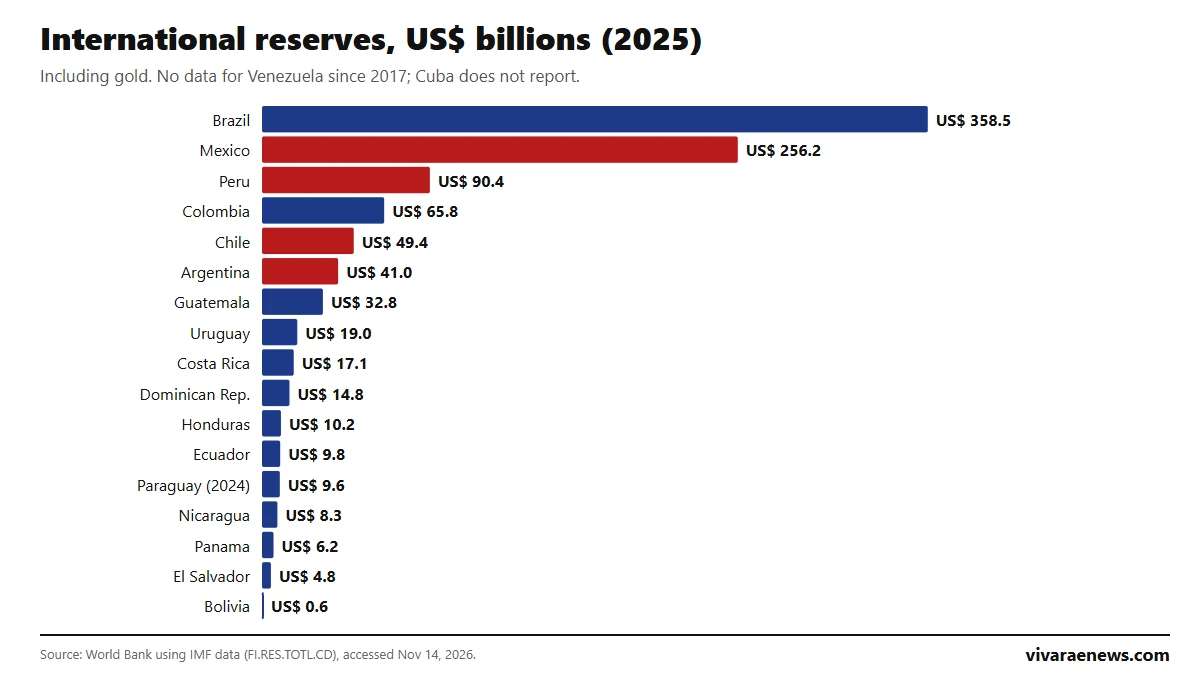
In practice, the cut changes nothing for people's pockets: Mexico has never used the line and still has access to US$18 billion if needed. For markets, it signals that the country feels better protected by its own reserves, which reached US$257.905 billion on November 6, according to the Bank of Mexico as quoted by Bloomberg Línea. That is the highest figure in the region after Brazil, as our ranking of international reserves in Latin America shows.
The announcement comes amid weeks of pressure on the peso and trade tension with the United States. For context, see why the Mexican peso fell for six weeks in a row and the ranking of interest rates in Latin America.
Frequently asked questions
How large is Mexico's flexible credit line?
SDR 13.369 billion, about US$18 billion, since the IMF review of November 11, 2026. Before, it was about US$24 billion.
Has Mexico used the IMF credit line?
No. Since 2009 it has kept it as precautionary insurance, without drawing on it.
Why did Mexico ask to reduce it?
The authorities say international reserves, at US$257.905 billion, already cover the line several times over, and keeping it available has a cost.
How long does the arrangement last?
The current arrangement was approved on November 13, 2025 for two years, so it expires in November 2027.