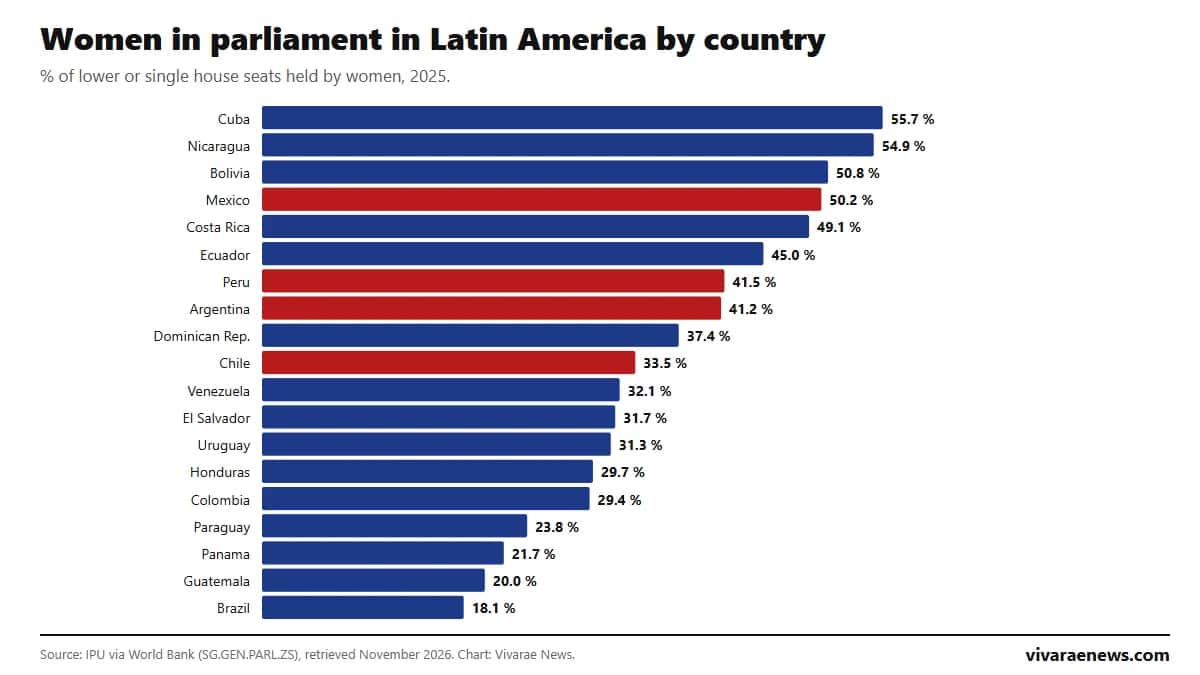
Cuba is the Latin American country with the highest share of women in parliament: 55.7% of the seats in its single chamber, according to Inter-Parliamentary Union (IPU) data published by the World Bank for 2025. It is followed by Nicaragua (54.9%), Bolivia (50.8%) and Mexico (50.2%), all four with a female majority or parity. At the other end, Brazil has just 18.1% women deputies, the lowest figure in the region, followed by Guatemala (20.0%) and Panama (21.7%).
The Latin America and Caribbean average is 36.6%, above that of OECD countries (33.4%) and the world average (27.2%). Elections since 2025 change the picture: Costa Rica elected in February 2026 an Assembly with 30 women out of 57 seats (52.6%), and Peru opened a bicameral Congress with 36.8% women. This ranking will be updated on this same page when the IPU and the World Bank publish new data.
Ranking of women in parliament in Latin America
| Rank | Country | Women in lower or single house (2025) | 2015 | 2000 |
|---|---|---|---|---|
| 1 | Cuba | 55.7% | 48.9% | 27.6% |
| 2 | Nicaragua | 54.9% | 41.3% | 9.7% |
| 3 | Bolivia | 50.8% | 53.1% | 11.5% |
| 4 | Mexico | 50.2% | 42.4% | 16.0% |
| 5 | Costa Rica | 49.1% | 33.3% | 19.3% |
| 6 | Ecuador | 45.0% | 41.6% | 14.6% |
| 7 | Peru | 41.5% | 22.3% | — |
| 8 | Argentina | 41.2% | — | 26.5% |
| 9 | Dominican Republic | 37.4% | 20.8% | 16.1% |
| 10 | Chile | 33.5% | 15.8% | 10.8% |
| 11 | Venezuela | 32.1% | 17.0% | — |
| 12 | El Salvador | 31.7% | 32.1% | 9.5% |
| 13 | Uruguay | 31.3% | 16.2% | 12.1% |
| 14 | Honduras | 29.7% | 25.8% | 9.4% |
| 15 | Colombia | 29.4% | 19.9% | 11.8% |
| 16 | Paraguay | 23.8% | 15.0% | 2.5% |
| 17 | Panama | 21.7% | 18.3% | 9.9% |
| 18 | Guatemala | 20.0% | 13.9% | 8.9% |
| 19 | Brazil | 18.1% | 9.9% | 5.7% |
Source: World Bank, indicator SG.GEN.PARL.ZS, proportion of seats held by women in the lower or single house of national parliament, with IPU data; retrieved November 1, 2026. In bicameral countries only the lower house is counted (for example, the Chamber of Deputies). "—": no data that year.
Changes in Latin American parliaments after the data
The World Bank's 2025 figure already reflects some recently renewed chambers, but not all. Checked against official and press sources in each country, these are the cases that change or should be read carefully:
| Country | World Bank figure | Updated figure | Source |
|---|---|---|---|
| Costa Rica | 49.1% (28 of 57) | 52.6% (30 of 57), 2026-2030 Assembly elected on February 1, 2026 | CRHoy, Delfino |
| Peru | 41.5% (2021-2026 unicameral Congress) | 36.8% (70 of 190) in the 2026-2031 bicameral Congress (130 deputies and 60 senators) | El Peruano |
| Chile | 33.5% | 33.5% (52 of 155) in the 2026-2030 Chamber; the Senate has 32% | Chamber of Deputies, BCN |
In Peru, the 36.8% figure adds both chambers; the final breakdown of women deputies and senators separately was not published in the official sources consulted. Bolivia and Honduras, which also renewed their assemblies between 2025 and 2026, show increases in the 2025 figure compared with 2024 (from 46.2% to 50.8% and from 27.3% to 29.7%), but we could not verify their figures with each country's official sources. Colombia renewed its Chamber in July 2026 and the 29.4% figure corresponds to the previous term.

Why some Latin American countries have more women in parliament
The countries at the top of the ranking share mandatory parity rules or quotas on candidate lists. Mexico added gender parity to its Constitution in 2019, and its Chamber of Deputies is 50.2% women; the country's presidency is also held by a woman, as detailed in our guide to Mexico's 2027 elections. Bolivia, Costa Rica, Ecuador and Nicaragua also apply parity on lists.
- Chile went from 15.8% women deputies in 2015 to more than a third after the 2015 quota law (Law 20,840), which prevents either sex from exceeding 60% of each party's candidates.
- Brazil has required since 1997 that at least 30% of candidates be of each sex, but does not reserve seats, and remains last in the region.
- Cuba and Nicaragua top the ranking, although their parliaments do not come from competitive elections comparable to those in the rest of the region, so the figure measures presence and not necessarily political power.
The data does not say how much they earn or what posts they hold within Congress. To compare salaries, see how much a deputy earns in Chile, how much a deputy earns in Mexico and how much a member of Congress earns in Peru.

How the presence of women in parliaments has changed since 2000
In 2000, no country in the region exceeded 30% women in its lower house: the highest was Cuba, with 27.6%, and Paraguay had 2.5%. In 25 years, the regional average rose to 36.6%. The biggest jumps were in Nicaragua (+45.3 points), Bolivia (+39.2), Mexico (+34.2) and Costa Rica (+29.8), all with parity rules. Brazil advanced 12.5 points, the smallest progress among countries with complete data.
| Country | 2000 | 2025 | Change (points) |
|---|---|---|---|
| Nicaragua | 9.7% | 54.9% | +45.3 |
| Bolivia | 11.5% | 50.8% | +39.2 |
| Mexico | 16.0% | 50.2% | +34.2 |
| Ecuador | 14.6% | 45.0% | +30.4 |
| Costa Rica | 19.3% | 49.1% | +29.8 |
| Chile | 10.8% | 33.5% | +22.7 |
| Brazil | 5.7% | 18.1% | +12.5 |
Source: World Bank, SG.GEN.PARL.ZS; change in percentage points is our own calculation with unrounded values.
- Definition: percentage of seats held by women in the lower or single house, according to the IPU.
- Cut-off date: the IPU updates its database monthly; the World Bank publishes an annual value.
- Limitation: it does not include senates or subnational parliaments.
How to cite this data
Vivarae News (2026). "Women in parliament in Latin America 2026: ranking by country". Updated on November 1, 2026. Available at https://vivaraenews.com/en/women-in-parliament-in-latin-america-ranking-by-country-2026/. The data may be reproduced by citing Vivarae News and linking to this page; each country's figures belong to the Inter-Parliamentary Union and the World Bank.
Frequently asked questions
Which Latin American country has the most women in parliament?
Cuba, with 55.7% of seats in 2025, followed by Nicaragua (54.9%), Bolivia (50.8%) and Mexico (50.2%), according to the IPU and the World Bank.
Which Latin American country has the fewest women in parliament?
Brazil, with 18.1% women deputies, followed by Guatemala (20.0%) and Panama (21.7%).
How many women are there in Chile's Chamber of Deputies?
52 of 155, or 33.5%, in the 2026-2030 term. In the Senate, women are 32%.
How many women are there in Peru's Congress?
70 of 190 legislators (36.8%) in the 2026-2031 bicameral Congress, according to El Peruano.
What is the Latin American average?
36.6% in 2025, compared with 33.4% in the OECD and 27.2% worldwide.