The monetary policy rate (TPM) is the benchmark interest rate set by the Central Bank of Chile to keep inflation close to its 3% annual target, and it has stood at 4.5% since December 17, 2025, according to the series of the [Bank for International Settlements](https://data.bis.org/topics/CBPOL) (BIS) with data from the [Central Bank of Chile](https://www.bcentral.cl/). The Central Bank's board decides it again on Tuesday, October 27, 2026.
Nobody pays the TPM directly, but it influences interest on consumer loans, mortgages, time deposits and even the dollar. This guide explains what the monetary policy rate is, how it works, how it reaches your wallet and how it has moved over almost 20 years.
What the monetary policy rate is
It is the rate at which the Central Bank wants banks to lend each other money overnight (the interbank rate). By moving that rate, the Central Bank makes money more or less expensive across the economy. The logic is simple:
| If the Central Bank… | What it seeks | Expected effect |
|---|---|---|
| Raises the TPM | To curb high inflation | More expensive loans, less consumption and less pressure on prices |
| Cuts the TPM | To support a weak economy when inflation is under control | Cheaper loans, more consumption and investment |
| Holds the TPM | To wait for more data or keep the current level | Market rates move with expectations about the future |
The goal is inflation measured by the CPI (see what the CPI is). The Central Bank aims for annual inflation of 3% over a horizon of around two years, with a tolerance range of one percentage point above and below.
How the monetary policy rate is decided in Chile
- Who decides: the Central Bank's five-member board, which is independent from the government.
- When: at eight monetary policy meetings (RPM) a year, on a calendar published in advance. The October 2026 meeting is on Monday the 26th and Tuesday the 27th.
- How it is announced: with a statement at the end of the meeting, at 6:00 p.m. on the second day. The minutes of each meeting are published later.
- What it looks at: inflation, activity (Imacec), employment, the exchange rate, the external outlook and market expectations, such as the Financial Traders Survey.
For Tuesday's meeting, traders expect the rate to stay at 4.5% (see what traders expect for October 27).

The monetary policy rate since 2007
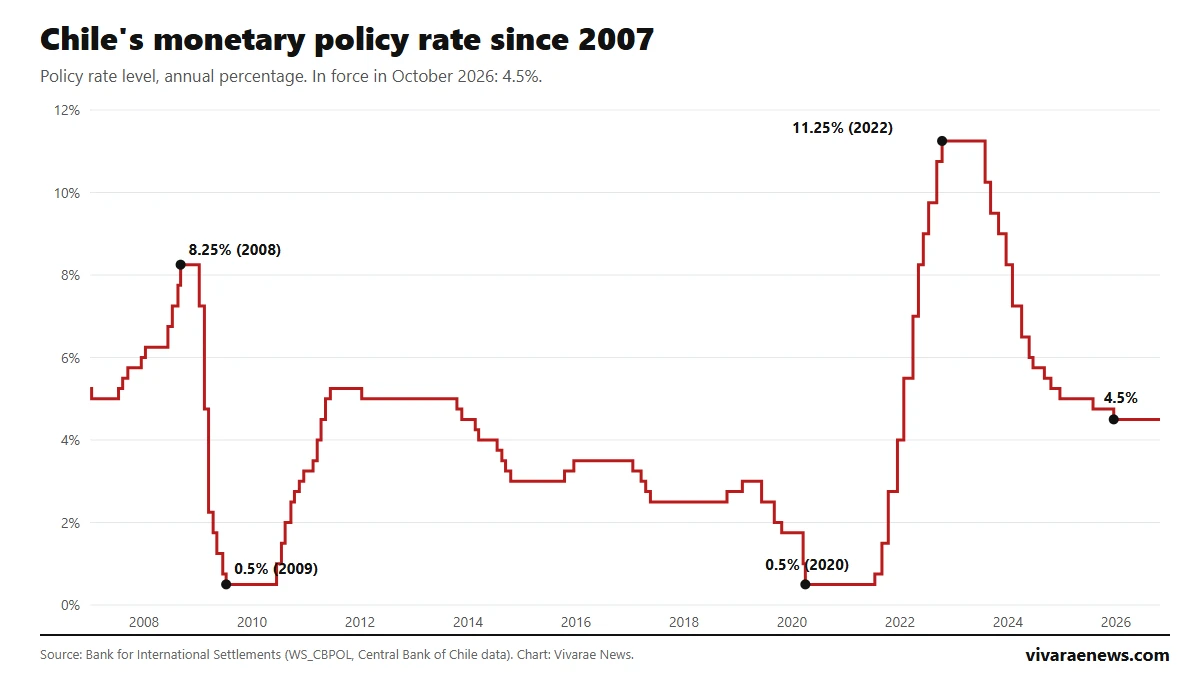
The TPM has covered almost the whole possible range in two decades: from 0.5% during the 2009 and 2020 crises to 11.25% in 2022, when inflation exceeded 14%.
| Year or episode | TPM | Context |
|---|---|---|
| September 2008 | 8.25% | Rising inflation before the financial crisis |
| July 2009 | 0.5% | Cuts after the global financial crisis |
| June 2011 | 5.25% | Normalization after the recovery |
| April 2020 | 0.5% | Technical floor during the pandemic |
| October 2022 | 11.25% | Highest in the series since 2007, due to post-pandemic inflation |
| July 2023 | 10.25% | Start of the cuts |
| December 2024 | 5% | End of a year with seven cuts |
| July 2025 | 4.75% | Cut |
| December 2025 | 4.5% | Latest change; current level |
Source: BIS, central bank policy rate series, which compiles Central Bank of Chile data. Dates are when each change took effect. The chart shows the full series:
How the TPM affects your wallet
| Product | What happens when the TPM rises | How fast |
|---|---|---|
| Consumer loans and credit cards | Their rates rise | Fast, within weeks or months |
| Mortgages | They rise, although they depend more on long-term rates | Slower |
| Time deposits | They pay more interest | Fast |
| Dollar | Tends to fall, because investing in pesos pays more | Variable; many other factors matter |
| Jobs and activity | They cool down | With a lag of several quarters |
These effects are tendencies, not exact rules: copper prices, U.S. interest rates and uncertainty weigh as much or more on the exchange rate (see what the observed dollar is). Mortgages in UF depend mainly on long-term rates (see what the UF is).
Chile compared with the region
With a 4.5% rate and 4.1% inflation in September, Chile's real rate is around 0.4 points, one of the lowest among the region's large economies. Brazil (13.75%) and Colombia (12.25%) have the highest rates. The full comparison, with real rates, is in our ranking of interest rates in Latin America.
Frequently asked questions
What is the TPM?
The benchmark interest rate set by the Central Bank of Chile to control inflation. It influences interest on loans and deposits.
What is the TPM today?
4.5%, in force since December 17, 2025. The Central Bank decides again on October 27, 2026.
Who sets the monetary policy rate?
The five-member board of the Central Bank of Chile, at eight meetings a year.
What has been the highest TPM?
Since 2007, 11.25%, between October 2022 and July 2023.
Why does the TPM go up?
To curb inflation: it makes credit more expensive, reduces consumption and lowers pressure on prices.