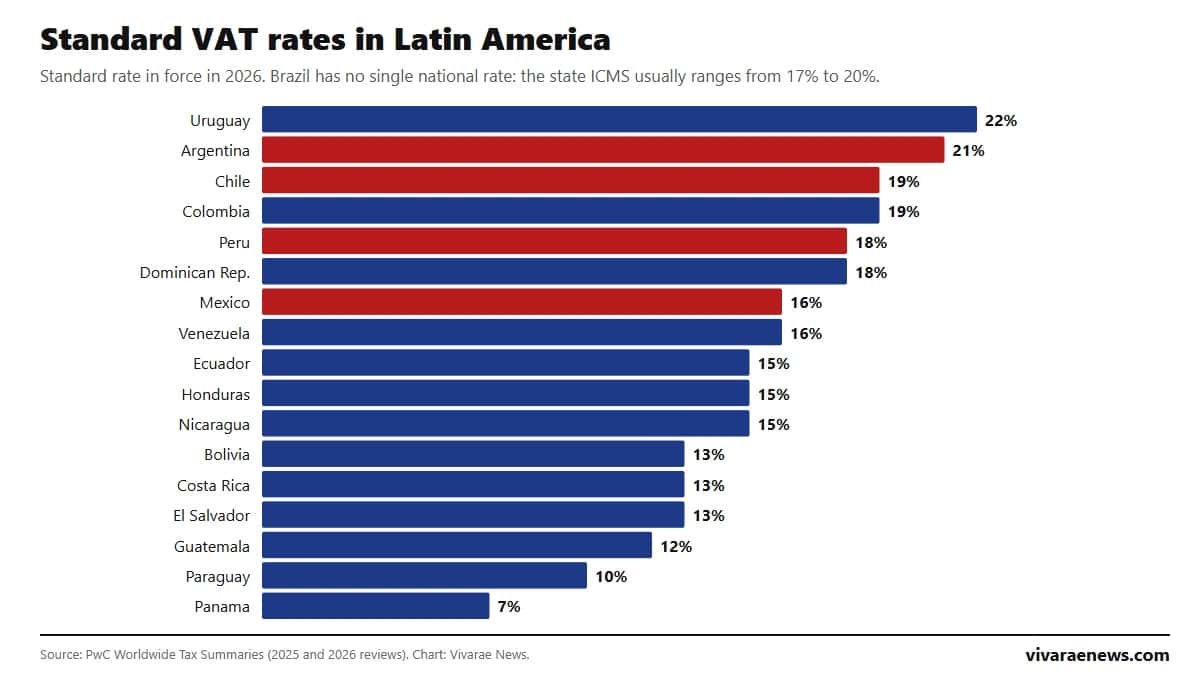
Uruguay has the highest standard value-added tax (VAT) rate in Latin America, 22%, followed by Argentina at 21% and Chile and Colombia at 19%, according to the country tax summaries of [PwC Worldwide Tax Summaries](https://taxsummaries.pwc.com/uruguay/corporate/other-taxes) reviewed in 2025 and 2026. Panama, at 7%, and Paraguay, at 10%, have the lowest rates. Brazil has no single national VAT.
VAT is the tax paid when buying goods and services, which each company in the chain passes on until it reaches the final consumer. This ranking compares the standard rate of 17 countries; we will update it on this same page when any of them changes it.
VAT ranking in Latin America
| Rank | Country | Standard rate | Name of the tax | Reduced or special rates |
|---|---|---|---|---|
| 1 | Uruguay | 22% | IVA | 10% for food, medicines, hotels and health |
| 2 | Argentina | 21% | IVA | 10.5% (home building, cattle, some loans and others) and 27% (non-residential utilities) |
| 3 | Chile | 19% | IVA | No general reduced rate |
| 3 | Colombia | 19% | IVA | 5% and 0% for selected goods |
| 5 | Peru | 18% | IGV (16%) + IPM (2%) | Exports zero-rated |
| 5 | Dominican Republic | 18% | ITBIS | Exemptions for basic food, health and education |
| 7 | Mexico | 16% | IVA | Exemptions for medicine, education and housing |
| 7 | Venezuela | 16% | IVA | 8% reduced; additional 5% to 25% on payments in foreign currency |
| 9 | Ecuador | 15% | IVA | 0% for goods listed in the law |
| 9 | Honduras | 15% | ISV (sales tax) | 18% for alcohol, tobacco and first-class air tickets |
| 9 | Nicaragua | 15% | IVA | Exemptions for medicines and basic food |
| 12 | Bolivia | 13% | IVA | Since Law 1733 it is shown separately on invoices |
| 12 | Costa Rica | 13% | IVA | 4%, 2%, 1% and 0.5% for health, education and basic food |
| 12 | El Salvador | 13% | IVA | Exports zero-rated |
| 15 | Guatemala | 12% | IVA | Specific exemptions |
| 16 | Paraguay | 10% | IVA | 5% for the family basket, farm products and housing |
| 17 | Panama | 7% | ITBMS | 10% for alcohol and hotels; 15% for tobacco |
Source: PwC Worldwide Tax Summaries, other taxes section for each country: Uruguay, Argentina, Chile, Colombia, Peru, Dominican Republic, Mexico, Venezuela, Ecuador, Honduras, Nicaragua, Bolivia, Costa Rica, El Salvador, Guatemala, Paraguay and Panama. Reviews range from December 2025 (Chile) to October 2026 (Paraguay). The split of Peru's 18% into IGV and IPM is set by Peruvian law.
The case of Brazil: why it has no single tax
Brazil levies three separate indirect taxes: the state ICMS, which in most states ranges from 17% to 20% (18% in São Paulo); the federal IPI on industrialized products; and the municipal ISS, of 2% to 5% on services, according to PwC. A tax reform will gradually replace them with a dual VAT; 2026 is a pilot year to adapt systems, and the new rates will be phased in over the following years. That is why Brazil is not in the ranking: there is no comparable national rate.

VAT in Chile, Mexico, Argentina and Peru compared with the region
| Country | Standard rate | Rank | Reduced rate for food? |
|---|---|---|---|
| Argentina | 21% | 2nd | Yes, 10.5% for some items |
| Chile | 19% | 3rd | No |
| Peru | 18% | 5th | No, with specific exemptions |
| Mexico | 16% | 7th | Basic food and medicines exempt or zero-rated |
Source: PwC. Chile is one of the few countries in the region that applies the standard rate to almost all food; others, such as Uruguay, Costa Rica or Paraguay, tax it at reduced rates. The standard rate alone is not enough to compare tax burdens: exemptions, evasion and the weight of other taxes also matter. For each country's fiscal context, see our public debt ranking.

Recent VAT changes in Latin America
- Ecuador now charges 15%; for years its standard rate was 12%.
- Bolivia changed its invoicing rules with Law 1733: the 13% VAT is no longer included in the net price and must be shown separately, according to PwC.
- Brazil began the transition to a dual VAT in 2026.
- Venezuela can set the standard rate each year between 8% and 16.5%; it is currently 16%.
Sources: PwC Ecuador, PwC Bolivia, PwC Brazil and PwC Venezuela. More regional comparisons in our rankings of gasoline prices and inflation.
How to cite this data
Vivarae News (2026). "VAT rates in Latin America 2026: ranking by country". Updated October 26, 2026. Available at https://vivaraenews.com/en/vat-rates-in-latin-america-ranking-by-country-2026/. The data may be reproduced by citing Vivarae News and linking to this page; each country's figures belong to their original source.
Frequently asked questions
Which Latin American country has the highest VAT?
Uruguay, with a standard rate of 22%, followed by Argentina (21%) and Chile and Colombia (19%).
Which country has the lowest VAT?
Panama, with 7%, followed by Paraguay, with 10%.
What is the VAT rate in Chile?
19%, one of the highest in the region, with no general reduced rate.
What is the VAT rate in Mexico, Argentina and Peru?
Mexico 16%, Argentina 21% and Peru 18% (16% IGV plus a 2% municipal promotion tax).
Why is Brazil not in the ranking?
Because it has no single national VAT: it levies the state ICMS, the federal IPI and the municipal ISS, and is moving to a dual VAT.