Peru's government published on Sunday, November 8, in an extraordinary edition of the official gazette El Peruano, its first legislative decrees issued under the powers delegated by Congress: Legislative Decree 1742, which allows the Armed Forces to guard the outside of prisons under a state of emergency; Decree 1743, which changes the rules on self-defense; and Decree 1744, which punishes with 10 to 15 years in prison anyone who lends a bank account or digital wallet to collect extortion payments. The decrees are signed by President Keiko Fujimori and Prime Minister Luis Galarreta.
The most debated change concerns self-defense: from now on, anyone who defends themselves from an attack is presumed to have acted reasonably, and it is up to prosecutors to prove otherwise. Justice Minister Ernesto Álvarez summed it up to the press: "It is about protecting the citizen and no longer the criminal," according to El Comercio. This article explains what each decree says, what changes in practice and what experts point out.
View the data as a table
| Legislative decrees published on November 8 | 3 |
| Days of delegated powers | 90 |
| Years in prison for lending accounts to extortionists | 10–15 |
| Votes in favor in the Senate | 35 |
What Legislative Decree 1743 changes in self-defense
Legislative Decree 1743 amends paragraph 3 of Article 20 of the Penal Code, which exempts from criminal liability anyone acting in self-defense of their own or third parties' legal interests. According to the official summary published by El Peruano, the decree:
| Change | What it says |
|---|---|
| Presumption of reasonableness | Anyone exercising self-defense is presumed to have acted reasonably against the attack; prosecutors must prove otherwise. |
| Standard for the means used | Proportionality of means is no longer the standard; the intensity and danger of the attack, the aggressor's conduct, the available means and the interests protected are considered. |
| Point of view | Reasonableness is assessed from the perspective of the person defending themselves and the circumstances at the time. |
| Qualified reasoning | A court ruling rejecting the presumption must give qualified reasoning, on pain of nullity; this also applies to ongoing cases. |
| Prosecutor's dismissal (Art. 334 of the Code of Criminal Procedure) | If the requirements are met, the prosecutor declares that the investigation should not be formalized and orders the case closed. |
Source: El Peruano, November 9, 2026. The decree is funded from the budgets of the agencies involved, with no additional demand on the Treasury. According to El Comercio, Minister Álvarez said self-defense cases used to take years to resolve and that "this has to be cut short, and it has been."
Self-defense: what criminal lawyers say
Lawyer Carlos Caro Coria explained in El Peruano that the reform reverses the burden: "the defense is presumed to be appropriate, and it is the prosecutor who has to prove otherwise." He warned, however, that the presumption does not apply if the attack never happened or had already ended, and that courts could review its constitutionality because "proportionality is not presumed." Criminal lawyer Vladimir Padilla told El Comercio that the practical effect may be limited, because "the prosecutor will always remain the referee."

Legislative Decree 1744: prison for lending accounts to extortionists
Legislative Decree 1744 adds a paragraph 3 to Article 200 of the Penal Code, which defines extortion. It applies the extortionist's penalty, 10 to 15 years in prison, to anyone who, knowing or having to presume the criminal purpose, lends bank accounts, digital wallets or e-money accounts to receive extortion money, according to El Comercio. Besides Fujimori, Galarreta and Álvarez, it is signed by Interior Minister César Astudillo.
The rule targets the "mule" accounts that gangs use to collect protection payments from transport workers and shopkeepers, a practice that runs through wallets such as Yape and Plin. Caro Coria called it "necessary" and "a teaching law": "lending your digital wallet is like lending a gun," he told El Comercio.
Legislative Decree 1742: Armed Forces at prisons
Legislative Decree 1742, the first in the series, authorizes the "exceptional and temporary" participation of the Armed Forces in the external security of prisons declared under emergency, in support of the National Penitentiary Institute (INPE) and the police, according to IusLatin. Troops will patrol perimeters, tighten controls against weapons and illegal substances, counter unauthorized drones and provide logistical and technological support to block illegal communications.
According to Correo, the measure adds to the extension until January 2027 of the state of emergency at the Challapalca (Tacna), Cochamarca (Pasco), Miguel Castro Castro and Ancón I (Lima) and El Milagro (La Libertad) prisons.
| Decree | Subject | What it does | Signatories |
|---|---|---|---|
| Leg. Decree 1742 | Prisons | Armed Forces in external security of prisons under emergency | Council of Ministers |
| Leg. Decree 1743 | Self-defense | Presumption of reasonableness; prosecutors must prove excess | Fujimori, Galarreta, Álvarez |
| Leg. Decree 1744 | Extortion | 10 to 15 years for lending accounts or wallets to extortionists | Fujimori, Galarreta, Álvarez, Astudillo |
Sources: El Peruano, El Comercio, IusLatin and Altavoz. The signatories of Leg. Decree 1742 do not appear in the summaries consulted.
The delegated powers: 90 days and what comes next
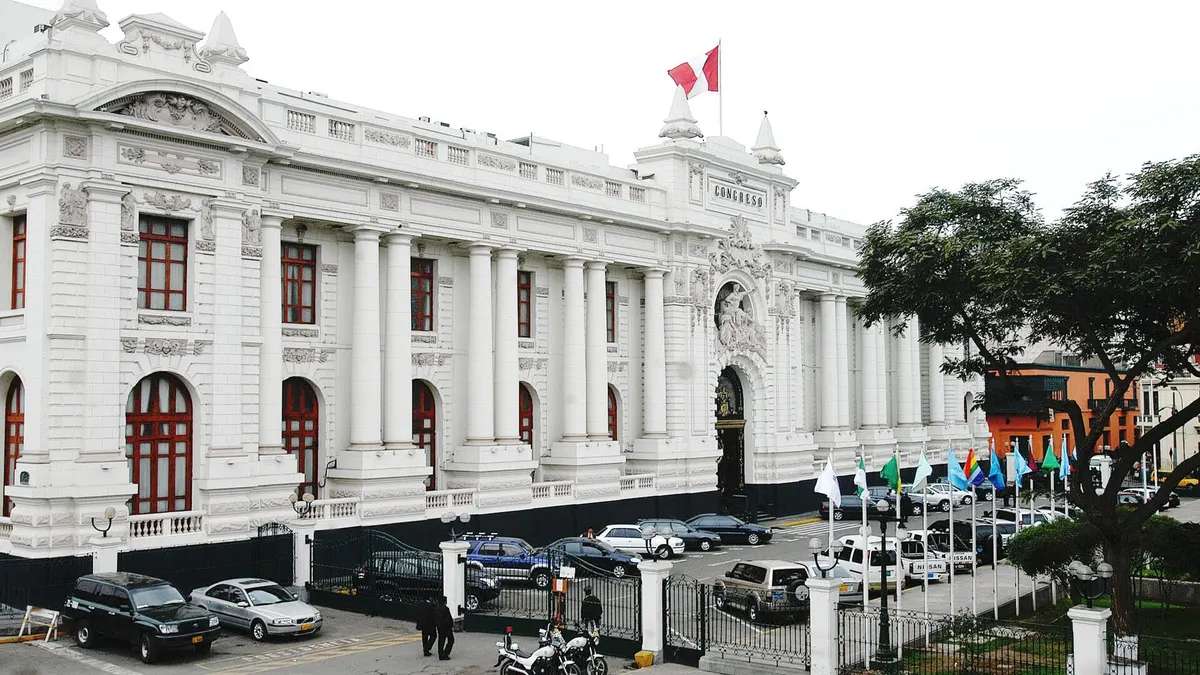
The Senate plenary approved on October 21, with 35 votes in favor, 18 against and 6 abstentions, delegating to the Executive the power to legislate for 90 days on public security and El Niño prevention, as Vivarae reported in its article on the delegated matters. Legislative decrees have the force of law, and Congress can amend or repeal them after publication.
View the data as a table
| seats | |
|---|---|
| In favor | 35 |
| Abstention | 6 |
| Against | 18 |
| Total | 59 |
- Oct 21, 2026Senate approves 90 days of delegated powers35 in favor, 18 against, 6 abstentions.
- Nov 8, 2026Leg. Decree 1742: troops at prisonsFirst rule issued under the powers.
- Nov 8, 2026Leg. Decrees 1743 and 1744Self-defense and accounts lent to extortionists.
- Nov 9, 2026Álvarez defends the reformThe justice minister answers critics.
According to the state news agency Andina, Minister Álvarez also announced a legislative decree to speed up prison construction. For context on the government, see the mega-prisons Peru is proposing and Keiko Fujimori's approval rating according to Ipsos.
Frequently asked questions
What is Legislative Decree 1743?
It is the rule that changes self-defense in Peru's Penal Code: it presumes that the person defending themselves acted reasonably and requires prosecutors to prove any excess.
When does it take effect?
Upon publication in El Peruano, in the extraordinary edition of November 8, 2026. The qualified-reasoning requirement also applies to ongoing cases.
What is the penalty for lending an account to extortionists?
10 to 15 years in prison, the same as for the extortionist, if the person knew or should have presumed the criminal purpose (Legislative Decree 1744).
Can Congress change these decrees?
Yes. Legislative decrees have the force of law, and Congress can amend or repeal them.