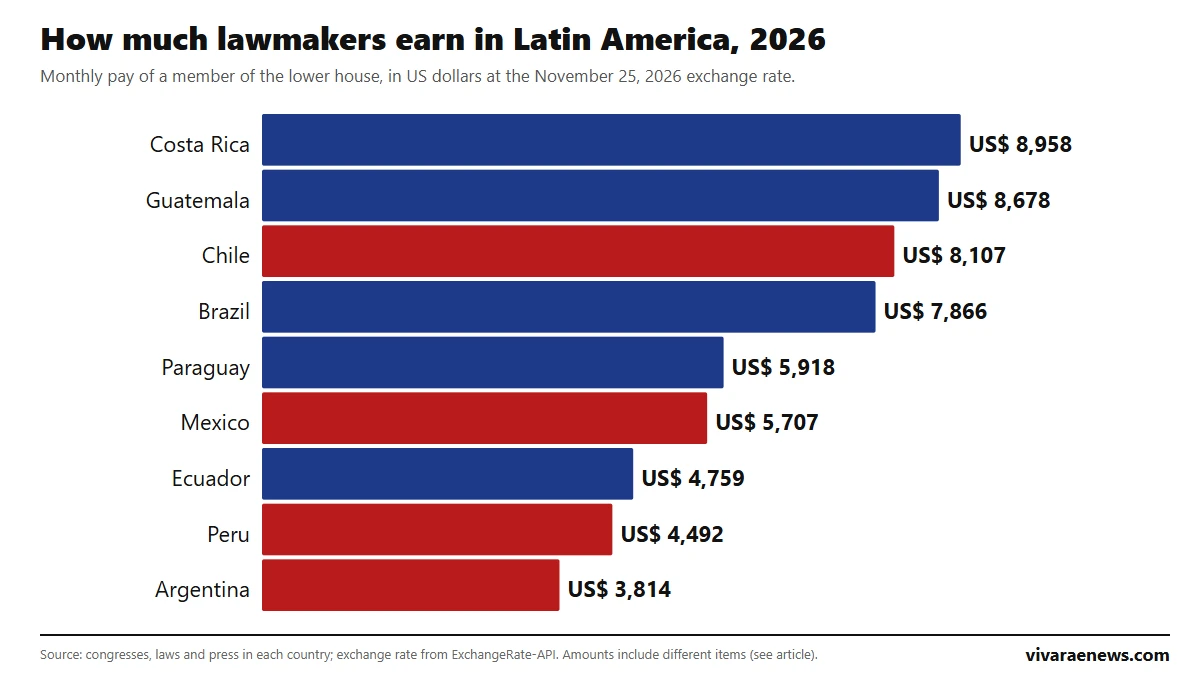
A member of Costa Rica's legislature can earn up to US$8,958 a month, the highest amount in Latin America in 2026, followed by Guatemala (US$8,678) and Chile (US$8,107), according to a Vivarae News ranking based on official or published amounts in nine countries, converted to dollars at the November 25, 2026 exchange rate. At the other end are Argentina, at US$3,814, and Peru, at US$4,492. Measured in minimum wages, the ranking changes: a Brazilian deputy earns 28.6 times the country's minimum wage, far above the rest (between 9.9 and 16.6 times).
Comparing legislative salaries is not simple: each country pays through different items (salary, representation expenses, attendance) and the dollar result depends on the exchange rate. That is why the table states what each amount includes and links to the source. We only include countries with a verifiable figure from 2025 or 2026; the rest are left out, as we explain at the end.
View the data as a table
| Costa Rica | US$ 8,958 |
| Chile | US$ 8,107 |
| Argentina | US$ 3,814 |
| Brazil, in minimum wages | 28.6x |
Ranking: how much lawmakers earn in Latin America in dollars
| Rank | Country | Monthly amount in local currency | US$ | What it includes | Source |
|---|---|---|---|---|---|
| 1 | Costa Rica | ₡ 4,000,714 | 8,958 | Attendance allowances (₡2,956,714) + representation expenses (₡1,044,000) | source (September 2026) |
| 2 | Guatemala | Q 66,300 | 8,678 | Base salary (Q46,700) + representation, plenary and committee allowances | source (July 2026) |
| 3 | Chile | $ 8,239,091 | 8,107 | Gross salary (dieta) | source (September 2026) |
| 4 | Brazil | R$ 46,366.19 | 7,866 | Gross salary (same as senators) | source (October 2026) |
| 5 | Paraguay | ₲ 37,900,000 | 5,918 | Salary + representation expenses | source (February 2026) |
| 6 | Mexico | $ 110,578.67 | 5,707 | Gross salary (net: 79,846 pesos) | source (2026 Pay Manual) |
| 7 | Ecuador | US$ 4,759 | 4,759 | Basic pay (excluding per diems and residence allowance) | source (in force since 2019) |
| 8 | Peru | S/ 15,600 | 4,492 | Salary (about S/ 32,000 with allowances) | source (2026) |
| 9 | Argentina | $ 6,072,000 | 3,814 | Gross salary (net: about 4.3 million pesos) | source (July 2026) |
Conversion: ExchangeRate-API exchange rates of November 25, 2026 (1 dollar = 1,016.25 Chilean pesos, 19.38 Mexican pesos, 1,592.02 Argentine pesos, 3.473 soles, 5.894 reais, 446.59 colones, 6,404 guaraníes and 7.640 quetzales). Ecuador uses the dollar. In Costa Rica the figure is the maximum: allowances are docked if the lawmaker misses sessions.
View the data as a table
| Costa Rica | US$ 8,958 · ₡ 4,000,714 |
| Guatemala | US$ 8,678 · Q 66,300 |
| Chile | US$ 8,107 · $ 8,239,091 |
| Brazil | US$ 7,866 · R$ 46,366.19 |
| Paraguay | US$ 5,918 · ₲ 37,900,000 |
| Mexico | US$ 5,707 · $ 110,578.67 |
| Ecuador | US$ 4,759 · US$ 4,759 |
| Peru | US$ 4,492 · S/ 15,600 |
| Argentina | US$ 3,814 · $ 6,072,000 |
How many minimum wages a lawmaker earns in each country
Measuring lawmakers' pay against their country's minimum wage corrects for exchange rates and the cost of living. By that yardstick, Brazil comes first by far (28.6 times), followed by Guatemala (16.6) and Argentina (15.2), which was last in dollars. Costa Rica and Ecuador, by contrast, rank low because their minimum wages are among the highest in the region.
| Country | Monthly minimum wage | Times the minimum |
|---|---|---|
| Brazil | R$ 1,621 | 28.6 |
| Guatemala | Q 4,002.28 | 16.6 |
| Argentina | $ 398,800 | 15.2 |
| Chile | $ 553,553 | 14.9 |
| Peru | S/ 1,230 | 12.7 |
| Paraguay | ₲ 3,044,000 | 12.5 |
| Mexico | $ 9,582.47 | 11.5 |
| Costa Rica | ₡ 373,092.30 | 10.7 |
| Ecuador | US$ 482 | 9.9 |
Minimum wages: Brazil, R$1,621 (Decree 12,797); Guatemala, Q4,002.28 for non-agricultural activities in the department of Guatemala, excluding the Q250 bonus (La Hora); Argentina, 398,800 pesos in November; Chile, 553,553 pesos; Peru, S/ 1,230; Paraguay, ₲3,044,000 since July (Bloomberg Línea); Mexico, 9,582.47 pesos; Costa Rica, ₡373,092 for unskilled workers; Ecuador, US$482 (El Universo). Chile, Mexico, Peru and Argentina's figures are those published in our country reports.
View the data as a table
| Monthly pay, US$ | Minimum wages | |
|---|---|---|
| Costa Rica | 8,958 | 11 |
| Guatemala | 8,678 | 17 |
| Chile | 8,107 | 15 |
| Brazil | 7,866 | 29 |
| Paraguay | 5,918 | 13 |
| Mexico | 5,707 | 12 |
| Ecuador | 4,759 | 10 |
| Peru | 4,492 | 13 |
| Argentina | 3,814 | 15 |
| Country | Rank in dollars | Rank in minimum wages | Change |
|---|---|---|---|
| Costa Rica | 1 | 8 | ▼ 7 |
| Guatemala | 2 | 2 | = |
| Chile | 3 | 4 | ▼ 1 |
| Brazil | 4 | 1 | ▲ 3 |
| Paraguay | 5 | 6 | ▼ 1 |
| Mexico | 6 | 7 | ▼ 1 |
| Ecuador | 7 | 9 | ▼ 2 |
| Peru | 8 | 5 | ▲ 3 |
| Argentina | 9 | 3 | ▲ 6 |
Argentina is the most striking case: last in dollars because of the weak peso, but third when measured against its minimum wage. Costa Rica goes the opposite way, from first to eighth, because its minimum wage is among the highest in the region. Chile stays near the top on both measures.
How much lawmakers earn in Latin America, country by country
- Costa Rica: allowances (₡2,956,714) are paid for attending sessions and committees; representation expenses (₡1,044,000) are fixed. In September, the Board ruled out a raise of about ₡147,000 for 2027.
- Guatemala: Q46,700 base salary, Q5,000 in representation expenses, Q9,600 for attending plenary sessions and Q5,000 for committees, according to La Hora.
- Chile: the salary is set by the Remuneration Commission, not by lawmakers themselves; it is the same for deputies and senators.
- Brazil: the R$46,366.19 salary has applied since February 2025 under Legislative Decree 172/2022 and is docked for unjustified absences.
- Argentina: senators earn more than twice as much as deputies, because their pay is tied to legislative staff wage deals.
- Peru: since July 2026 Congress has two chambers (130 deputies and 60 senators) and all earn a salary of S/ 15,600.
For the Argentine case in detail, see how much a deputy and a senator earn in Argentina; for who sits in those chambers, see women in Congress in Latin America.
Methodology: which countries are left out of the lawmakers ranking
We use the monthly amount of a lower-house (or unicameral congress) member published by the congress itself, by law or by media citing the official payroll, converted to dollars at a single exchange rate on a single date. We do not add allowances for staff, offices or per diems, which are not salary. Countries without a verifiable 2025 or 2026 figure were left out: Colombia, where pay would be around 55 million pesos gross a month according to Portafolio, but the decree that eliminated the special bonus was suspended by the Council of State and we did not find the official amount in force; and Uruguay, Bolivia, El Salvador, Honduras, Panama, the Dominican Republic, Nicaragua, Venezuela and Cuba. We will update this same page when amounts change or we confirm new countries.
How to cite this data
You may use the figures and chart on this page by citing VIVARAE NEWS and each country's original source: Vivarae News (2026). "How much do lawmakers earn in Latin America: ranking by country 2026". Updated November 25, 2026. https://vivaraenews.com/en/how-much-do-lawmakers-earn-in-latin-america-ranking-by-country-2026/
Frequently asked questions
Which Latin American country pays its lawmakers the most?
Costa Rica, with up to US$8,958 a month in 2026, followed by Guatemala (US$8,678) and Chile (US$8,107), among the nine countries with a verifiable figure.
How much does a Chilean lawmaker earn in dollars?
About US$8,107 a month: a gross salary of 8,239,091 pesos, ranking 3rd of nine countries.
Where do lawmakers earn the least?
In Argentina (US$3,814) and Peru (US$4,492). But in minimum wages, an Argentine deputy earns 15.2 times the minimum, more than in Chile or Mexico.
How often is this ranking updated?
Whenever amounts or exchange rates change significantly, on this same page.