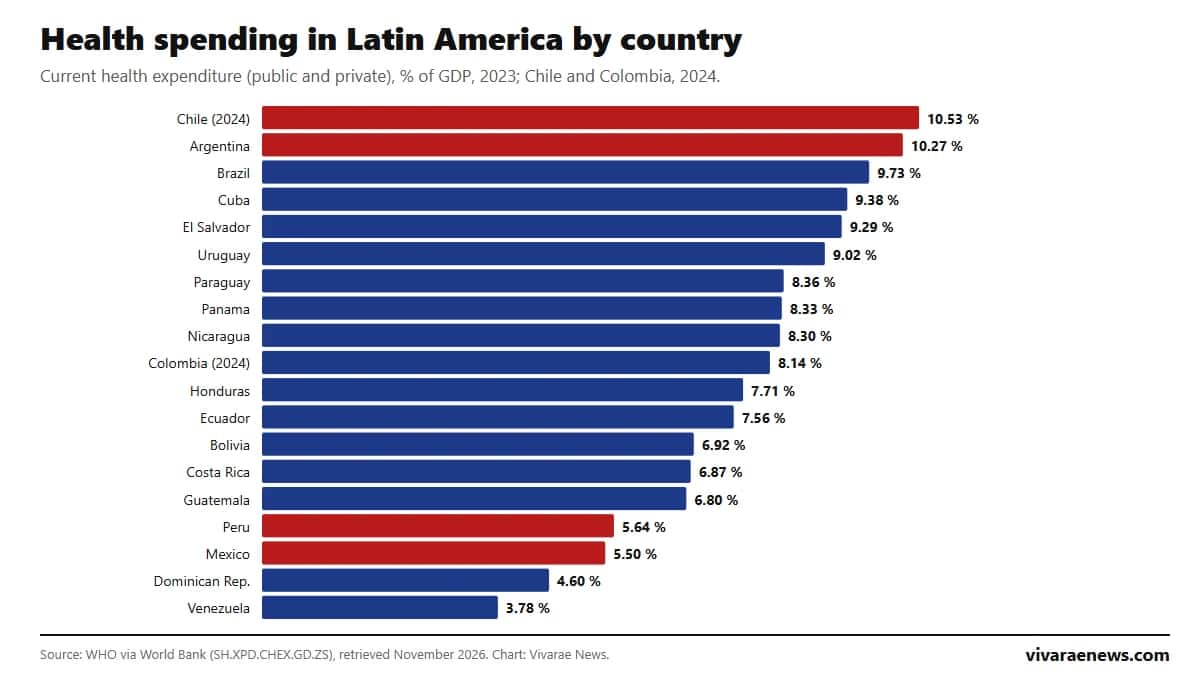
Chile is the Latin American country that spends most on health relative to its economy: 10.53% of GDP in 2024, followed by Argentina (10.27%) and Brazil (9.73%), both with 2023 data. At the other end are Venezuela (3.78%) and the Dominican Republic (4.60%). These are the WHO current health expenditure figures published by the World Bank (indicator SH.XPD.CHEX.GD.ZS), retrieved on November 2, 2026.
The indicator adds public and private spending, including what households pay out of pocket. The Latin America and Caribbean average is 7.94% of GDP, below the world average (10.06%) and far from the OECD (12.75%). Mexico (5.50%) and Peru (5.64%) are among the four lowest spenders.
Ranking of health spending in Latin America by country
| Rank | Country | Health spending (% of GDP) | Per person (US$) | In 2015 (% of GDP) |
|---|---|---|---|---|
| 1 | Chile (2024) | 10.53% | 1,760 | 8.35% |
| 2 | Argentina | 10.27% | 1,457 | 10.27% |
| 3 | Brazil | 9.73% | 1,010 | 8.91% |
| 4 | Cuba | 9.38% | 1,199 (2020) | 12.81% |
| 5 | El Salvador | 9.29% | 501 | 8.76% |
| 6 | Uruguay | 9.02% | 2,076 | 8.26% |
| 7 | Paraguay | 8.36% | 527 | 6.69% |
| 8 | Panama | 8.33% | 1,558 | 6.94% |
| 9 | Nicaragua | 8.30% | 217 | 7.96% |
| 10 | Colombia (2024) | 8.14% | 644 | 7.52% |
| 11 | Honduras | 7.71% | 249 | 7.48% |
| 12 | Ecuador | 7.56% | 509 | 7.77% |
| 13 | Bolivia | 6.92% | 255 | 6.55% |
| 14 | Costa Rica | 6.87% | 1,163 | 7.59% |
| 15 | Guatemala | 6.80% | 392 | 6.01% |
| 16 | Peru | 5.64% | 446 | 4.90% |
| 17 | Mexico | 5.50% | 761 | 5.53% |
| 18 | Dominican Republic | 4.60% | 489 | 4.74% |
| 19 | Venezuela | 3.78% | 186 | — |
Source: World Bank and spending per person, with data from the WHO Global Health Expenditure Database. 2023 data except where noted. Spending per person is in current dollars; Cuba's figure is from 2020 and should be read with caution because of its official exchange rate.
Spending per person: Uruguay leads the region
Measured in dollars per person, the order changes. Uruguay spends US$ 2,076 per person, followed by Chile (US$ 1,760), Panama (US$ 1,558) and Argentina (US$ 1,457). At the other end, Venezuela (US$ 186), Nicaragua (US$ 217) and Honduras (US$ 249) spend less than a tenth of that. The regional average is US$ 816 per person, versus US$ 1,317 worldwide and US$ 5,916 in the OECD.
| Region | Health spending (% of GDP) | Per person (US$) | Public spending (% of GDP) | Out-of-pocket (% of total) |
|---|---|---|---|---|
| Latin America and the Caribbean | 7.94% | 816 | 4.05% | 29.69% |
| World | 10.06% | 1,317 | 6.14% | 17.33% |
| OECD | 12.75% | 5,916 | 7.98% | 13.35% |
Source: World Bank with WHO data, 2023. Per person, the region spends less than a seventh of the OECD average on health, and its households pay out of pocket a share more than twice as high.

Public health spending: only three countries meet PAHO's benchmark
The Pan American Health Organization's Strategy for Universal Access to Health, approved in 2014, sets a reference of public health spending of at least 6% of GDP. With 2023 data, only Cuba, Uruguay and Argentina exceed it. Chile reaches 5.11% (2024) and Mexico 2.68%.
| Country | Public health spending (% of GDP) | Out-of-pocket (% of health spending) |
|---|---|---|
| Cuba | 7.83% | 16.58% |
| Uruguay | 6.53% | 17.10% |
| Argentina | 6.19% | 24.47% |
| Colombia (2024) | 5.68% | 14.74% |
| El Salvador | 5.62% | 32.49% |
| Chile (2024) | 5.11% | 39.15% |
| Brazil | 4.29% | 26.23% |
| Peru | 3.58% | 26.98% |
| Mexico | 2.68% | 41.24% |
| Guatemala | 2.44% | 57.18% |
| Venezuela | 1.20% | 29.69% |
Source: World Bank, indicators SH.XPD.GHED.GD.ZS and SH.XPD.OOPC.CH.ZS, with WHO data. Selected countries, 2023 data except where noted. The regional average for public spending is 4.05% of GDP and out-of-pocket spending is 29.69% of the total.
Chile, Argentina, Peru and Mexico in health spending
- Chile: tops the ranking as a share of GDP, but household out-of-pocket spending rose to 39.15% of the total in 2024, one of the highest in the region and almost three times the OECD average (13.35%). In 2015 it was 34.51%. Sector salaries are in how much a doctor earns in Chile and how much a nurse earns in Chile.
- Argentina: spends 10.27% of GDP, the same as in 2015, of which 6.19% is public spending. Out-of-pocket covers 24.47%.
- Peru: rose from 4.90% in 2015 to 5.64% in 2023, with a temporary jump to 6.67% in 2021 due to the pandemic.
- Mexico: spends 5.50% of GDP and its public spending, 2.68%, is among the lowest in the region; families pay 41.24% of spending out of pocket. Salary details are in how much a doctor earns in Mexico.
What health spending in Latin America measures and what it does not
Current health expenditure includes care, medicines, prevention and administration, but not investment in hospitals and equipment. High spending does not imply better outcomes: it depends on how it is split between public and private and on how efficient the system is. To cross it with a health outcome, see life expectancy in Latin America, and for the economic context, GDP per capita by country. This ranking will be updated at the same address when the WHO publishes 2024 figures for the whole region.
How to cite this data
Vivarae News (2026). "Health spending in Latin America 2026: ranking by country". Updated November 2, 2026. Available at https://vivaraenews.com/en/health-spending-in-latin-america-ranking-by-country-2026/. The data may be reproduced citing Vivarae News and linking to this page; each country's figures belong to the WHO and the World Bank.
Frequently asked questions
Which Latin American country spends most on health?
Chile, at 10.53% of GDP in 2024, followed by Argentina (10.27%) and Brazil (9.73%) in 2023. Per person, Uruguay leads with US$ 2,076.
Which Latin American country spends least on health?
Venezuela, at 3.78% of GDP and US$ 186 per person in 2023, followed by the Dominican Republic (4.60%).
How much does Mexico spend on health?
5.50% of GDP in 2023, about US$ 761 per person. Public spending is 2.68% of GDP and out-of-pocket spending 41.24% of the total.
What is out-of-pocket health spending in Chile?
39.15% of total health spending in 2024, according to the WHO and the World Bank, versus 13.35% in the OECD.
How much should a country spend on public health?
PAHO recommends at least 6% of GDP in public spending. In Latin America only Cuba, Uruguay and Argentina exceed it.