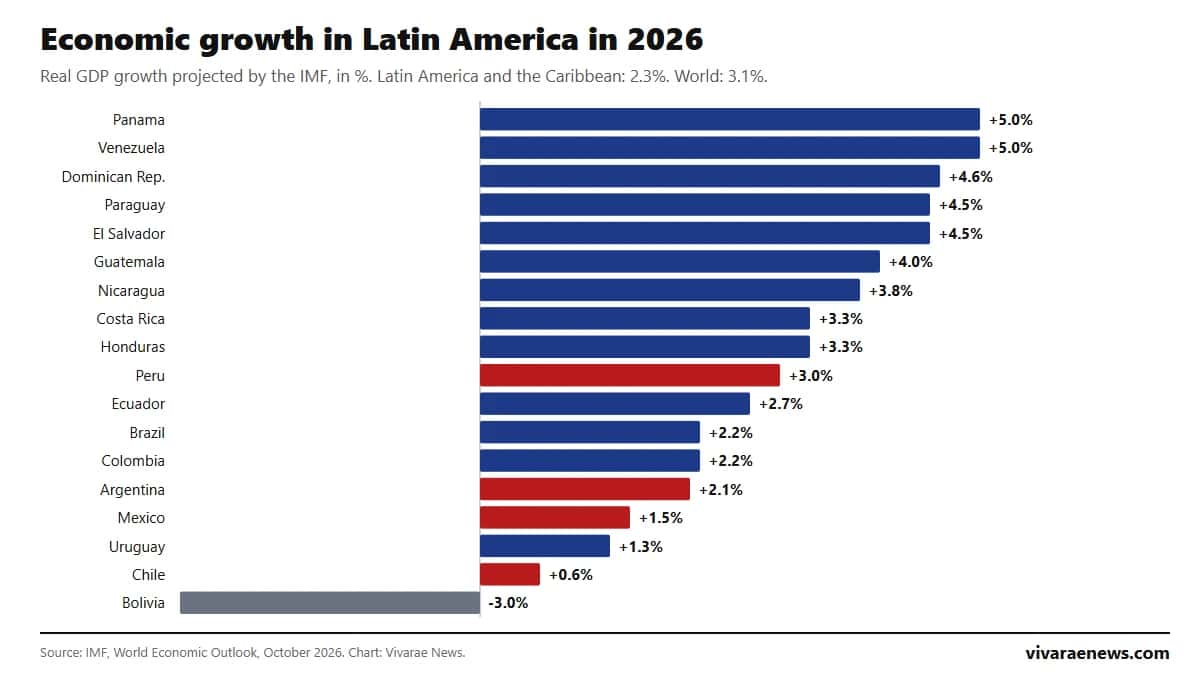
Panama and Venezuela will be Latin America's fastest-growing economies in 2026, at 5.0% each, while Chile (0.6%) and Bolivia (-3.0%) close the ranking, according to the International Monetary Fund's (IMF) October 2026 World Economic Outlook (WEO) ([IMF](https://www.imf.org/external/datamapper/NGDP_RPCH@WEO/OEMDC/ADVEC/WEOWORLD)). The region as a whole, Latin America and the Caribbean, would grow 2.3%, below the global economy's 3.1% (Infobae).
The ranking compares IMF projections for 18 Latin American countries. It is a common benchmark because the IMF uses the same method for all; each country also has its own official forecasts, which may differ.
Ranking of economic growth in Latin America in 2026
| Rank | Country | 2025 | 2026 (projection) | 2027 (projection) |
|---|---|---|---|---|
| 1 | Panama | +4.4% | +5.0% | +4.2% |
| 2 | Venezuela | +9.0% | +5.0% | +7.0% |
| 3 | Dominican Republic | +2.1% | +4.6% | +4.4% |
| 4 | Paraguay | +6.6% | +4.5% | +4.0% |
| 5 | El Salvador | +3.9% | +4.5% | +4.0% |
| 6 | Guatemala | +4.3% | +4.0% | +3.8% |
| 7 | Nicaragua | +4.9% | +3.8% | +3.8% |
| 8 | Costa Rica | +4.6% | +3.3% | +3.5% |
| 9 | Honduras | +3.8% | +3.3% | +3.4% |
| 10 | Peru | +3.4% | +3.0% | +2.9% |
| 11 | Ecuador | +3.7% | +2.7% | +2.5% |
| 12 | Brazil | +2.3% | +2.2% | +1.9% |
| 13 | Colombia | +2.6% | +2.2% | +2.3% |
| 14 | Argentina | +4.5% | +2.1% | +3.5% |
| 15 | Mexico | +0.5% | +1.5% | +1.8% |
| 16 | Uruguay | +1.8% | +1.3% | +2.4% |
| 17 | Chile | +2.5% | +0.6% | +2.6% |
| 18 | Bolivia | -1.6% | -3.0% | -1.5% |
Source: IMF, World Economic Outlook database, October 2026, real GDP growth at constant prices (IMF DataMapper). Panama and Venezuela tie at 5.0%, as do Paraguay and El Salvador at 4.5% and Brazil and Colombia at 2.2%; within each tie, order implies no difference. Guyana, an English-speaking South American country we do not include in the Latin American ranking, would grow 22.3%, driven by its oil output.
What drives economic growth in Latin America
The top spots go to small and mid-sized economies: Panama, Paraguay, the Dominican Republic, El Salvador and Guatemala would grow 4% or more. Venezuela grows from a very low base after the deep contraction of the past decade. The region's three largest economies, Brazil (2.2%), Mexico (1.5%) and Argentina (2.1%), sit below the regional average, which explains why Latin America and the Caribbean grows only 2.3%. Bolivia is the only country projected to contract in both 2026 and 2027.
| Region (IMF) | 2025 | 2026 | 2027 |
|---|---|---|---|
| World | 3.5% | 3.1% | 3.4% |
| Latin America and the Caribbean | n/a | 2.3% | n/a |
| South America | 2.9% | 2.1% | 2.4% |
| Central America | 3.7% | 4.2% | 4.0% |
| Western Hemisphere (includes the US and Canada) | 2.4% | 2.2% | 2.3% |
Sources: IMF DataMapper for regional aggregates and Infobae for Latin America and the Caribbean, a group the IMF's public API does not publish separately. "n/a": not available in those sources.
Who speeds up and who slows down economic growth in Latin America
| Country | 2025 | 2026 | Change (points) |
|---|---|---|---|
| Dominican Republic | 2.1% | 4.6% | +2.5 |
| Mexico | 0.5% | 1.5% | +1.0 |
| Panama | 4.4% | 5.0% | +0.6 |
| El Salvador | 3.9% | 4.5% | +0.6 |
| Chile | 2.5% | 0.6% | -1.9 |
| Paraguay | 6.6% | 4.5% | -2.1 |
| Argentina | 4.5% | 2.1% | -2.4 |
| Venezuela | 9.0% | 5.0% | -4.0 |
Our calculation with IMF data. Fourteen of the 18 countries would grow less in 2026 than in 2025. Those speeding up are the Dominican Republic, Mexico, Panama and El Salvador; those slowing most sharply are the ones coming off strong rebounds, such as Venezuela and Argentina. For 2027, the IMF expects several to pick up again: Chile, for example, would go from 0.6% to 2.6%, and Argentina from 2.1% to 3.5%.
The IMF's biggest cuts in Latin America
| Country | Cut to 2026 projection | Current projection |
|---|---|---|
| Chile | -1.8 points | 0.6% |
| Argentina | -1.4 points | 2.1% |
| Uruguay | -0.5 points | 1.3% |
Source: Infobae. For Chile, it is the lowest figure since the pandemic (see the IMF's cut for Chile). Argentina grew 4.5% in 2025, but its activity fell in July and August (see the August EMAE). The IMF raised its forecasts for Venezuela, Brazil, Paraguay, Bolivia, Ecuador and Peru.
Economic growth in Latin America compared with other indicators
Growth is not the whole story. Mexico would grow 1.5% with unemployment of just 2.8% (see unemployment in Mexico), while Chile combines low growth with the region's highest unemployment rate (see the Latin America unemployment ranking). To complete the picture, also see inflation by country, the minimum wage in Latin America and gasoline prices.

How to cite this data
You may use the figures and chart on this page by citing the original source (IMF, World Economic Outlook, October 2026) and Vivarae News. Suggested citation: "Economic growth in Latin America: ranking by country 2026 according to the IMF", Vivarae News, updated October 22, 2026, https://vivaraenews.com/en/economic-growth-in-latin-america-ranking-by-country-2026/. We update this page at the same address when the IMF publishes new projections (April and October, with updates in January and July).
Frequently asked questions
Which Latin American country will grow most in 2026?
Panama and Venezuela, at 5.0% each, according to the IMF. If Guyana is counted, its 22.3% growth is the highest.
How much will Latin America grow in 2026?
2.3% for Latin America and the Caribbean, according to the IMF, compared with 3.1% for the world economy.
Which country will grow least?
Bolivia, with a 3.0% contraction, followed by Chile at 0.6%.
How much will Mexico grow?
1.5% in 2026 and 1.8% in 2027, according to the IMF.
How often is this ranking updated?
With each edition of the IMF's World Economic Outlook: April and October, with updates in January and July.