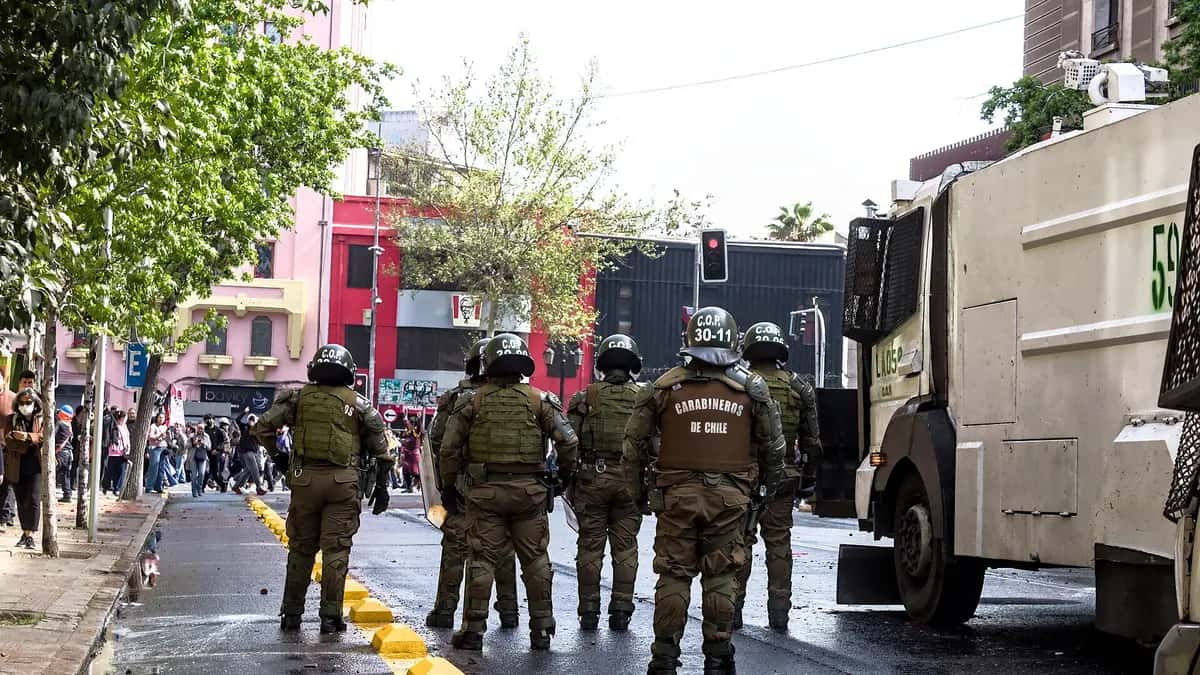
Chile's Law 21,849 on Use of Force Rules (known as RUF) was published in the Official Gazette on Friday, October 16, 2026, the same day President José Antonio Kast signed it into law, according to [Radio Universidad de Chile](https://radio.uchile.cl/2026/10/16/ruf-se-publica-en-el-diario-oficial-mientras-el-tc-debe-resolver-impugnacion-de-la-oposicion/). For the first time, the law creates a common legal framework for the Carabineros, the PDI investigative police and the armed forces when they carry out public order duties. But it comes with an open front: 16 opposition senators filed a challenge before the Constitutional Court against the provisions on potentially lethal force.
The bill was introduced under the previous government and spent more than three years in Congress, according to El Mostrador. This is what the law says, how its levels work and what is at stake at the Court.
What are Chile's use of force rules
Use of force rules define when and how a police officer or soldier may use force against a person, from simple presence up to a firearm. Until now they were scattered across decrees, protocols and internal circulars of each institution. Law 21,849 raises them to the level of law and sets four principles: legality, necessity, responsibility and reasonableness, according to the summary by EnEstrado.
| Item | Detail |
|---|---|
| Number | Law 21,849 |
| Published in the Official Gazette | Friday, October 16, 2026 |
| Enacted by | President José Antonio Kast, October 16 |
| Comptroller's approval | Tuesday, October 13, according to Radio Universidad de Chile |
| Final Senate vote | 29 in favor, 15 against, 1 abstention (joint committee report) |
| Chamber of Deputies vote | 111 in favor |
| Who it applies to | Carabineros, PDI, armed forces and the Maritime Police when it performs public order, border or critical infrastructure duties |
| Deadline for regulations | One year |
Sources differ slightly on the date of final passage: Emol and T13 reported Senate approval on Wednesday, October 7, while Radio Universidad de Chile places it on Thursday, October 8.
The five levels of the use of force rules for the police
The law first classifies the conduct of the person being stopped into five levels and then defines five levels of police response. The means of force can be physical, mechanical, kinetic, chemical or electrical.
| Level | Conduct of the person | Police response allowed by law |
|---|---|---|
| 1 | Active cooperation | Physical and institutional presence: patrols, vehicles, carrying devices |
| 2 | Passive resistance (does not follow instructions) | Verbal persuasion, mediation and negotiation |
| 3 | Active resistance with physical evasion | Physical restraint and immobilization, for example with handcuffs |
| 4 | Active aggression that endangers property or officers | Less-lethal weapons or devices |
| 5 | Potentially lethal active aggression | Potentially lethal force |
Under the law, potentially lethal force may be used in the line of duty, in self-defense, to carry out court orders, to prevent detainees from escaping or to protect critical infrastructure from serious danger. A key point: the levels are not a mandatory ladder. They "do not necessarily have to be applied step by step", explained Public Security Minister Martín Arrau, if the threat is imminent.
The eight rules for the armed forces
For soldiers deployed for public order, border control or critical infrastructure, the law sets eight rules, from lowest to highest intensity. Commanders can detail them by resolution for each deployment.
| Rule | What it allows |
|---|---|
| 1 | Deterrent deployment of troops, vehicles, vessels and weapons |
| 2 | Communication, dialogue and verbal mediation |
| 3 | Less-lethal hand-held means: smoke, water, batons, pepper spray |
| 4 | Devices that launch projectiles with deterrent elements |
| 5 | Physical restraint; force may not be used against a restrained person who is not resisting |
| 6 | Blank ammunition as a deterrent |
| 7 | Shotguns with riot-control ammunition in case of imminent danger to life or critical infrastructure |
| 8 | Lethal weapons only in case of imminent danger to life, people who do not drop a weapon when ordered, or attacks on military facilities or critical infrastructure |
According to 24 Horas, the law also protects personnel with the Criminal Code's line-of-duty defense when they act within these rules.
The Constitutional Court challenge to the use of force rules
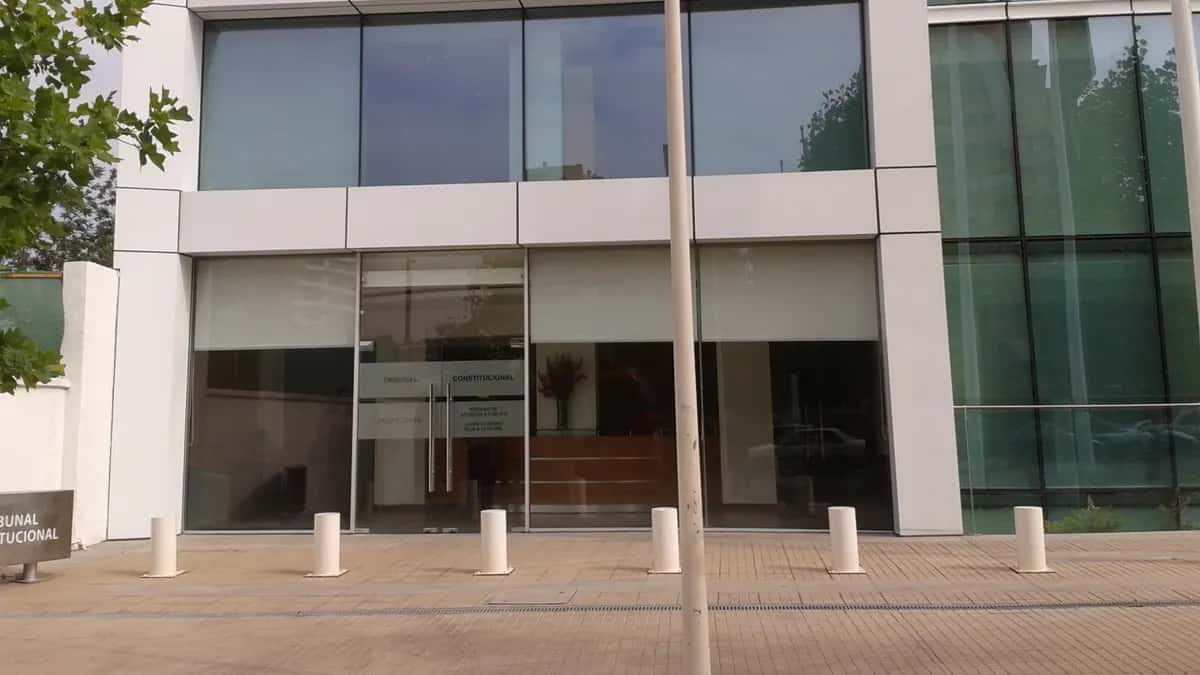
Sixteen opposition senators, including Socialist Juan Luis Castro, filed a challenge before the Constitutional Court on October 9. They question the provisions on reasonableness and potentially lethal force, arguing that some would allow firearms to be used without a serious or imminent danger to the life of the officer or third parties.
- The government's argument: the challenge arrived after the enactment decree reached the Comptroller's Office, so it should be declared inadmissible. "It has to be done according to the law, and the Constitution is very clear", said Interior Undersecretary Máximo Pavez.
- The senators' argument: the session record was delivered on October 9 at 6 p.m., which prevented them from filing earlier. "Knowing there was a pending constitutional review, they sent the law to be enacted", Castro said.
- What comes next: the Court must first decide whether to admit the challenge. No date has been given for that decision.
The Socialist Party had already filed a constitutional reservation during the debate, according to La Tercera. Deputy Lorena Fries (Frente Amplio), a member of the joint committee, asked the government not to see the Court "as a threat".
What changes now
The law took effect on publication. Institutions have one year to issue regulations on weapons, operational planning and the recording and reporting of the use of force; in the meantime, their internal protocols remain in force as long as they do not contradict the law. For citizens, the most visible change is that the rules no longer depend on a circular that can be changed without going through Congress, but on a law with common criteria for police and soldiers. More context on the police in how much a police officer earns in Chile.
Frequently asked questions
What number is the use of force law?
It is Law 21,849, published in the Official Gazette on October 16, 2026.
Who do the use of force rules apply to?
The Carabineros, the PDI and the armed forces when performing public order duties, and the Maritime Police when it performs those functions.
Must an officer go through every level before using a weapon?
No. The law allows moving directly to a higher level if the threat is imminent and legal requirements are met.
Why is it before the Constitutional Court?
Sixteen opposition senators filed a challenge against the rules on potentially lethal force. The government says it was filed too late. The Court must decide whether to admit it.
When does it take effect?
On publication. Complementary regulations have a one-year deadline.