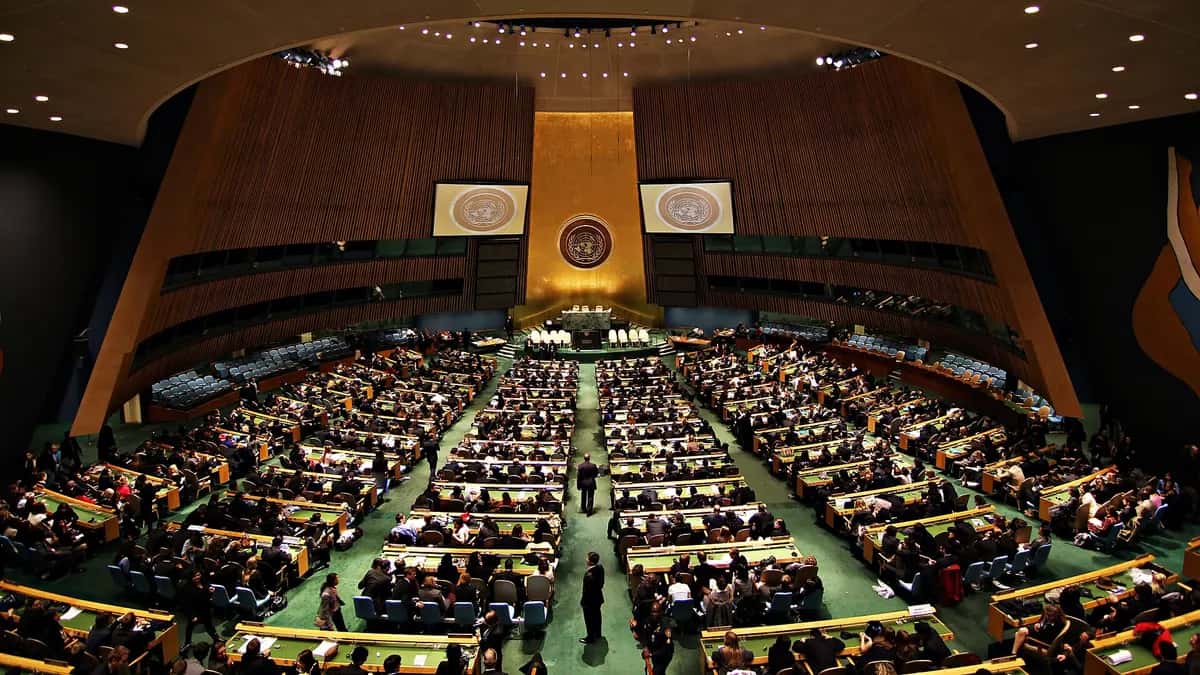
Chile abstained for the first time in 33 years in the United Nations General Assembly vote calling for an end to the economic, commercial and financial embargo imposed by the United States on Cuba. The resolution was adopted on Wednesday, October 28, with 130 votes in favour, 17 against and 25 abstentions, according to UN News. It is the lowest number of votes in favour in the last 20 years.
Until 2025, Chile had voted for this resolution without interruption, from the government of Patricio Aylwin to that of Gabriel Boric, according to The Clinic. The change was announced a day earlier by the ambassador to the UN, Roberto Ampuero. This article explains what was voted on, how the region voted, what José Antonio Kast's government argued and what the opposition says.
What the UN voted on the Cuba embargo
The resolution, tabled by Cuba, calls for lifting the blockade that the United States has maintained on the island since 1960. It cites the 1996 Helms-Burton Act for its effects on companies from other countries, asks states not to apply rules of that kind and requests a follow-up report from the Secretary-General, according to the UN News summary. General Assembly resolutions are not binding: they do not oblige the United States to lift the restrictions.
| Year | In favour | Against | Abstentions | Note |
|---|---|---|---|---|
| 1992 | 59 | 3 | 71 | First debate; there were also 46 absences |
| 2015 | 191 | 2 | 0 | All-time high, during the Obama-era thaw |
| 2016 | 191 | 0 | 2 | The United States abstained for the first time |
| 2017 | 191 | 2 | 0 | The US vote against returns |
| 2025 | 165 | 7 | 12 | Previous year |
| 2026 | 130 | 17 | 25 | 34th vote; the lowest support in 20 years |
Source: UN News and UN News preview. In 2015, 2016 and 2017 the abstentions are derived from the total of 193 member states; in 2016 the United States and Israel abstained. According to Chilean Foreign Ministry sources quoted by The Clinic, this year's 25 abstentions are the highest number the resolution has ever had.

How Latin America voted on the Cuba embargo
The most visible shift in 2026 was in the region. According to UN News, five Latin American countries voted against and four abstained:
| Vote | Latin American countries | Source |
|---|---|---|
| Against | Argentina, Colombia, Costa Rica, Ecuador and Paraguay | UN News |
| Abstention | Chile, Honduras, Peru and the Dominican Republic | UN News |
| Against (outside the region) | United States and Israel, among others | Radio Universidad de Chile |
| Abstention (outside the region) | Germany, South Korea and Italy, among others | Radio Universidad de Chile |
Sources: UN News and Radio Universidad de Chile. The full country-by-country list is in the General Assembly record; this article only includes the votes reported by those sources. The United States had asked countries in the region to vote against or at least abstain: "At least abstain or walk out," US ambassador Mike Waltz said at an event in New York, according to The Clinic.
Why Chile abstained: the government's arguments
Ambassador Roberto Ampuero explained the position in the Assembly. He said Chile maintains its rejection of economic measures imposed unilaterally by one state against another, but that "the difficulties faced by Cuban families are not explained solely by external factors; restrictions on freedoms, on political and economic participation and on the full exercise of civil rights also weigh on them," according to 24 Horas.
- "Looking at people's reality": Ampuero said the decision "is not about taking sides in the dispute between states".
- Human rights: the government argues that reducing the debate to economics, without addressing political freedoms, is "an unjustifiable omission".
- No military intervention: according to the Chilean mission, Cuba was told that Chile does not support military measures or foreign interference (The Clinic).
- A joint statement that went nowhere: in the previous weeks, the Chilean mission circulated a draft for several countries to question the human rights situation on the island. It did not gather enough support, according to The Clinic.
Cuban foreign minister Bruno Rodríguez had said on October 21 that the United States was using "a Latin American country as a front man" to change votes. He did not say which; The Clinic reported that it was Chile. During the debate, Rodríguez said the embargo had cost 22.9 million dollars just in the time the session lasted, while Waltz argued that "there is no blockade" and that the United States exported more than 876 million dollars to Cuba in eight months of 2026 (UN News).
Other shifts in Chile's foreign policy in 2026
The abstention is not the only change. According to Radio Universidad de Chile, the government withdrew from the Non-Aligned Movement in August and in September backed Morocco's sovereignty over Western Sahara, an issue on which Chile had kept to the line of a UN-mediated solution.
| Date | Decision | Previous position |
|---|---|---|
| August 2026 | Withdrawal from the Non-Aligned Movement | Chile was a member |
| September 2026 | Support for Morocco's sovereignty over Western Sahara | Support for a UN-mediated solution |
| October 28, 2026 | Abstention on the resolution against the Cuba embargo | 33 years voting in favour |
Source: Radio Universidad de Chile. The relationship with Washington also appears in other issues, such as the Coalition Against Cartels promoted by the United States, where Chile takes part as an observer.
What the opposition says about Chile's abstention on the Cuba embargo
The opposition criticized the decision, according to BioBioChile. The president of the PPD party, Raúl Soto, called it "a mistake": he said one can be critical of the Cuban regime, but that "it is a very different thing to validate" an embargo that "punishes not Cuba's ruling class, but the people". Deputy Gonzalo Winter (Frente Amplio) accused President Kast of subordinating himself "in a shameful way" to the United States.
The Communist Party, for its part, welcomed the UN vote against the embargo, according to the Cuban agency Prensa Latina. The government has not announced further changes of position in other General Assembly votes. The government's standing in the polls is covered in the latest Cadem poll.
Frequently asked questions
How did Chile vote at the UN on the Cuba embargo?
It abstained on October 28, 2026. It is the first time in 33 years that it did not vote for the resolution calling for the embargo to be lifted.
What was the result of the vote?
130 votes in favour, 17 against and 25 abstentions, according to UN News. The resolution was adopted for the 34th time.
Which Latin American countries voted against?
Argentina, Colombia, Costa Rica, Ecuador and Paraguay. Chile, Honduras, Peru and the Dominican Republic abstained.
Does the resolution force the United States to lift the embargo?
No. UN General Assembly resolutions are not binding.
Who explained Chile's position?
The ambassador to the UN, Roberto Ampuero, who cited the lack of political freedoms and civil rights in Cuba.