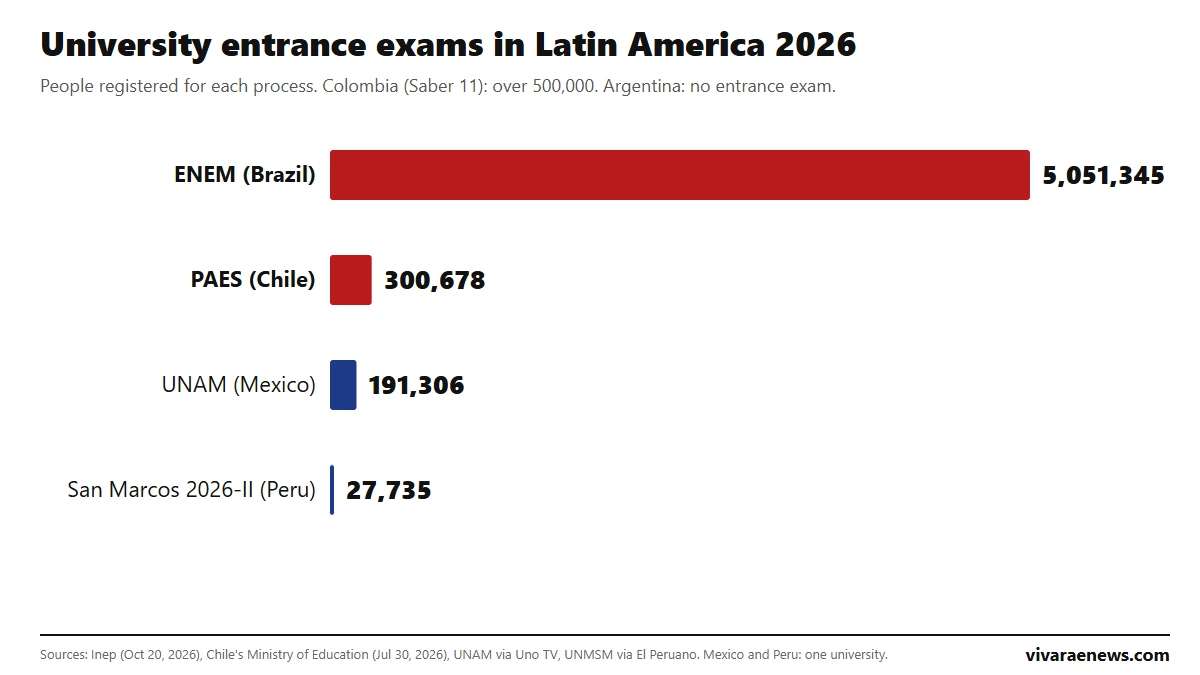
Brazil's ENEM is the largest university entrance exam in Latin America: Inep counted 5,051,345 confirmed registrations for 2026, almost 17 times the 300,678 people registered for Chile's PAES, according to Chile's Ministry of Education. In Colombia, more than 500,000 students sat the Saber 11 (calendar A) on July 26, according to Icfes. Mexico and Peru have no single test: each university decides, and UNAM alone received 191,306 registrations. Argentina is the exception: access to public universities is open and unrestricted by law.
This fact sheet brings together the official data for the six systems: the date, the body that runs each test and how many people apply. It is updated at this same URL with each admissions cycle.
Latin America's university entrance exams in one table
View the data as a table
| ENEM registrants (Brazil) | 5,051,345 |
| PAES registrants (Chile) | 300,678 |
| UNAM registrations (Mexico) | 191,306 |
| San Marcos applicants (Peru) | 27,735 |
| Country | Test | Run by | Type | 2026 applicants | 2026 date |
|---|---|---|---|---|---|
| Brazil | ENEM | Inep | National | 5,051,345 | November 8 and 15 |
| Colombia | Saber 11 | Icfes | National, mandatory | More than 500,000 (calendar A) | July 26 (calendar A) |
| Chile | PAES | DEMRE | National | 300,678 | November 30 to December 2 |
| Mexico | EXANI-II and own exams | Ceneval and each university | Per institution | 191,306 at UNAM alone | UNAM: May and June |
| Peru | Each university's exam | Each university | Per institution | 27,735 at San Marcos 2026-II | San Marcos: March 7-15 |
| Argentina | No entrance exam | Law 27,204 | Open access | Not applicable | UBA: CBC enrollment |
Sources: Inep, Icfes, Chile's Ministry of Education, DEMRE, Ceneval, UNAM via Uno TV, El Peruano and Law 27,204. The Mexico and Peru figures refer to a single university, because those countries have no single national exam; they are not comparable with a national total.
| Chile | PAES | Reading, Mathematics 1 (mandatory), Mathematics 2, History or Science | 100 to 1,000 points per test |
| Brazil | ENEM | Languages, Humanities, Natural Sciences, Mathematics and an essay | Item response theory; essay 0 to 1,000 |
| Colombia | Saber 11 | Critical reading, Mathematics, Social studies, Natural sciences and English | Overall score 0 to 500 |
| Mexico | EXANI-II | Reading comprehension, Indirect writing, Mathematical thinking and 2 subject modules | 138 scored items, no penalty for wrong answers |
| Peru | Each university's exam | Knowledge and aptitude, set by each university | By place and program |
| Argentina | No exam | Foundation cycle or bridging courses, not used to exclude | Not applicable |
View the data as a table
| ENEM | National exam | Inep, Brasília: 5,051,345 confirmed registrations |
| PAES | National exam | DEMRE, Santiago: 300,678 registrants |
| Saber 11 | National exam | Icfes, Bogotá: more than 500,000 test-takers (calendar A) |
| UNAM | Per-institution exam | Mexico City (home of UNAM and Ceneval): 191,306 UNAM registrations |
| San Marcos | Per-institution exam | Lima: 27,735 applicants in 2026-II |
| UBA | No entrance exam | Buenos Aires: open, unrestricted access (Law 27,204) |
PAES 2026 in Chile: 300,678 registrants for 2027 admissions

Chile's university entrance test, the PAES (Prueba de Acceso a la Educación Superior), is run by DEMRE at the University of Chile. Registration for the regular PAES closed on July 27, 2026 with 300,678 people, just 0.02% more than the 300,613 of the previous year, the Ministry of Education reported. 60.4% live outside the Santiago Metropolitan Region, 73.9% are in their final year of high school and 53.1% are women. The Mathematics 2 (M2) test reached 164,306 registrants, the largest increase.
The mandatory tests are Reading Competence and Mathematics 1; candidates also take at least one elective (History and Social Sciences, or Science), and some degree programs require M2. Each is scored from 100 to 1,000 points. According to the DEMRE calendar, the regular PAES takes place on November 30 and December 1 and 2, 2026; scores are released on January 4, 2027, applications run from January 4 to 7 and selected candidates are announced on January 18.
| 2026 regular PAES | Figure |
|---|---|
| Registrants | 300,678 |
| Previous year | 300,613 |
| Subsidized private schools | 157,701 |
| Public schools | 107,471 |
| Fee-paying private schools | 34,106 |
| Mathematics 2 registrants | 164,306 |
Source: Chile's Ministry of Education, preliminary figures at the close of registration. In the regional ranking of higher education enrollment, Chile ranks first, with a gross rate of 110.2% in 2024 according to UNESCO.
ENEM 2026: the region's largest university entrance exam
The Exame Nacional do Ensino Médio is run by Inep and is the main route into university in Brazil: its scores are used by Sisu (public universities), Prouni (scholarships at private ones) and Fies (student loans). Inep's dashboard of October 20 recorded 5,051,345 confirmed registrations: 63.98% women and 67.94% exempt from the fee. The fee for those who paid was R$ 85. This year, public school seniors were registered automatically, and the Inep tally shows a 47.1% rise over 2022.
The test has 180 multiple-choice questions and an essay over two Sundays: November 8 (Languages, Humanities and the essay) and November 15 (Natural Sciences and Mathematics). According to the Ministry of Education's preliminary tally reported by the Brazilian press, 32% of registrants did not show up on day one, up from 27% in 2025, and the essay topic was the value of Brazil's public health system (SUS). Individual results are expected in mid-January 2027.
Saber 11 in Colombia: the mandatory test for university entry
In Colombia, the Icfes Saber 11 exam is a requirement for entering higher education, and universities use it for selection. It covers five tests (Critical reading, Mathematics, Social studies and citizenship, Natural sciences and English) and gives an overall score from 0 to 500. It is held twice a year, depending on each school's calendar: calendar A, used by the vast majority, took place on July 26, 2026 with more than 500,000 test-takers, and results were released in late September, according to Icfes.
Mexico: EXANI-II and each university's own exam
Mexico has no single national test. Ceneval's EXANI-II is contracted by the universities that use it, and it is not offered to individual applicants: it has 168 items, of which 138 count toward the score (Reading comprehension, Indirect writing, Mathematical thinking and two program modules), lasts up to 4.5 hours and does not penalize wrong answers, according to Ceneval. It is taken on paper, online at a venue or from home. The two largest universities, UNAM and IPN, run their own exams.
In UNAM's 2026 selection exam, held online for the first time, 191,306 applicants registered and 158,712 sat the exam, according to Uno TV. 21,962 won a place through the exam and 28,151 through the automatic pass from UNAM's own high schools, Crónica reported. That means 13.8% of those who sat the exam were admitted. A later report puts those admitted through the exam at 20,923, and no UNAM bulletin is available to confirm the final figure.
View the data as a table
| Registered applicants | 191,306 |
| Sat the exam | 158,712 |
| Places by exam | 21,962 |
| Automatic pass | 28,151 |
Peru: each university sets its own admission exam
Peru has no national exam either: the University Law (30220) requires admission through a public competition at each university. The most sought-after is the National University of San Marcos. In its 2026-II admissions, held on four dates between March 7 and 15, 27,735 applicants competed for 5,804 places in 81 programs, according to El Peruano: about 4.8 per place. In Medicine, 4,656 applicants competed for 108 places, 43 per place. Other outlets reported 5,669 places; this sheet uses the figure from the official gazette. For those aiming at health careers, see also how much a doctor earns in Peru.
View the data as a table
| Applicants | 27,735 |
| Places | 5,804 |
| Medicine applicants | 4,656 |
| Medicine places | 108 |
Argentina: open access to public universities, with no exam
Law 27,204, passed in 2015, replaced article 7 of the Higher Education Law (24,521) and established that anyone who completes secondary school may enter a public university freely and without restriction. Universities may run bridging courses, but they cannot be used to exclude students. At the University of Buenos Aires, the first year is the Ciclo Básico Común (CBC): there is no entrance exam, and each subject is passed with two midterm exams. That is why Argentina does not appear in this sheet's applicant figures.
2026-2027 calendar of university entrance exams
- Mar 7-15, 2026San Marcos 2026-II admissions (Peru)27,735 applicants for 5,804 places.
- Jul 17, 2026UNAM selection results (Mexico)21,962 places by exam.
- Jul 26, 2026Saber 11 calendar A (Colombia)More than 500,000 test-takers.
- Jul 27, 2026PAES registration closes (Chile)300,678 registrants.
- Nov 8, 2026ENEM day one (Brazil)Languages, Humanities and essay.
- Nov 15, 2026ENEM day two (Brazil)Natural Sciences and Mathematics.
- Nov 30-Dec 2, 2026Regular PAES (Chile)
- Jan 4, 2027PAES scores and applications (Chile)Applications from January 4 to 7.
- Jan 18, 2027Selection results (Chile)
| Date | Milestone |
|---|---|
| November 8 and 15, 2026 | ENEM (Brazil) |
| November 30 to December 2, 2026 | Regular PAES (Chile) |
| January 4, 2027 | PAES scores |
| Mid-January 2027 | ENEM results (Inep forecast) |
| January 18, 2027 | Selected candidates at Chilean universities |
Sources: DEMRE and Inep. The teachers who prepare these students are also covered in our salary sheets, such as how much a teacher earns in Chile.
Frequently asked questions
What is the largest university entrance exam in Latin America?
Brazil's ENEM, with 5,051,345 confirmed registrations in 2026.
How many people take the PAES in 2026?
300,678 people registered for the regular PAES for 2027 admissions, held from November 30 to December 2.
Which countries have no national entrance exam?
Mexico and Peru have no single test: each university uses its own exam or contracts EXANI-II. Argentina has no entrance exam for public universities.
Can ENEM be used to study outside Brazil?
Yes, at some institutions in Portugal that have agreements with Inep, according to the 2026 edital.
How to cite this data
Vivarae News (2026). "University entrance exams in Latin America 2026: PAES, ENEM, Saber 11 and EXANI-II". Updated November 9, 2026. Available at https://vivaraenews.com/en/university-entrance-exams-in-latin-america-2026-paes-enem-saber-11-and-exani-ii/. The data may be reproduced by citing Vivarae News and linking to this page; each country's figures come from Inep, Chile's Ministry of Education and DEMRE, Icfes, Ceneval, UNAM, UNMSM and Law 27,204.