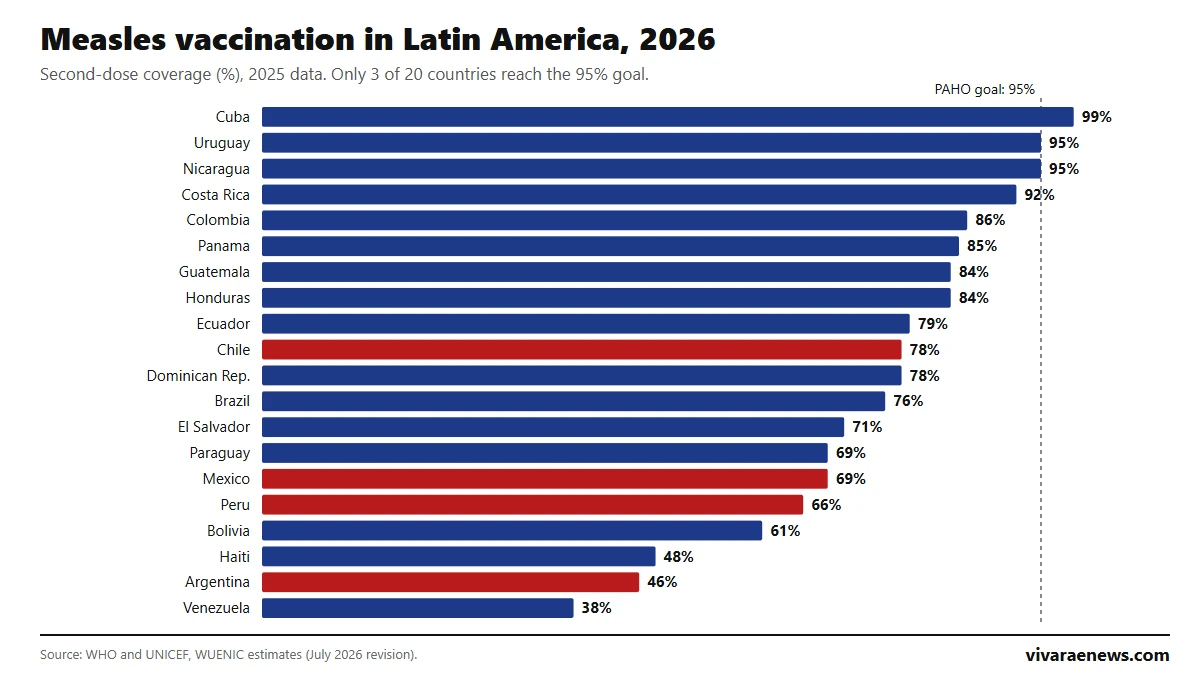
Only 3 of 20 Latin American countries vaccinate 95% or more of their children with both measles doses, the goal PAHO considers necessary to stop the virus: Cuba (99%), Uruguay (95%) and Nicaragua (95%), according to WHO and UNICEF (WUENIC estimates) estimates for 2025. Chile reaches 78% with the second dose, Mexico 69%, Peru 66% and Argentina 46%, one of the lowest levels in the region along with Venezuela (38%) and Haiti (48%).
The data matters this year: as of November 13, 2026, the region had 58,213 confirmed measles cases and 82 deaths, compared with 12,806 cases in the same period of 2025, according to PAHO. Bolivia, Mexico and the United States lost their measles-free status (see what happened in Mexico). This is the full ranking of measles vaccination in Latin America, with the first dose (MCV1) and the second (MCV2).
View the data as a table
| Countries with 95%+ second-dose coverage | 3 |
| Second dose in the Americas | 78% |
| Confirmed cases in 2026 | 58,213 |
| Measles deaths in 2026 | 82 |
Measles vaccination ranking in Latin America 2026
The ranking orders countries by second-dose coverage, the dose that completes protection. WHO recommends two doses because a single dose leaves some children without immunity. The data are the July 2026 revision of the joint WHO and UNICEF estimates (WUENIC), published in the Global Health Observatory.
| Rank | Country | Second dose 2025 | First dose 2025 | Second dose 2024 | Second dose 2019 |
|---|---|---|---|---|---|
| 1 | Cuba | 99% | 99% | 99% | 99% |
| 2 | Uruguay | 95% | 98% | 95% | 99% |
| 3 | Nicaragua | 95% | 94% | 98% | 99% |
| 4 | Costa Rica | 92% | 98% | 87% | 93% |
| 5 | Colombia | 86% | 91% | 86% | 89% |
| 6 | Panama | 85% | 87% | 85% | 97% |
| 7 | Guatemala | 84% | 90% | 79% | 78% |
| 8 | Honduras | 84% | 87% | 85% | 93% |
| 9 | Ecuador | 79% | 78% | 74% | 76% |
| 10 | Chile | 78% | 95% | 73% | 91% |
| 11 | Dominican Republic | 78% | 95% | 78% | 60% |
| 12 | Brazil | 76% | 90% | 81% | 54% |
| 13 | El Salvador | 71% | 98% | 71% | 76% |
| 14 | Paraguay | 69% | 90% | 69% | 83% |
| 15 | Mexico | 69% | 88% | 69% | 55% |
| 16 | Peru | 66% | 84% | 66% | 66% |
| 17 | Bolivia | 61% | 67% | 61% | 44% |
| 18 | Haiti | 48% | 62% | 54% | 40% |
| 19 | Argentina | 46% | 82% | 46% | 84% |
| 20 | Venezuela | 38% | 53% | 51% | 13% |
Source: WHO/UNICEF, WUENIC, July 2026 revision. The first dose is measured in one-year-olds; the second, at the age each country sets (in Argentina, for example, it is given at school entry). In some countries the 2025 figure repeats 2024's, because the estimate is kept when there is no new data.
View the data as a table
| Cuba | 99% |
| Uruguay | 95% |
| Nicaragua | 95% |
| Costa Rica | 92% |
| Colombia | 86% |
| Panama | 85% |
| Guatemala | 84% |
| Honduras | 84% |
| Ecuador | 79% |
| Chile | 78% |
| Dominican Republic | 78% |
| Brazil | 76% |
| El Salvador | 71% |
| Paraguay | 69% |
| Mexico | 69% |
| Peru | 66% |
| Bolivia | 61% |
| Haiti | 48% |
| Argentina | 46% |
| Venezuela | 38% |
First and second dose: where measles vaccination drops
The first dose is ahead of the second in almost every country. Six reach 95% or more with the first: Cuba (99%), Costa Rica, El Salvador and Uruguay (98%), and Chile and the Dominican Republic (95%). The gap between them leaves children half-protected: in El Salvador it falls from 98% to 71%, in Argentina from 82% to 46% and in Chile from 95% to 78%. Across the Americas, coverage was 88% for the first dose and 78% for the second in 2025.
View the data as a table
| First dose (%) | Second dose (%) | |
|---|---|---|
| Cuba | 99% | 99% |
| Uruguay | 98% | 95% |
| Nicaragua | 94% | 95% |
| Costa Rica | 98% | 92% |
| Colombia | 91% | 86% |
| Panama | 87% | 85% |
| Guatemala | 90% | 84% |
| Honduras | 87% | 84% |
| Ecuador | 78% | 79% |
| Chile | 95% | 78% |
| Dominican Republic | 95% | 78% |
| Brazil | 90% | 76% |
| El Salvador | 98% | 71% |
| Paraguay | 90% | 69% |
| Mexico | 88% | 69% |
| Peru | 84% | 66% |
| Bolivia | 67% | 61% |
| Haiti | 62% | 48% |
| Argentina | 82% | 46% |
| Venezuela | 53% | 38% |
| Country | First dose | Second dose | Gap |
|---|---|---|---|
| Argentina | 82% | 46% | 36 points |
| El Salvador | 98% | 71% | 27 points |
| Paraguay | 90% | 69% | 21 points |
| Mexico | 88% | 69% | 19 points |
| Peru | 84% | 66% | 18 points |
| Chile | 95% | 78% | 17 points |
| Dominican Republic | 95% | 78% | 17 points |
| Venezuela | 53% | 38% | 15 points |
Source: WHO/UNICEF, WUENIC, July 2026 revision. The eight countries with the largest gap between the first and second doses. PAHO also recommends measuring by municipality, because a high national average can hide communities with low coverage.
How measles vaccination changed since 2015
The pandemic lowered coverage in 2020 and 2021 and several countries did not recover. Argentina had 99% with the second dose in 2018 and fell to 46% in 2024 and 2025. Chile dropped from 93% in 2018 to 70% in 2023 and rebounded to 78%. Brazil went the other way: from 44% in 2020 to 76% in 2025. Mexico had very uneven years, with 55% in 2019 and 97% in 2021.
View the data as a table
| Chile | Mexico | Argentina | Peru | Brazil | Americas | |
|---|---|---|---|---|---|---|
| 2015 | 89% | 96% | 87% | 63% | 80% | 78% |
| 2016 | 87% | 98% | 88% | 68% | 77% | 80% |
| 2017 | 90% | 62% | 91% | 67% | 67% | 75% |
| 2018 | 93% | 99% | 99% | 67% | 76% | 84% |
| 2019 | 91% | 55% | 84% | 66% | 54% | 73% |
| 2020 | 83% | 79% | 71% | 52% | 44% | 73% |
| 2021 | 91% | 97% | 79% | 60% | 46% | 77% |
| 2022 | 81% | 83% | 94% | 54% | 58% | 77% |
| 2023 | 70% | 74% | 54% | 66% | 69% | 77% |
| 2024 | 73% | 69% | 46% | 66% | 81% | 79% |
| 2025 | 78% | 69% | 46% | 66% | 76% | 78% |
| Year | Chile | Mexico | Argentina | Peru | Brazil | Americas |
|---|---|---|---|---|---|---|
| 2015 | 89% | 96% | 87% | 63% | 80% | 78% |
| 2016 | 87% | 98% | 88% | 68% | 77% | 80% |
| 2017 | 90% | 62% | 91% | 67% | 67% | 75% |
| 2018 | 93% | 99% | 99% | 67% | 76% | 84% |
| 2019 | 91% | 55% | 84% | 66% | 54% | 73% |
| 2020 | 83% | 79% | 71% | 52% | 44% | 73% |
| 2021 | 91% | 97% | 79% | 60% | 46% | 77% |
| 2022 | 81% | 83% | 94% | 54% | 58% | 77% |
| 2023 | 70% | 74% | 54% | 66% | 69% | 77% |
| 2024 | 73% | 69% | 46% | 66% | 81% | 79% |
| 2025 | 78% | 69% | 46% | 66% | 76% | 78% |
Source: WHO/UNICEF, WUENIC, July 2026 revision. The Americas include the United States and Canada. To see how these countries compare on health spending, check the health spending ranking for Latin America and the infant mortality ranking.
What PAHO says about measles in 2026
- Goal: at least 95% coverage with both doses in every community, according to PAHO.
- Status lost: Bolivia, Mexico and the United States lost elimination because the same virus lineage circulated for 12 months or more; Canada had lost it in November 2025.
- Global deaths: WHO estimates 95,000 measles deaths in 2024, most of them children under 5.
- Children not fully protected: about 29 million infants worldwide in 2025, according to WHO and UNICEF.
The death and unprotected-children figures come from the WHO measles fact sheet of July 15, 2026.
| Cuba | 99% | 99% | 99% | 99% |
| Uruguay | 95% | 98% | 96% | 99% |
| Nicaragua | 95% | 94% | 99% | 99% |
| Costa Rica | 92% | 98% | 95% | 93% |
| Colombia | 86% | 91% | 95% | 89% |
| Panama | 85% | 87% | 97% | 97% |
| Guatemala | 84% | 90% | 90% | 78% |
| Honduras | 84% | 87% | 90% | 93% |
| Ecuador | 79% | 78% | 83% | 76% |
| Chile | 78% | 95% | 95% | 91% |
| Dominican Republic | 78% | 95% | 96% | 60% |
| Brazil | 76% | 90% | 91% | 54% |
| El Salvador | 71% | 98% | 96% | 76% |
| Paraguay | 69% | 90% | 87% | 83% |
| Mexico | 69% | 88% | 73% | 55% |
| Peru | 66% | 84% | 85% | 66% |
| Bolivia | 61% | 67% | 79% | 44% |
| Haiti | 48% | 62% | 74% | 40% |
| Argentina | 46% | 82% | 86% | 84% |
| Venezuela | 38% | 53% | 93% | 13% |
How to cite this data
How to cite this data: "Measles vaccination in Latin America: ranking by country 2026", Vivarae News, November 23, 2026, https://vivaraenews.com/en/measles-vaccination-in-latin-america-ranking-by-country-2026/. WHO/UNICEF data (WUENIC, July 2026 revision). We will update this ranking at the same address when WHO publishes the 2027 revision.
Frequently asked questions
Which Latin American country vaccinates most against measles?
Cuba, with 99% for both the first and second doses in 2025, according to WHO and UNICEF. Uruguay and Nicaragua follow, with 95% for the second dose.
What is Chile's measles vaccination coverage?
95% for the first dose and 78% for the second in 2025. The second dose was up from 70% in 2023.
Why are two doses needed?
Because a single dose does not protect every child. WHO recommends two for lasting immunity, and PAHO asks for at least 95% coverage with both.
Which countries lost measles-free status?
Bolivia, Mexico and the United States, according to PAHO in November 2026. Canada lost it in November 2025.