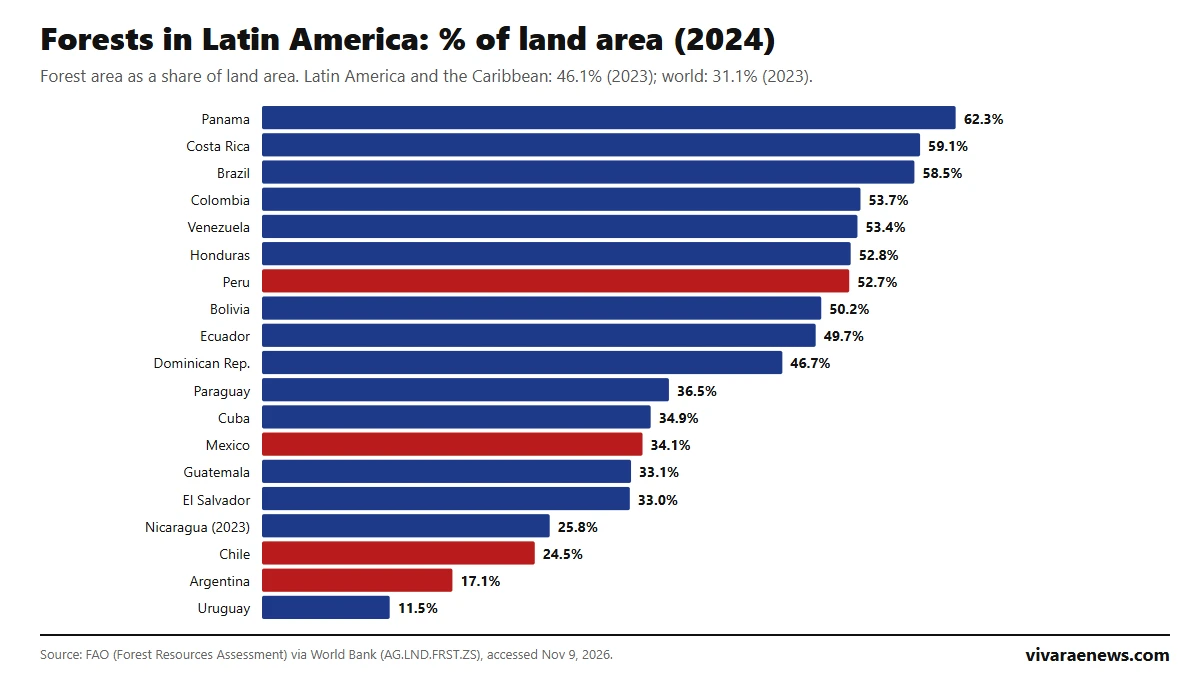
Panama is the Latin American country with the largest share of its land covered by forest, 62.3% in 2024, followed by Costa Rica (59.1%) and Brazil (58.5%), according to FAO data published by the World Bank. At the other end are Uruguay (11.5%), Argentina (17.1%) and Chile (24.5%). Latin America and the Caribbean have 46.1% of their land under forest, versus 31.1% worldwide (2023).
The region lost 13.6% of its forest area between 1990 and 2023: 145,247 thousand hectares, more than the whole of Bolivia. Brazil accounts for the largest loss in hectares, and Paraguay and Nicaragua for the largest in proportion. Chile, Uruguay, Costa Rica, Cuba and the Dominican Republic have more forest today than in 1990. This ranking of forests in Latin America is updated on this same page when the FAO publishes new data.
View the data as a table
| Forest cover in Latin America | 46.1% |
| Forest lost since 1990 | 13.6% |
| Most forested country | 62.3% |
| Chile | 24.5% |
Ranking of forests in Latin America by country
| Rank | Country | Forest (% of land) | Area (thousand ha) | Year |
|---|---|---|---|---|
| 1 | Panama | 62.3% | 4,618 | 2024 |
| 2 | Costa Rica | 59.1% | 2,986 | 2024 |
| 3 | Brazil | 58.5% | 489,343 | 2024 |
| 4 | Colombia | 53.7% | 59,590 | 2024 |
| 5 | Venezuela | 53.4% | 47,138 | 2024 |
| 6 | Honduras | 52.8% | 5,912 | 2024 |
| 7 | Peru | 52.7% | 67,459 | 2024 |
| 8 | Bolivia | 50.2% | 54,610 | 2024 |
| 9 | Ecuador | 49.7% | 12,340 | 2024 |
| 10 | Dominican Rep. | 46.7% | 2,251 | 2024 |
| 11 | Paraguay | 36.5% | 14,461 | 2024 |
| 12 | Cuba | 34.9% | 3,620 | 2024 |
| 13 | Mexico | 34.1% | 66,393 | 2024 |
| 14 | Guatemala | 33.1% | 3,549 | 2024 |
| 15 | El Salvador | 33.0% | 684 | 2024 |
| 16 | Nicaragua | 25.8% | 3,108 | 2023 |
| 17 | Chile | 24.5% | 18,167 | 2024 |
| 18 | Argentina | 17.1% | 46,778 | 2024 |
| 19 | Uruguay | 11.5% | 2,006 | 2024 |
Source: FAO, Global Forest Resources Assessment, via the World Bank (AG.LND.FRST.ZS and AG.LND.FRST.K2), accessed November 9, 2026. Forest area is land with trees taller than 5 meters and canopy cover above 10%, over more than half a hectare; it includes plantations and excludes trees in agricultural or urban use, according to the FAO definition. That is why countries with many plantations, such as Chile and Uruguay, add forest even when it is monoculture.
View the data as a table
| Panama | 62.3% |
| Costa Rica | 59.1% |
| Brazil | 58.5% |
| Colombia | 53.7% |
| Venezuela | 53.4% |
| Honduras | 52.8% |
| Peru | 52.7% |
| Bolivia | 50.2% |
| Ecuador | 49.7% |
| Dominican Republic | 46.7% |
| Paraguay | 36.5% |
| Cuba | 34.9% |
| Mexico | 34.1% |
| Guatemala | 33.1% |
| El Salvador | 33.0% |
| Nicaragua | 25.8% |
| Chile | 24.5% |
| Argentina | 17.1% |
| Uruguay | 11.5% |
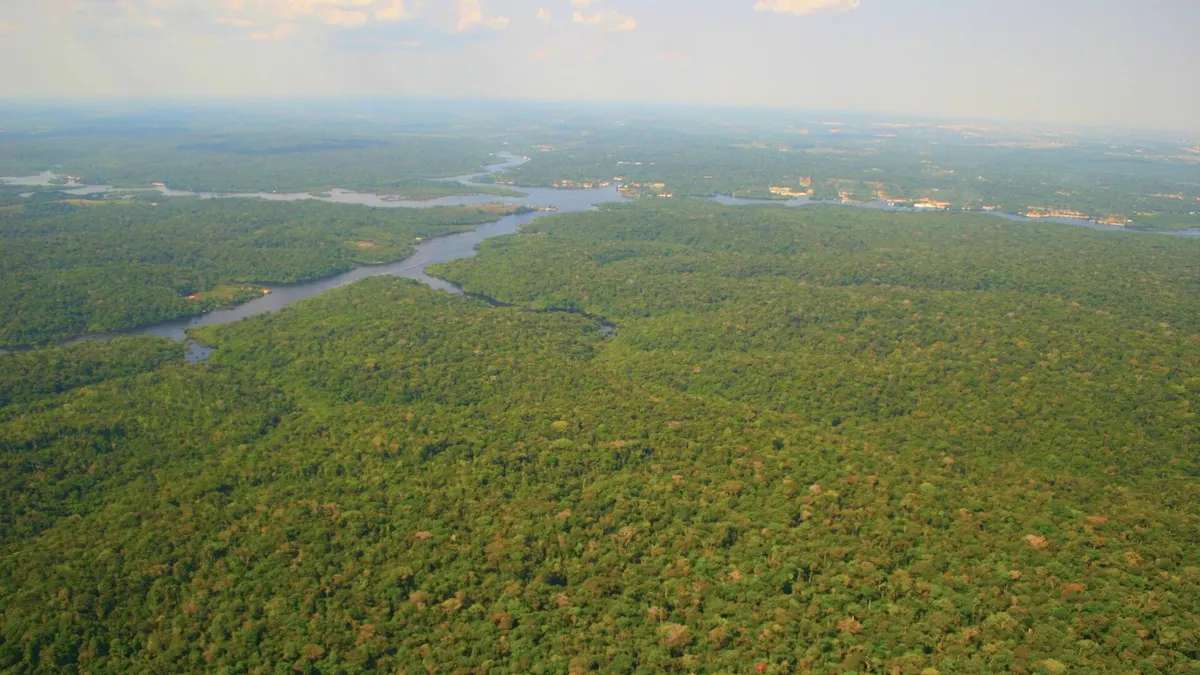
How much forest Latin America has lost since 1990
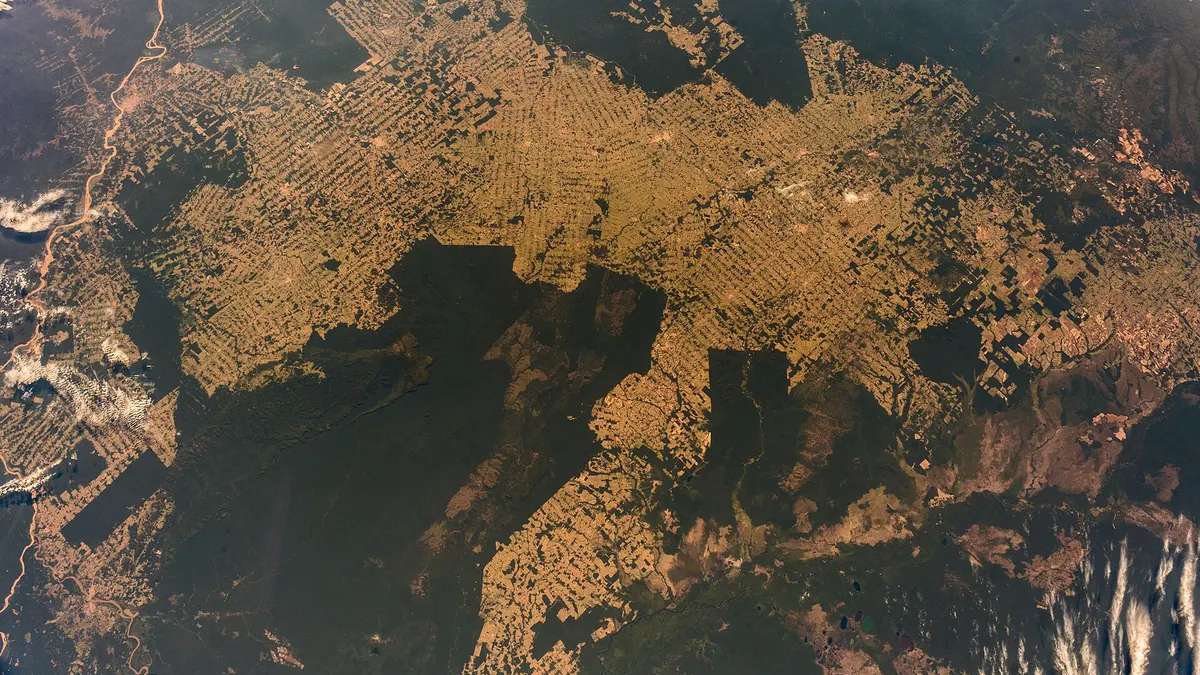
Brazil went from 618,443 thousand to 489,343 thousand hectares of forest between 1990 and 2024, a 20.9% drop: it lost 129,101 thousand hectares, almost 90% of what the whole region lost. In proportion, the biggest losses are in Nicaragua (-56.2% to 2023) and Paraguay (-43.7%), where forest fell to 36.5% of the land.
| Country | Forest 1990 (thousand ha) | Forest latest (thousand ha) | Change |
|---|---|---|---|
| Nicaragua | 7,099 | 3,108 | -56.2% |
| Paraguay | 25,680 | 14,461 | -43.7% |
| Guatemala | 4,852 | 3,549 | -26.9% |
| Honduras | 7,644 | 5,912 | -22.7% |
| Brazil | 618,443 | 489,343 | -20.9% |
| Argentina | 55,990 | 46,778 | -16.5% |
The six largest proportional losses between 1990 and 2024. Source: FAO, Global Forest Resources Assessment, via the World Bank (AG.LND.FRST.ZS and AG.LND.FRST.K2), accessed November 9, 2026. 2024 data; Nicaragua, 2023.
| Panama | 66.7% | 62.3% | 4,618 | -6.8% |
| Costa Rica | 54.0% | 59.1% | 2,986 | 8.2% |
| Brazil | 74.0% | 58.5% | 489,343 | -20.9% |
| Colombia | 58.7% | 53.7% | 59,590 | -8.5% |
| Venezuela | 57.2% | 53.4% | 47,138 | -6.6% |
| Honduras | 68.3% | 52.8% | 5,912 | -22.7% |
| Peru | 60.2% | 52.7% | 67,459 | -12.4% |
| Bolivia | 57.0% | 50.2% | 54,610 | -11.6% |
| Ecuador | 52.9% | 49.7% | 12,340 | -15.7% |
| Dominican Rep. | 44.1% | 46.7% | 2,251 | 5.6% |
| Paraguay | 64.6% | 36.5% | 14,461 | -43.7% |
| Cuba | 21.5% | 34.9% | 3,620 | 56.6% |
| Mexico | 36.9% | 34.1% | 66,393 | -7.5% |
| Guatemala | 45.3% | 33.1% | 3,549 | -26.9% |
| El Salvador | 35.5% | 33.0% | 684 | -7.0% |
| Nicaragua | 59.0% | 25.8% | 3,108 | -56.2% |
| Chile | 22.6% | 24.5% | 18,167 | 8.1% |
| Argentina | 20.5% | 17.1% | 46,778 | -16.5% |
| Uruguay | 5.0% | 11.5% | 2,006 | 128.1% |
Mexico has lost 7.5% of its forest since 1990, Peru 12.4% and Argentina 16.5%. Deforestation is also a source of emissions that does not appear in energy and industry inventories; this month's climate summit is discussing it in Türkiye: see what is being negotiated at COP31 and what Latin America brings.
The Latin American countries that gained forest
Five countries have more forest today than in 1990. Uruguay more than doubled it (+128.1%), although it is still last in the ranking at 11.5% of its land. Chile added 8.1%, about 1,356 thousand hectares, and Costa Rica 8.2%. In Chile and Uruguay, where the forestry industry relies on pine and eucalyptus plantations, that increase includes plantations, which the FAO counts as forest.
| Country | % of land in 1990 | % of land latest | Gain (thousand ha) |
|---|---|---|---|
| Uruguay | 5.0% | 11.5% | +1,126 |
| Cuba | 21.5% | 34.9% | +1,308 |
| Costa Rica | 54.0% | 59.1% | +227 |
| Chile | 22.6% | 24.5% | +1,356 |
| Dominican Rep. | 44.1% | 46.7% | +119 |
Source: FAO, Global Forest Resources Assessment, via the World Bank (AG.LND.FRST.ZS and AG.LND.FRST.K2), accessed November 9, 2026. In Chile, forest went from 22.6% to 24.5% of the land between 1990 and 2024, although the area has been almost flat since 2015: 18,217 thousand hectares in 2015 and 18,167 thousand in 2024. At 24.5%, Chile ranks 17 of 19, below the regional and world averages. Its territory includes the Atacama Desert and treeless high mountains, which lowers the national share.
View the data as a table
| Brazil | Peru | Mexico | Paraguay | Chile | Argentina | Uruguay | |
|---|---|---|---|---|---|---|---|
| 1990 | 74.0% | 60.2% | 36.9% | 64.6% | 22.6% | 20.5% | 5.0% |
| 1995 | 70.5% | 59.0% | 36.4% | 59.9% | 23.0% | 20.0% | 6.3% |
| 2000 | 67.1% | 57.9% | 35.8% | 55.1% | 23.4% | 19.5% | 7.6% |
| 2005 | 65.0% | 56.7% | 35.4% | 50.4% | 23.9% | 18.9% | 8.7% |
| 2010 | 62.8% | 55.5% | 35.1% | 45.7% | 24.3% | 18.2% | 9.7% |
| 2015 | 61.7% | 54.3% | 34.8% | 41.2% | 24.6% | 17.7% | 10.5% |
| 2020 | 60.1% | 53.6% | 34.4% | 38.0% | 24.5% | 17.4% | 11.0% |
| 2024 | 58.5% | 52.7% | 34.1% | 36.5% | 24.5% | 17.1% | 11.5% |
For other regional indicators with the same method, see the ranking of CO2 emissions per capita and the renewable energy ranking for Latin America.
Frequently asked questions
Which Latin American country has the most forest?
In proportion, Panama: 62.3% of its land in 2024. In total area, Brazil, with 489,343 thousand hectares, according to the FAO via the World Bank.
How much forest does Chile have?
24.5% of its land, 18,167 thousand hectares in 2024. That is 8.1% more than in 1990, an increase that includes forestry plantations.
Which country has lost the most forest since 1990?
In hectares, Brazil (129,101 thousand). In proportion, Nicaragua (-56.2% to 2023) and Paraguay (-43.7%).
Do plantations count as forest?
Yes. The FAO includes forestry plantations in forest area, as long as they meet the height, canopy cover and area thresholds.
How to cite this data
Vivarae News (2026). "Forests in Latin America: ranking by country 2026". Updated November 9, 2026. Available at https://vivaraenews.com/en/forests-in-latin-america-ranking-by-country-2026/. The data may be reproduced by citing Vivarae News and linking to this page; each country's figures come from the FAO Forest Resources Assessment, published by the World Bank.