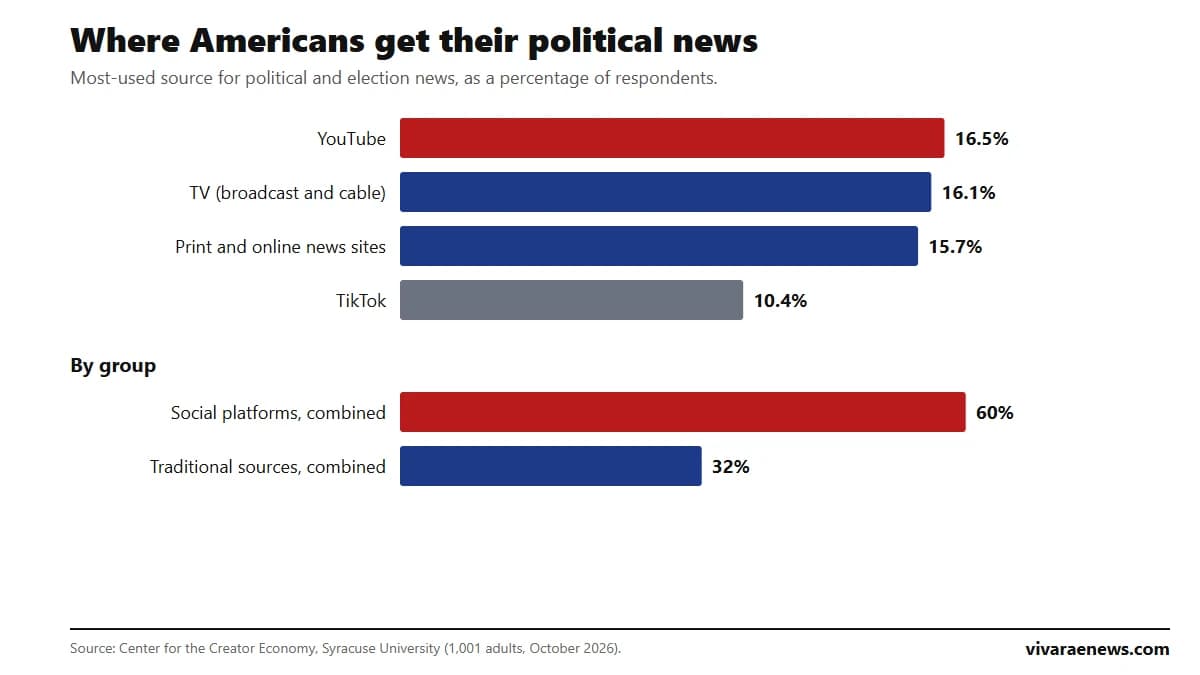
YouTube is the most-used platform in the United States for political news: 16.5% of adults choose it, against 16.1% who prefer television, according to a Syracuse University study published on 8 October 2026. The difference is minimal. The underlying story is a different one: taken together, social platforms beat traditional sources by 60% to 32%.
What the study says
| Most-used source for political and election news | Percentage |
|---|---|
| YouTube | 16.5% |
| Broadcast and cable TV | 16.1% |
| Print and online news sites | 15.7% |
| TikTok | 10.4% |
The first three figures come from Syracuse University's announcement; the TikTok one is reported by Tubefilter, which adds that the app trails both X and Facebook. The study is the first report from the university's Center for the Creator Economy and is based on a survey of 1,001 US adults, conducted through the Prolific platform.
Why the headline is a little misleading
Because YouTube wins as a single platform, not as a type of media. The announcement itself makes the point: combined, TV and news sites outpace YouTube nearly two to one. And there is less than a point between the top three, a distance that in a survey of a thousand cases amounts to a tie.
What is clear is the overall trend. 59% say they get general news from social media "often or always", and 55% do the same for political information. Besides, much of what is watched on YouTube is produced by the same TV channels and newspapers, so the shift is more one of screen than of source.
Creators versus journalists: whom people trust
| Statement | Percentage who agree |
|---|---|
| Trust a creator more when they publicly correct their mistakes | 86% |
| See a meaningful difference between a news creator and a journalist | 79% |
| Doing the reporting matters more than formal journalism credentials | 67% |
| Trust a well-known creator as much as a journalist or major news organisation | 61% |
This is the most interesting part of the report. Most people trust independent creators as much as journalists on political topics, but they do not confuse them: four in five see them as different roles. And what counts most for earning trust is neither the title nor the brand, but correcting mistakes in public.
There are differences by political leaning: Republicans place more trust in independent creators, and Democrats in journalists and news organisations.
How to read this study
- Who did it. The Syracuse centre trains content creators: it has an interest in the trade looking like it has a future. Tubefilter itself points this out when reporting the news.
- It is an online panel. The survey was run with users of Prolific, a platform of paid participants, with a sample adjusted to resemble the population.
- It measures politics, not all news. The ranking question is about politics and elections.
- It is the United States. It says nothing about Latin America, although the direction of change is similar in many countries.
What it means for anyone who publishes content
That video is no longer an add-on. If a growing share of the audience reaches the news through a video platform, outlets and brands that only publish text compete for an ever smaller slice. And that trust is built by showing the work: where the data comes from and what was corrected.
The same shift is visible in commerce: see how Rihanna sold live on TikTok Shop. And on platform prices, how much YouTube Premium and the rest of streaming cost in Chile.
Frequently asked questions
Is YouTube the main news source in the United States?
It is the single most-used platform for political news, at 16.5%, according to the Syracuse study. Television has 16.1%, a minimal difference.
How many people get their news from social media?
59% of US adults say they get general news from social media often or always.
Do people trust news creators?
61% trust a well-known creator as much as a journalist or a major news organisation on political topics.
Who did the study?
Syracuse University's Center for the Creator Economy, with a survey of 1,001 adults.